The Crayon Coast
Una historia gratuita en inglés de nivel A2 para estudiantes, para leer en línea en 7 idiomas, con opción de escucharla en la app gratuita Storyteller.
Two teens on a short ferry ride use a small cousin's crayon map to choose the right place to get off.
¡Ese fue el avance! Escucha la historia completa en la app gratuita Storyteller. Descargar la app
El audio no está disponible en este momento.
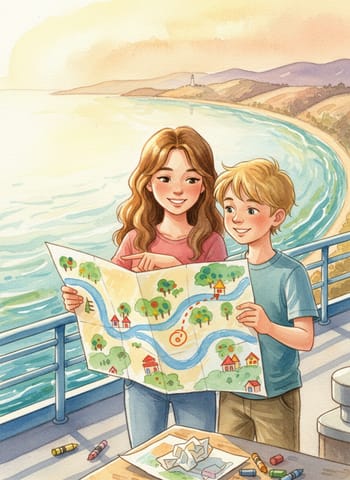
The ferry leaves the harbor with a low horn. Elan stands at the rail on the top deck. Behind him, the town gets smaller.
El transbordador sale del puerto con un bocinazo grave. Elan está de pie junto a la baranda de la cubierta superior. Detrás de él, el pueblo se va haciendo más pequeño.
The crossing takes twenty-five minutes. Elan wants to enjoy every minute. He is fifteen. It is his first trip to the island.
La travesía dura veinticinco minutos. Elan quiere disfrutar cada minuto. Tiene quince años. Es su primer viaje a la isla.
Samir comes up the stairs with two paper cups of juice. He is also fifteen, and he is the reason for the trip.
Samir sube las escaleras con dos vasos de papel con jugo. También tiene quince años, y es el motivo del viaje.
"Here," Samir says. He gives Elan a cup. "Did you bring the map?"
«Toma», dice Samir. Le da un vaso a Elan. «¿Trajiste el mapa?».
"Of course." Elan opens his jacket and takes out a folded sheet of paper. "It is not wet."
«Claro». Elan abre su chaqueta y saca una hoja de papel doblada. «No está mojado».
The map is not a normal one. Samir's little cousin drew it with crayons. She lives on the island. She wants the boys to visit her favorite place. Her drawing shows a blue sea and a green hill. It shows a yellow house too. A very tall tree stands by it, with a bird on top.
El mapa no es un mapa normal. La primita de Samir lo dibujó con crayones. Ella vive en la isla. Quiere que los chicos visiten su lugar favorito. Su dibujo muestra un mar azul y una colina verde. También muestra una casa amarilla. Junto a ella hay un árbol altísimo, con un pájaro en la copa.
At the bottom, there is a thick black line. Next to it she wrote, in large letters, COME HERE.
Abajo hay una gruesa línea negra. Al lado ella escribió, con letras grandes, VENGAN AQUÍ.
"It is a great map," Samir says. "But I have a question. Where is the black line?"
«Es un gran mapa», dice Samir. «Pero tengo una pregunta. ¿Dónde está la línea negra?».
"A road?"
«¿Un camino?».
"Maybe a dock."
«Quizás un muelle».
Elan looks closer. The line could be a road, a dock, or a snake. The little girl is a better artist than a mapmaker.
Elan mira más de cerca. La línea podría ser un camino, un muelle o una serpiente. La niña es mejor artista que cartógrafa.
"The ferry stops at two docks," Elan says. He reads the sign on the wall. "North Landing and South Landing. We must choose the right one."
«El transbordador para en dos muelles», dice Elan. Lee el letrero de la pared. «Embarcadero Norte y Embarcadero Sur. Tenemos que elegir el correcto».
"What does the ticket say?"
«¿Qué dice el boleto?».
"It says both. We choose when we get off." Elan checks his watch. "We have about fifteen minutes before the first stop."
«Dice los dos. Elegimos cuando bajemos». Elan mira su reloj. «Tenemos unos quince minutos antes de la primera parada».
They sit on a bench and spread the map on their knees. Samir turns it one way, then the other. A seagull lands on the rail and watches them.
Se sientan en un banco y extienden el mapa sobre las rodillas. Samir lo gira hacia un lado, luego hacia el otro. Una gaviota se posa en la baranda y los observa.
"Look," Samir says. "The sea is on the left. The hill is on the right. So we must come from the bottom of the paper."
«Mira», dice Samir. «El mar está a la izquierda. La colina está a la derecha. Así que debemos venir desde la parte de abajo del papel».
"Then the black line is where we start. That means it is a dock. But which one?"
«Entonces la línea negra es donde empezamos. Eso significa que es un muelle. ¿Pero cuál?».
"I don't know." Samir rubs his neck. "Her letter says she can see the ferry from her house. She has no phone, so we cannot ask her."
«No lo sé». Samir se frota el cuello. «Su carta dice que puede ver el transbordador desde su casa. No tiene teléfono, así que no podemos preguntarle».
Elan thinks. Some things in a child's drawing are easy to find. He taps the picture of the tree.
Elan piensa. Algunas cosas en el dibujo de un niño son fáciles de encontrar. Golpea con el dedo el dibujo del árbol.
"This is the clue," he says. "A tall tree with a bird. We can look for it from the water."
«Esta es la pista», dice. «Un árbol alto con un pájaro. Podemos buscarlo desde el agua».
Samir stands up. "The deck is too crowded to see the island. Everybody is in front of us."
Samir se levanta. «La cubierta está demasiado llena para ver la isla. Todos están delante de nosotros».
It is true. A family stands at the front rail. Three men in work clothes lean next to them. A man with a camera takes pictures of everything.
Es verdad. Una familia está en la baranda delantera. Tres hombres con ropa de trabajo se apoyan a su lado. Un hombre con una cámara fotografía todo.
"Then we need a better view," Elan says.
«Entonces necesitamos una mejor vista», dice Elan.
He looks up. Behind the bench, a metal ladder goes up to a small platform. A sign says STAFF ONLY. The platform has a bright orange ring, and nothing else.
Mira hacia arriba. Detrás del banco, una escalera metálica sube a una pequeña plataforma. Un letrero dice SOLO PERSONAL. La plataforma tiene un salvavidas anaranjado brillante, y nada más.
Samir shakes his head. "No."
Samir niega con la cabeza. «No».
"We only look," Elan says. "Two minutes."
«Solo miramos», dice Elan. «Dos minutos».
"We will be in trouble."
«Nos meteremos en problemas».
"Then we ask first." Elan walks to a worker. She wears a blue jacket and holds a rope. "Excuse me. May we stand on the high platform for two minutes? We want to find a tree on the island."
«Entonces preguntamos primero». Elan camina hacia una trabajadora. Lleva una chaqueta azul y sostiene una soga. «Disculpe. ¿Podemos subir a la plataforma alta dos minutos? Queremos encontrar un árbol en la isla».
The woman looks at him. She looks at the paper in his hand. "Is that a map?"
La mujer lo mira. Mira el papel en su mano. «¿Eso es un mapa?».
"A child drew it. We must find the right dock."
«Lo dibujó una niña. Tenemos que encontrar el muelle correcto».
The woman reads the page. A small smile appears. "Good drawing. I know that tree. It is the old pine on the hill. The bird is a statue." She points at the island. "The yellow house is near it, by the little fishing pier."
La mujer lee la hoja. Aparece una pequeña sonrisa. «Buen dibujo. Conozco ese árbol. Es el viejo pino de la colina. El pájaro es una estatua». Señala la isla. «La casa amarilla está cerca, junto al pequeño muelle de pesca».
"So the tree and the house are close together?" Samir asks.
«¿Entonces el árbol y la casa están juntos?», pregunta Samir.
"Yes. Your friend with the crayons drew everything in one picture. Real life is bigger." She nods at the ladder. "Go up. Hold the rail with both hands."
«Sí. Tu amiga de los crayones dibujó todo en una sola imagen. La vida real es más grande». Señala la escalera con un gesto. «Suban. Sujétense de la baranda con las dos manos».
"Thank you!" Elan says.
«¡Gracias!», dice Elan.
They climb. The platform is small and cold. From here, the island rises out of the sea.
Suben. La plataforma es pequeña y fría. Desde aquí, la isla se alza del mar.
Elan holds the map up. He looks from the paper to the island. He moves it left, then right.
Elan sostiene el mapa en alto. Mira del papel a la isla. Lo mueve a la izquierda, luego a la derecha.
"There," he says. He points. "The tall tree. And a house with a yellow roof. They are close together."
«Ahí», dice. Señala. «El árbol alto. Y una casa con techo amarillo. Están juntos».
"Which is the dock?" Samir asks.
«¿Cuál es el muelle?», pregunta Samir.
Elan looks for the black line. At the foot of the hill, a short pier reaches out. It is between the tree and the house. It is closer to North Landing.
Elan busca la línea negra. Al pie de la colina, un muelle corto se adentra en el agua. Está entre el árbol y la casa. Queda más cerca del Embarcadero Norte.
"The pier is in the middle," he says. "The girl drew everything near it. She did not mean North or South. She meant the little pier between them."
«El muelle está en el medio», dice. «La niña dibujó todo cerca de él. No se refería al Norte ni al Sur. Se refería al pequeño muelle entre ellos».
Samir laughs. "So where does the ferry stop?"
Samir ríe. «¿Entonces dónde para el transbordador?».
Elan checks the ship's sign again. "The ferry stops at North Landing first. That is the closest to the pier. We get off there and walk five minutes."
Elan vuelve a mirar el letrero del barco. «El transbordador para primero en el Embarcadero Norte. Es el más cercano al muelle. Bajamos ahí y caminamos cinco minutos».
"Great plan," Samir says.
«Gran plan», dice Samir.
They climb down. The woman with the rope gives them a big smile. Samir takes the map. He folds it with care along its lines.
Bajan por la escalera. La mujer de la soga les regala una gran sonrisa. Samir toma el mapa. Lo dobla con cuidado por sus pliegues.
The ferry slows. The horn sounds again, low and long. People pick up their bags and move toward the door.
El transbordador reduce la marcha. La bocina suena de nuevo, grave y larga. La gente recoge sus bolsas y se mueve hacia la puerta.
Elan and Samir stay at the rail one moment longer. The island is close now. Under the pine tree, the stone bird shines in the sun.
Elan y Samir se quedan en la baranda un momento más. La isla ya está cerca. Bajo el pino, el pájaro de piedra brilla al sol.
The map lies in Samir's hand. Its crayon sea is soft and bright. The black line at the bottom is a pier now.
El mapa descansa en la mano de Samir. Su mar de crayón es suave y brillante. La línea negra de abajo ahora es un muelle.
The gangway touches the dock with a quiet bump.
La pasarela toca el muelle con un suave golpecito.