Seven O'Clock on the Stairs
Una historia gratuita en inglés de nivel A2 para estudiantes, para leer en línea en 7 idiomas, con opción de escucharla en la app gratuita Storyteller.
While the lift stays broken, a shy girl finally asks the neighbour boy why he climbs the stairs with a hot pot.
¡Ese fue el avance! Escucha la historia completa en la app gratuita Storyteller. Descargar la app
El audio no está disponible en este momento.
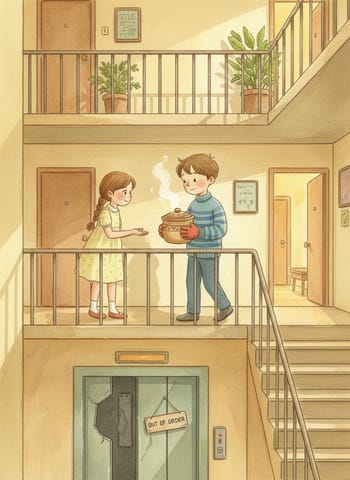
The sign on the lift says, "Out of order. Back soon."
El letrero del ascensor dice: «Fuera de servicio. Volvemos pronto».
Three weeks is a long time for soon. Every morning, Malika reads the sign again. Every evening, it says the same thing. The lift stays dead, and the stairs stay long.
Tres semanas es mucho tiempo para «pronto». Cada mañana, Malika vuelve a leer el letrero. Cada tarde, dice lo mismo. El ascensor sigue muerto, y las escaleras siguen largas.
Malika lives on the ninth floor of a tall grey building. She is fifteen. Every day she climbs nine floors with her school bag. Her legs hurt, and her bag feels like a rock.
Malika vive en el noveno piso de un edificio alto y gris. Tiene quince años. Todos los días sube nueve pisos con su mochila del colegio. Le duelen las piernas, y la mochila le pesa como una roca.
On the stairs, people complain. They complain on the second floor and on the fifth floor. They complain to each other and to the walls. Nobody calls the building office. Everyone thinks that someone else does it.
En las escaleras, la gente se queja. Se queja en el segundo piso y en el quinto. Se quejan entre ellos y a las paredes. Nadie llama a la administración del edificio. Todos piensan que otro lo hace.
Every evening at seven, Malika hears slow steps below. Then Omar climbs past her door. He is sixteen, and he lives on the eleventh floor. He carries a big steel pot with two handles. He holds it with a pair of thick yellow oven gloves. Steam comes out from under the lid. The smell of spiced rice fills the stairs.
Cada tarde a las siete, Malika oye pasos lentos abajo. Luego Omar sube frente a su puerta. Tiene dieciséis años y vive en el piso once. Lleva una gran olla de acero con dos asas. La sostiene con un par de gruesos guantes amarillos de cocina. Sale vapor por debajo de la tapa. El olor a arroz con especias llena la escalera.
Malika stands in her doorway each evening. She tells herself it is for the smell. Omar always says, "Hello." Malika always says, "Hello," very quickly. Then he goes up, and she goes in.
Malika se queda en su puerta cada tarde. Se dice que es por el olor. Omar siempre dice: «Hola». Malika siempre dice: «Hola», muy rápido. Luego él sube, y ella entra.
The stairs smell of paint, dust, and other people's dinners. Each landing has a small window. Each window shows a bit more of the city. Malika knows every crack in the wall.
Las escaleras huelen a pintura, polvo y cenas ajenas. Cada descanso tiene una ventanita. Cada ventana muestra un poco más de la ciudad. Malika conoce cada grieta de la pared.
On Monday, Omar stops on her landing for a short rest. His face is shiny from the heat of the pot. He nods at her, and she nods back. That is all. On Tuesday, the same thing happens. On Wednesday, he nearly drops a glove, and she nearly speaks. "Nearly" is the best word for Malika this week.
El lunes, Omar se detiene en su descanso para una breve pausa. Tiene la cara brillante por el calor de la olla. Le hace un gesto con la cabeza, y ella se lo devuelve. Eso es todo. El martes, pasa lo mismo. El miércoles, él casi deja caer un guante, y ella casi habla. «Casi» es la mejor palabra para Malika esta semana.
The neighbours talk about him. They do not talk to him.
Los vecinos hablan de él. No hablan con él.
The man from the fifth floor speaks first. "Why does he carry hot food up eleven floors?"
El hombre del quinto piso habla primero. «¿Por qué lleva comida caliente por once pisos?».
"And why the oven gloves?" says the woman from the fourth. "On the stairs? Like a cook in a film."
«¿Y por qué los guantes de cocina?», dice la mujer del cuarto. «¿En las escaleras? Como un cocinero de película».
"Strange boy," says the man.
«Un chico raro», dice el hombre.
They say it to each other, never to Omar. Malika hears every word. She has the same questions. They sit in her chest like small stones.
Se lo dicen entre ellos, nunca a Omar. Malika oye cada palabra. Tiene las mismas preguntas. Están en su pecho como pequeñas piedras.
At school, her friend notices. "You look odd today," she says.
En el colegio, su amiga lo nota. «Hoy te ves rara», dice.
"There is a boy in my building," says Malika. "He carries a pot up the stairs. He wears oven gloves. Nobody knows why."
«Hay un chico en mi edificio», dice Malika. «Sube una olla por las escaleras. Lleva guantes de cocina. Nadie sabe por qué».
"So ask him."
«Pues pregúntale».
"What if he is rude?"
«¿Y si es grosero?».
"What if he is not?" says her friend. She eats a fruit and shrugs. "It is only a question, Malika. He will not hurt you."
«¿Y si no lo es?», dice su amiga. Come una fruta y se encoge de hombros. «Es solo una pregunta, Malika. No te va a hacer daño».
That night, Malika lies in bed and thinks about the question. It is easy to say in her head. In her mouth, the question is too big. It will not come out.
Esa noche, Malika se acuesta y piensa en la pregunta. Es fácil decirla en su cabeza. En su boca, la pregunta es demasiado grande. No sale.
On Thursday, Omar arrives at seven. His steps are slower than usual. He reaches the ninth floor. He puts the pot down on the top step and breathes hard. His oven gloves are wet with steam.
El jueves, Omar llega a las siete. Sus pasos son más lentos de lo usual. Llega al noveno piso. Deja la olla en el escalón de arriba y respira con fuerza. Sus guantes están mojados de vapor.
Malika is in her doorway. Her heart beats fast. She takes one step out.
Malika está en su puerta. El corazón le late rápido. Da un paso hacia afuera.
"Can I ask you something?" she says.
«¿Puedo preguntarte algo?», dice.
Omar looks up. He seems surprised. "Yes?"
Omar levanta la vista. Parece sorprendido. «¿Sí?».
"Why do you carry a hot pot up the stairs? And why do you wear oven gloves?"
«¿Por qué subes una olla caliente por las escaleras? ¿Y por qué llevas guantes de cocina?».
For a second he says nothing. Then he laughs. It is a short, tired laugh, but a real one.
Por un segundo no dice nada. Luego se ríe. Es una risa corta y cansada, pero verdadera.
"Three weeks," he says. "I pass this door every night, and nobody asks me anything. They only look."
«Tres semanas», dice. «Paso por esta puerta todas las noches, y nadie me pregunta nada. Solo miran».
"I am sorry," says Malika.
«Lo siento», dice Malika.
"No, it is good. Thank you." He wipes his forehead with his arm. "Our cooker broke on the same day as the lift. The building has a cooking room in the basement. Any family can use it. So I cook down there and carry dinner up."
«No, está bien. Gracias». Se limpia la frente con el brazo. «Nuestra cocina se descompuso el mismo día que el ascensor. El edificio tiene una sala de cocina en el sótano. Cualquier familia puede usarla. Así que cocino allá abajo y subo la cena».
"Eleven floors," says Malika.
«Once pisos», dice Malika.
"Eleven floors. Twice, if I forget the spoons." He holds up his hands and wiggles his yellow fingers. "And the gloves? The handles of this pot are hot enough to cook an egg. These are the only things I have that can hold them."
«Once pisos. Dos veces, si me olvido de las cucharas». Levanta las manos y mueve sus dedos amarillos. «¿Y los guantes? Las asas de esta olla están tan calientes que se podría cocinar un huevo. Es lo único que tengo para poder sostenerlas».
Malika laughs. She cannot stop herself. It is a loud laugh. It goes up and down the stairs.
Malika se ríe. No puede evitarlo. Es una risa fuerte. Sube y baja por las escaleras.
"Nobody helped you?" she asks, when she can speak.
«¿Nadie te ayudó?», pregunta, cuando puede hablar.
"Nobody asked if I needed help." He shrugs. "And I did not ask them. It is hard to ask. Especially when everyone sees a strange boy with a pot."
«Nadie preguntó si necesitaba ayuda». Se encoge de hombros. «Y yo no les pedí. Es difícil pedir. Sobre todo cuando todos ven a un chico raro con una olla».
Malika thinks about her three weeks of staying silent in the doorway. She thinks about the small stones in her chest. They feel lighter now.
Malika piensa en sus tres semanas de silencio en el umbral. Piensa en las pequeñas piedras de su pecho. Ahora se sienten más ligeras.
"Two floors left," says Omar. He bends and takes the pot by its handles. The steam rises again. The warm smell of rice and spice fills the air. Malika's stomach makes a loud sound.
«Faltan dos pisos», dice Omar. Se agacha y toma la olla por las asas. El vapor sube otra vez. El cálido olor a arroz y especias llena el aire. El estómago de Malika hace un ruido fuerte.
Omar hears it. He smiles. He stops, and he takes one glove off his hand. Then he holds it out to her.
Omar lo oye. Sonríe. Se detiene y se quita un guante de la mano. Luego se lo ofrece.
"The pot has two handles," he says. "One glove each. Do you want the front handle or the back?"
«La olla tiene dos asas», dice. «Un guante cada uno. ¿Quieres el asa de adelante o la de atrás?».