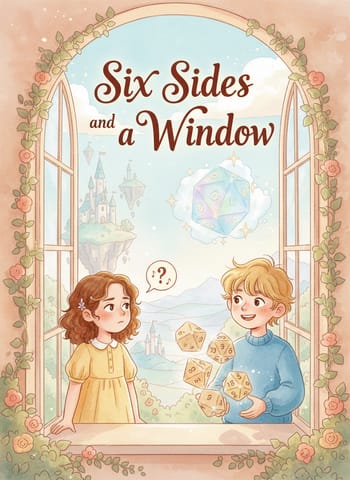
Six Sides and a Window
A free A2-level English story for language learners, readable online in 7 languages, with an option to listen via the free Storyteller app.
Dalia thinks the boy with the dice is mocking her, until she asks him why he rolls them.
That was the preview! Hear the full story in the free Storyteller app. Get the app
Audio isn't available right now.
The ticket booth of the old cinema is a small glass box. It stands by the front door. Inside there is a stool and a lamp. There is also a little metal tray for money. The glass has a round hole at the bottom. People pass their coins through it.
Dalia sits in the booth every Saturday. She is sixteen. The job is quiet, and she likes quiet. She sells tickets, tears them in half and gives back the change. Between films, she reads a book on her knee.
Every Saturday at ten past four, a boy comes to her window. His name is Paolo. She knows it because a friend at school tells her. He is tall and thin. He wears a green scarf even in summer.
Paolo always does the same thing. He puts a small cloth bag on the counter. He opens it and takes out a die. He rolls it on the metal tray. It clicks and spins and stops.
He looks at the die for a long time. Then he looks at Dalia. Then he buys a ticket.
The first time, Dalia finds it funny. The second time, she finds it strange. Now it is the sixth Saturday, and she is tired of it.
Today the line behind Paolo is long. Six people wait with their coats and their popcorn money. Dalia sees them look at their watches.
Paolo puts the bag on the tray. The dice click together in the bag.
"Please don't," Dalia says.
Paolo stops with his hand in the bag. "Sorry?"
"The dice. Please don't roll them today. People wait."
Paolo looks behind him. He sees the line. He moves his hand away from the tray. "Okay," he says in a low voice. "One ticket for the half-past-four film, please."
Dalia tears the ticket. She pushes it through the hole. He gives her the coins. His fingers are cold. He looks at her as if he wants to say more. But he only picks up his bag and goes.
Dalia watches him walk to the door. His shoulders are low. She feels a small, hard stone in her stomach.
She tells herself it is his fault. He makes a game out of her work. He laughs at her with those dice, she thinks. Maybe it is a joke with his friends. Maybe he thinks she is just a number on a die.
But there is a problem with this idea. He never laughs. He never smiles. He always looks a little worried.
The film starts. The lobby becomes quiet. Dalia opens her book, but she cannot read. The words slide around the page. She keeps seeing his green scarf.
At six o'clock, the film ends. People come out into the lobby. Some stop at her window to ask about the next show. Paolo comes out last. He walks slowly. He does not look at the booth.
Dalia gets up from her stool. She opens the little side door of the booth. She never does that. The air outside the glass feels bigger.
"Paolo," she says.
He turns around. His eyes are wide, as if he expects bad news.
"I'm sorry," Dalia says. "I was rude before. But I also want to ask you something. Why do you roll the dice every time? Is it a joke about me?"
"A joke?" Paolo says. His mouth falls open. "No! I thought you hated it."
"I hate it," says Dalia. "I think you laugh at me."
"Never," says Paolo. He shakes his head hard. "I thought you were angry with me because I take too long. I could not stop doing it. If I stop, it feels wrong."
"But why?" asks Dalia. "What are the dice for?"
Paolo sits down on the bench by the wall. After a moment, Dalia sits beside him. He opens the cloth bag and pours the dice into his hand.
There are fourteen of them, and none of them match. One is large and wooden. One is small and blue. One has ten sides, and one has only four. One has letters on it, not numbers. One is so old that the dots are almost gone.
"I can't choose," says Paolo. "Not my seat, not anything. I stand in front of the board and I wait. I always want the best seat. I never find it. Last year I missed two whole films because I could not decide."
"So you roll the dice," says Dalia.
"Yes. The dice choose my seat. If I roll a four, I sit in row four. If I roll a letter, I sit at the row end. It's not a game. It's a way to stop thinking."
Dalia looks at the dice in his open hand. "Where did you find them?"
"Everywhere," says Paolo. "Each one was lost by some game. The blue one is from a flea market. The wooden one is from under a cafe chair. I like them because each one is the only one. They are all a bit wrong, but they work."
Dalia smiles. It is the first time she smiles at him. "I'm sorry I said stop," she says.
"I'm sorry I never told you," says Paolo. "I do not know how to start."
They sit for a while. The lobby lamps hum. A cleaner starts to clean the lobby.
"Can I try one?" Dalia asks.
Paolo gives her the small blue die. She shakes it in her hands. She drops it on the bench. It rolls and stops on a three.
"Row three," says Paolo. "Next Saturday."
"Row three," says Dalia. "I will keep it for you. I will tell nobody."
Paolo laughs. It is a soft, surprised laugh. He puts the dice back in the bag one by one. Before he closes the bag, he stops. He keeps the blue die out and puts it in her hand.
"For the booth," he says. "In case someone else cannot choose."
Then he waves and walks out into the evening street. His green scarf disappears behind the glass door.
Dalia goes back to her booth and closes the little side door. She sits on the stool and turns on the lamp. She puts the blue die on the metal tray, under the light.
It stays there until closing time. It is the smallest thing in the whole room. Light from the street sign falls across it. The three dots look like three small stars.