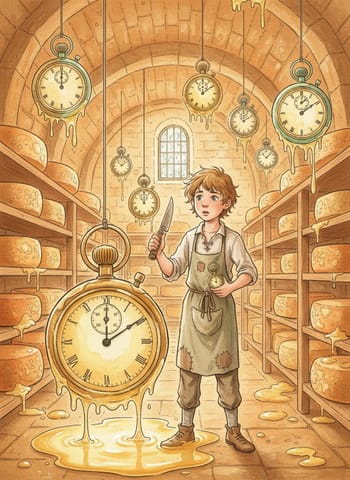
The Slow Stopwatch in the Cheese Cellar
Uma história gratuita em inglês de nível B2 para estudantes, para ler online em 7 idiomas, com opção de ouvir no app gratuito Storyteller.
An apprentice named Willem asks to run a cheese cellar alone for a week and receives exactly what he wanted, in a form he did not expect.
Essa foi a prévia! Ouça a história completa no app gratuito Storyteller. Baixar o app
O áudio não está disponível no momento.
The cheese cellar lay inside the hill, behind a wooden door as thick as a man's arm. Inside, it was cool and dim and smelled of damp stone. On every shelf from floor to ceiling, the round pale wheels sat in rows like sleeping animals. Willem had worked there for ten months, and he still touched the door frame every morning for luck.
A adega de queijos ficava dentro da colina, atrás de uma porta de madeira grossa como o braço de um homem. Lá dentro, era fresco e na penumbra, e cheirava a pedra úmida. Em todas as prateleiras, do chão ao teto, as rodas pálidas e redondas descansavam em fileiras como animais adormecidos. Willem trabalhava ali havia dez meses e ainda tocava o batente da porta todas as manhãs, para dar sorte.
Oksana, the head cheesemaker, kept the cellar the way some people keep a promise. She turned the wheels by hand and tested them with a thin steel probe. She wrote every result into a notebook with a pencil that never seemed to get shorter. She was thirty-eight, she rarely raised her voice, and in ten months she had never told Willem that he was doing well.
Oksana, a mestra queijeira, cuidava da adega como algumas pessoas cuidam de uma promessa. Ela virava as rodas à mão e as testava com uma fina sonda de aço. Anotava cada resultado num caderno com um lápis que nunca parecia ficar menor. Tinha trinta e oito anos, raramente levantava a voz e, em dez meses, nunca havia dito a Willem que ele estava indo bem.
On a Monday in spring, Willem finally spoke the thing he had been rehearsing for weeks. He stood at the washing table with a wet cloth in his hand. "I would like to run the cellar by myself for a week," he said.
Numa segunda-feira de primavera, Willem finalmente disse o que vinha ensaiando havia semanas. Estava junto à mesa de lavagem, com um pano molhado na mão. "Eu gostaria de cuidar da adega sozinho por uma semana", disse ele.
Oksana did not look up from her notebook. "Why?"
Oksana não levantou os olhos do caderno. "Por quê?"
"Because I want to know whether I can." He swallowed. "You do everything. I follow. I do not know what happens when I am the one who decides."
"Porque quero saber se consigo." Ele engoliu em seco. "A senhora faz tudo. Eu sigo. Não sei o que acontece quando sou eu quem decide."
She wrote something down, closed the notebook, and finally looked at him. For a long moment her face gave nothing away.
Ela anotou algo, fechou o caderno e finalmente olhou para ele. Por um longo momento, o rosto dela não revelou nada.
"I leave on Friday to visit my brother at the coast," she said. "I was going to ask the neighbours to check the cellar twice a day. If you want it, you can have the week. Every wheel, every bath, every number in the book."
"Eu viajo na sexta para visitar meu irmão no litoral", disse ela. "Ia pedir aos vizinhos que olhassem a adega duas vezes por dia. Se você quer, a semana é sua. Cada roda, cada banho, cada número do caderno."
"Yes," Willem said. "Please."
"Sim", disse Willem. "Por favor."
"Then you will need this." She opened a drawer under the counter and took out an old steel stopwatch with a cracked glass face. She set it on the table between them. "Every brine bath in the cellar is timed with it. Forty minutes for the young wheels, fifty-five for the older ones. Write the times in the book and never skip an entry."
"Então você vai precisar disto." Ela abriu uma gaveta sob o balcão e tirou um velho cronômetro de aço com o mostrador de vidro rachado. Pôs sobre a mesa entre os dois. "Todo banho de salmoura da adega é cronometrado com ele. Quarenta minutos para as rodas novas, cinquenta e cinco para as mais velhas. Anote os tempos no caderno e nunca pule um registro."
Willem picked up the stopwatch. It was heavier than it looked, and the second hand moved smoothly around the dial. "Does it work properly?"
Willem pegou o cronômetro. Era mais pesado do que parecia, e o ponteiro dos segundos se movia suavemente pelo mostrador. "Ele funciona direito?"
"It works," said Oksana, and she went back to her notebook.
"Funciona", disse Oksana, e voltou ao caderno.
On Friday morning she left with a small bag and a bag of apples, and the cellar became his. For the first two days he moved through it carefully, afraid of making a mistake. He turned the wheels in the order she had taught him. He washed the rinds. He started the stopwatch for each brine bath and wrote the minutes in the book. Every time he closed the wooden door behind him, he felt a quiet pride.
Na sexta de manhã, ela partiu com uma bolsa pequena e um saco de maçãs, e a adega passou a ser dele. Nos primeiros dois dias, ele se movimentou com cuidado, com medo de errar. Virou as rodas na ordem que ela havia ensinado. Lavou as cascas. Acionou o cronômetro para cada banho de salmoura e anotou os minutos no caderno. Toda vez que fechava a porta de madeira atrás de si, sentia um orgulho silencioso.
On the third day something began to bother him. He had set the stopwatch for the fifty-five minute bath at nine in the morning. He had spent the time cleaning the shelves by the north wall. When he looked up, the stopwatch had just reached fifty-five minutes, but the cellar clock above the door said it was nearly ten past ten.
No terceiro dia, algo começou a incomodá-lo. Ele havia ligado o cronômetro para o banho de cinquenta e cinco minutos às nove da manhã. Passara o tempo limpando as prateleiras junto à parede norte. Quando levantou os olhos, o cronômetro tinha acabado de chegar aos cinquenta e cinco minutos, mas o relógio da adega, acima da porta, marcava quase dez e dez.
Willem frowned. He told himself that he had simply misread the clock, and he lifted the wheels out of the brine. But that evening the same thing happened with the young wheels. The stopwatch said forty minutes, and the cellar clock said fifty.
Willem franziu a testa. Disse a si mesmo que simplesmente tinha lido o relógio errado e tirou as rodas da salmoura. Mas naquela noite a mesma coisa aconteceu com as rodas novas. O cronômetro dizia quarenta minutos, e o relógio da adega dizia cinquenta.
He sat down on an upturned crate, put the stopwatch beside the clock, and watched them both for ten full minutes. The big clock moved forward by ten minutes. The stopwatch moved by only eight.
Ele se sentou numa caixa virada, pôs o cronômetro ao lado do relógio e observou os dois por dez minutos inteiros. O relógio grande avançou dez minutos. O cronômetro avançou apenas oito.
"It runs slow," he said out loud to the empty cellar. "It has been running slow since Friday. And every bath I timed was too long."
"Ele anda devagar", disse em voz alta para a adega vazia. "Anda devagar desde sexta. E cada banho que cronometrei foi longo demais."
He opened the notebook to the page of the previous weeks. In Oksana's neat pencil, the times for the same baths were marked with a small cross beside each number. The crosses were easy to miss, but they were everywhere. He had read the notebook a hundred times and never understood them.
Abriu o caderno na página das semanas anteriores. No lápis caprichado de Oksana, os tempos dos mesmos banhos estavam marcados com uma pequena cruz ao lado de cada número. As cruzes eram fáceis de não ver, mas estavam por toda parte. Ele havia lido o caderno cem vezes e nunca as entendera.
For a moment Willem felt sick. Nine wheels had spent far too long in the brine since Friday. If the salt had gone too deep, the cheeses would turn sharp and hard in a month. He thought about calling Oksana at the coast, and he put the idea down again. She had left him the cellar. She had also, he realised, left him a stopwatch that lied.
Por um instante, Willem sentiu enjoo. Nove rodas tinham ficado tempo demais na salmoura desde sexta. Se o sal tivesse penetrado fundo, os queijos ficariam azedos e duros em um mês. Pensou em ligar para Oksana no litoral e abandonou a ideia. Ela lhe deixara a adega. Também lhe deixara, percebeu, um cronômetro que mentia.
He spent the rest of the evening doing arithmetic. The stopwatch lost two minutes in every ten. A fifty-five minute bath therefore had to end at forty-four on the dial, and a forty minute bath at thirty-two. He made a small chart and taped it to the shelf above the washing table. Then he carried the nine wheels to the sink and rinsed the salt from their rinds in cold water. He laid them on dry boards so the salt could spread evenly. He wrote the real times in the notebook, with a small cross beside each number.
Passou o resto da noite fazendo contas. O cronômetro perdia dois minutos a cada dez. Um banho de cinquenta e cinco minutos, portanto, tinha de terminar em quarenta e quatro no mostrador, e um banho de quarenta minutos em trinta e dois. Fez uma tabelinha e a colou na prateleira acima da mesa de lavagem. Depois levou as nove rodas até a pia e enxaguou o sal das cascas com água fria. Deitou-as em tábuas secas para que o sal se espalhasse por igual. Anotou os tempos reais no caderno, com uma pequena cruz ao lado de cada número.
By Monday the cellar was working as it should. He checked each bath against the big clock, not the stopwatch. He checked each wheel by the sound of his knuckles on the rind. When the neighbour came with a basket of eggs, she looked around. She said that everything seemed in perfect order, and that she had not seen the cellar so tidy in years.
Na segunda-feira, a adega funcionava como devia. Ele conferia cada banho pelo relógio grande, não pelo cronômetro. Conferia cada roda pelo som dos nós dos dedos na casca. Quando a vizinha veio com uma cesta de ovos, olhou em volta. Disse que tudo parecia em perfeita ordem e que fazia anos que não via a adega tão arrumada.
Oksana returned on Friday evening, smelling of sea air and carrying a paper bag of shells for the kitchen. She walked straight to the shelves without taking off her coat and ran her hand along the rinds. She opened the notebook and read it in silence for a long time. Willem stood by the door and tried to look like someone who was not afraid.
Oksana voltou na sexta à noite, cheirando a maresia e trazendo um saco de papel com conchas para a cozinha. Foi direto às prateleiras sem tirar o casaco e passou a mão pelas cascas. Abriu o caderno e o leu em silêncio por um bom tempo. Willem ficou junto à porta e tentou parecer alguém que não estava com medo.
"You found the stopwatch," she said at last.
"Você achou o cronômetro", disse ela por fim.
"On the third day," he answered. "I rinsed nine wheels that had soaked too long. I think they will be fine. I should have noticed on the first day, and I am sorry."
"No terceiro dia", respondeu ele. "Enxaguei nove rodas que tinham ficado de molho demais. Acho que vão ficar boas. Eu devia ter percebido no primeiro dia, e sinto muito."
"Sorry for what? You noticed it." She closed the book. "I have owned that watch for fourteen years. I use it to teach people that the thing you trust most can be the thing that fools you. Everyone who has worked here has made the same mistake, though most of them wait a week to find it."
"Sente muito pelo quê? Você percebeu." Ela fechou o caderno. "Tenho esse relógio há catorze anos. Uso para ensinar que aquilo em que você mais confia pode ser justamente o que te engana. Todo mundo que trabalhou aqui cometeu o mesmo erro, embora a maioria demore uma semana para descobrir."
"You knew it would happen," Willem said slowly. "You asked me to run the cellar, and you gave me a broken watch on purpose."
"A senhora sabia que isso ia acontecer", disse Willem devagar. "A senhora me pediu para cuidar da adega e me deu um relógio quebrado de propósito."
"You asked for a week of deciding," Oksana said. "I gave you a week of deciding. A person who has only followed instructions has never had to decide anything. That is what a cellar is for."
"Você pediu uma semana de decisões", disse Oksana. "Eu te dei uma semana de decisões. Quem só seguiu instruções nunca precisou decidir nada. É para isso que serve uma adega."
She took the stopwatch from the table, looked at it fondly, and put it in his hand.
Ela pegou o cronômetro da mesa, olhou para ele com carinho e o colocou na mão de Willem.
"It is yours now," she said. "When the next apprentice comes, I will be watching how you teach it."
"Agora é seu", disse ela. "Quando o próximo aprendiz chegar, vou ver como você ensina."