The Grade Appeal
Uma história gratuita em inglês de nível B2 para estudantes, para ler online em 4 idiomas, com opção de ouvir no app gratuito Storyteller.
Dilnoza goes to ask her teacher for a higher mark, but reading the comments line by line changes what she wants from the meeting.
Essa foi a prévia! Ouça a história completa no app gratuito Storyteller. Baixar o app
O áudio não está disponível no momento.
Dilnoza had rehearsed her speech all the way to the classroom. She had been practicing it since Monday, in the shower, on the bus, even during maths. "I respectfully believe that this essay deserves a higher mark." The B in the corner of the page had been written in green ink, with a small, calm flourish. It looked like a fact, not an opinion.
Dilnoza tinha ensaiado seu discurso durante todo o caminho até a sala de aula. Vinha praticando desde segunda-feira, no chuveiro, no ônibus, até durante a aula de matemática. "Acredito respeitosamente que esta redação merece uma nota mais alta." O B no canto da página tinha sido escrito com tinta verde, com um pequeno floreio calmo. Parecia um fato, não uma opinião.
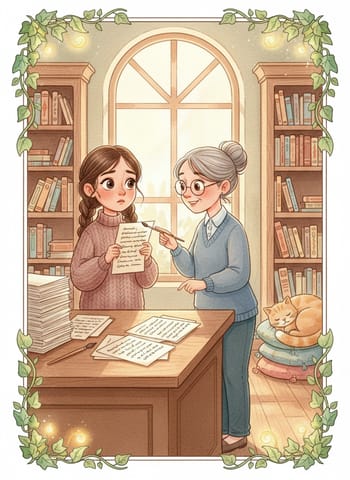
Her teacher was waiting at the desk with the essay already open. "Let's go through it together," she said. "You can stop me whenever you disagree."
A professora esperava na mesa com a redação já aberta. "Vamos ver juntas", disse ela. "Você pode me interromper sempre que discordar."
The essay was about whether a city should close its center to cars. Dilnoza had written it in a single night, fueled by tea and certainty, and she had been proud of how quickly the sentences had come. "I thought the argument was strong," she began. "It's clear. It's well written."
A redação era sobre se uma cidade deveria fechar o centro para os carros. Dilnoza a escrevera numa única noite, movida a chá e a certeza, e se orgulhara da rapidez com que as frases tinham vindo. "Achei que o argumento era forte", começou. "É claro. Está bem escrito."
"It is well written," her teacher agreed. "Let's start with the opening, then." She ran a finger down the first margin note. Where does this statistic come from?
"Está bem escrito mesmo", concordou a professora. "Então vamos começar pela abertura." Passou o dedo pela primeira anotação na margem. De onde vem essa estatística?
Dilnoza opened her mouth. The figure had come from something she had read, or possibly something someone had said. She couldn't remember. "I think it was an article," she said.
Dilnoza abriu a boca. O número vinha de algo que ela lera, ou talvez de algo que alguém dissera. Não conseguia lembrar. "Acho que foi de um artigo", disse.
"You think." The teacher said it gently. "If a reader asked you the same question, what would you tell them?"
"Acha." A professora disse isso com delicadeza. "Se um leitor lhe fizesse a mesma pergunta, o que você diria a ele?"
They moved on. The second paragraph had a note beside a sentence that began "Everybody knows." The third had a bracket around a sentence, with a comment: this contradicts your point in paragraph one. Dilnoza read it twice, then a third time, and felt her ears getting warm.
Seguiram adiante. O segundo parágrafo tinha uma anotação ao lado de uma frase que começava com "Todo mundo sabe". O terceiro tinha uma frase entre colchetes, com um comentário: isso contradiz o que você disse no parágrafo um. Dilnoza leu duas vezes, depois uma terceira, e sentiu as orelhas esquentarem.
It did contradict it. She could see it clearly now, the way you see the dust on a table once someone has opened the curtains. In the same essay she had argued that shops would suffer and that shops would benefit. She had never noticed, because she had never read it back.
Contradizia mesmo. Ela via isso com clareza agora, como se vê a poeira numa mesa depois que alguém abre as cortinas. Na mesma redação, havia defendido que as lojas sairiam perdendo e que as lojas sairiam ganhando. Nunca tinha percebido, porque nunca a relera.
"I didn't give you a B for the writing," the teacher said. "The writing is an A. Your sentences are simply ahead of your evidence. That is the gap I marked."
"Não dei B pela escrita", disse a professora. "A escrita é nota A. Suas frases simplesmente estão à frente das suas provas. Essa é a lacuna que eu marquei."
Dilnoza put the speech away somewhere at the back of her head. "If I rewrote it," she said slowly, "would it be an A?"
Dilnoza guardou o discurso em algum canto lá no fundo da cabeça. "Se eu reescrevesse", disse devagar, "seria um A?"
"If you rewrote it with sources, I would happily read it again. I can't promise a grade." The teacher almost smiled. "But I can promise to read the essay you could have written."
"Se você reescrevesse com fontes, eu leria de novo com prazer. Não posso prometer uma nota." A professora quase sorriu. "Mas posso prometer ler a redação que você poderia ter escrito."
They spent the rest of the afternoon with the page between them. The teacher drew a small table on the back: claim, source, counterargument. Dilnoza filled it in with a pencil, three rows at a time, and for once she did not hurry.
Passaram o resto da tarde com a página entre as duas. A professora desenhou uma tabelinha no verso: afirmação, fonte, contra-argumento. Dilnoza a preencheu a lápis, três linhas de cada vez, e pela primeira vez não teve pressa.
By the time the corridor lights switched off, the table had grown into a full plan. It had a new order for the paragraphs and two sources that still had to be found. In the middle, she would argue against herself on purpose.
Quando as luzes do corredor se apagaram, a tabela já tinha virado um plano completo. Tinha uma nova ordem para os parágrafos e duas fontes ainda por encontrar. No meio, ela argumentaria contra si mesma de propósito.
She thanked her teacher, which she had not expected to do. Then she turned the essay over, plan side up, and read it again all the way down the empty corridor.
Agradeceu à professora, o que não esperava fazer. Depois virou a redação, com o plano para cima, e a leu de novo por todo o corredor vazio.