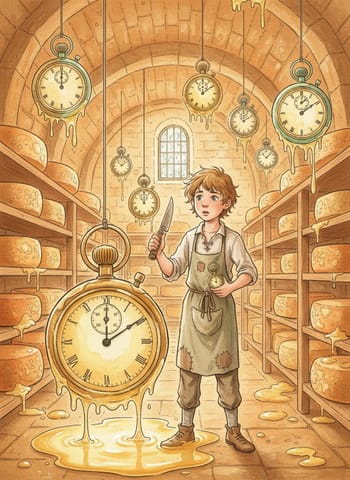
The Slow Stopwatch in the Cheese Cellar
Una historia gratuita en inglés de nivel B2 para estudiantes, para leer en línea en 7 idiomas, con opción de escucharla en la app gratuita Storyteller.
An apprentice named Willem asks to run a cheese cellar alone for a week and receives exactly what he wanted, in a form he did not expect.
¡Ese fue el avance! Escucha la historia completa en la app gratuita Storyteller. Descargar la app
El audio no está disponible en este momento.
The cheese cellar lay inside the hill, behind a wooden door as thick as a man's arm. Inside, it was cool and dim and smelled of damp stone. On every shelf from floor to ceiling, the round pale wheels sat in rows like sleeping animals. Willem had worked there for ten months, and he still touched the door frame every morning for luck.
La bodega de quesos estaba dentro de la colina, detrás de una puerta de madera tan gruesa como el brazo de un hombre. Adentro, el aire era fresco, la luz tenue y olía a piedra húmeda. En cada estante, del suelo al techo, las ruedas pálidas y redondas descansaban en hileras como animales dormidos. Willem llevaba diez meses trabajando allí y todavía tocaba el marco de la puerta cada mañana para dar suerte.
Oksana, the head cheesemaker, kept the cellar the way some people keep a promise. She turned the wheels by hand and tested them with a thin steel probe. She wrote every result into a notebook with a pencil that never seemed to get shorter. She was thirty-eight, she rarely raised her voice, and in ten months she had never told Willem that he was doing well.
Oksana, la maestra quesera, cuidaba la bodega como algunas personas cumplen una promesa. Volteaba las ruedas a mano y las probaba con una fina sonda de acero. Anotaba cada resultado en un cuaderno con un lápiz que nunca parecía acortarse. Tenía treinta y ocho años, rara vez levantaba la voz y en diez meses nunca le había dicho a Willem que lo estaba haciendo bien.
On a Monday in spring, Willem finally spoke the thing he had been rehearsing for weeks. He stood at the washing table with a wet cloth in his hand. "I would like to run the cellar by myself for a week," he said.
Un lunes de primavera, Willem por fin dijo lo que llevaba semanas ensayando. Estaba de pie junto a la mesa de lavado con un paño mojado en la mano. «Me gustaría manejar la bodega yo solo durante una semana», dijo.
Oksana did not look up from her notebook. "Why?"
Oksana no levantó la vista de su cuaderno. «¿Por qué?».
"Because I want to know whether I can." He swallowed. "You do everything. I follow. I do not know what happens when I am the one who decides."
«Porque quiero saber si puedo». Tragó saliva. «Usted lo hace todo. Yo la sigo. No sé qué pasa cuando yo soy quien decide».
She wrote something down, closed the notebook, and finally looked at him. For a long moment her face gave nothing away.
Ella anotó algo, cerró el cuaderno y por fin lo miró. Durante un largo momento, su rostro no dejó ver nada.
"I leave on Friday to visit my brother at the coast," she said. "I was going to ask the neighbours to check the cellar twice a day. If you want it, you can have the week. Every wheel, every bath, every number in the book."
«El viernes me voy a visitar a mi hermano a la costa», dijo. «Iba a pedirles a los vecinos que revisaran la bodega dos veces al día. Si la quieres, puedes quedarte con la semana. Cada rueda, cada baño, cada número del cuaderno».
"Yes," Willem said. "Please."
«Sí», dijo Willem. «Por favor».
"Then you will need this." She opened a drawer under the counter and took out an old steel stopwatch with a cracked glass face. She set it on the table between them. "Every brine bath in the cellar is timed with it. Forty minutes for the young wheels, fifty-five for the older ones. Write the times in the book and never skip an entry."
«Entonces vas a necesitar esto». Abrió un cajón bajo el mostrador y sacó un viejo cronómetro de acero con la cubierta de vidrio agrietada. Lo puso sobre la mesa, entre los dos. «Cada baño de salmuera de la bodega se mide con él. Cuarenta minutos para las ruedas jóvenes, cincuenta y cinco para las más viejas. Anota los tiempos en el cuaderno y nunca te saltes una entrada».
Willem picked up the stopwatch. It was heavier than it looked, and the second hand moved smoothly around the dial. "Does it work properly?"
Willem tomó el cronómetro. Pesaba más de lo que parecía, y la manecilla de los segundos se movía suavemente por la esfera. «¿Funciona bien?».
"It works," said Oksana, and she went back to her notebook.
«Funciona», dijo Oksana, y volvió a su cuaderno.
On Friday morning she left with a small bag and a bag of apples, and the cellar became his. For the first two days he moved through it carefully, afraid of making a mistake. He turned the wheels in the order she had taught him. He washed the rinds. He started the stopwatch for each brine bath and wrote the minutes in the book. Every time he closed the wooden door behind him, he felt a quiet pride.
El viernes por la mañana ella se fue con un bolso pequeño y una bolsa de manzanas, y la bodega pasó a ser suya. Durante los dos primeros días se movió por ella con cuidado, con miedo de cometer un error. Volteó las ruedas en el orden que ella le había enseñado. Lavó las cortezas. Puso en marcha el cronómetro para cada baño de salmuera y anotó los minutos en el cuaderno. Cada vez que cerraba la puerta de madera tras de sí, sentía un orgullo callado.
On the third day something began to bother him. He had set the stopwatch for the fifty-five minute bath at nine in the morning. He had spent the time cleaning the shelves by the north wall. When he looked up, the stopwatch had just reached fifty-five minutes, but the cellar clock above the door said it was nearly ten past ten.
El tercer día, algo empezó a inquietarlo. Había puesto el cronómetro para el baño de cincuenta y cinco minutos a las nueve de la mañana. Había pasado ese tiempo limpiando los estantes junto a la pared norte. Cuando levantó la vista, el cronómetro acababa de llegar a los cincuenta y cinco minutos, pero el reloj de la bodega, sobre la puerta, marcaba casi las diez y diez.
Willem frowned. He told himself that he had simply misread the clock, and he lifted the wheels out of the brine. But that evening the same thing happened with the young wheels. The stopwatch said forty minutes, and the cellar clock said fifty.
Willem frunció el ceño. Se dijo que simplemente había leído mal el reloj y sacó las ruedas de la salmuera. Pero esa tarde pasó lo mismo con las ruedas jóvenes. El cronómetro marcaba cuarenta minutos y el reloj de la bodega, cincuenta.
He sat down on an upturned crate, put the stopwatch beside the clock, and watched them both for ten full minutes. The big clock moved forward by ten minutes. The stopwatch moved by only eight.
Se sentó en un cajón volteado, puso el cronómetro junto al reloj y los observó a los dos durante diez minutos completos. El reloj grande avanzó diez minutos. El cronómetro avanzó solo ocho.
"It runs slow," he said out loud to the empty cellar. "It has been running slow since Friday. And every bath I timed was too long."
«Va lento», dijo en voz alta a la bodega vacía. «Va lento desde el viernes. Y todos los baños que medí fueron demasiado largos».
He opened the notebook to the page of the previous weeks. In Oksana's neat pencil, the times for the same baths were marked with a small cross beside each number. The crosses were easy to miss, but they were everywhere. He had read the notebook a hundred times and never understood them.
Abrió el cuaderno en la página de las semanas anteriores. En el pulcro lápiz de Oksana, los tiempos de esos mismos baños estaban marcados con una pequeña cruz junto a cada número. Las cruces eran fáciles de pasar por alto, pero estaban por todas partes. Había leído el cuaderno cien veces y nunca las había entendido.
For a moment Willem felt sick. Nine wheels had spent far too long in the brine since Friday. If the salt had gone too deep, the cheeses would turn sharp and hard in a month. He thought about calling Oksana at the coast, and he put the idea down again. She had left him the cellar. She had also, he realised, left him a stopwatch that lied.
Por un momento, Willem sintió náuseas. Nueve ruedas habían pasado demasiado tiempo en la salmuera desde el viernes. Si la sal había penetrado demasiado, los quesos saldrían ásperos y duros en un mes. Pensó en llamar a Oksana a la costa, y volvió a descartar la idea. Ella le había dejado la bodega. También le había dejado, se dio cuenta, un cronómetro que mentía.
He spent the rest of the evening doing arithmetic. The stopwatch lost two minutes in every ten. A fifty-five minute bath therefore had to end at forty-four on the dial, and a forty minute bath at thirty-two. He made a small chart and taped it to the shelf above the washing table. Then he carried the nine wheels to the sink and rinsed the salt from their rinds in cold water. He laid them on dry boards so the salt could spread evenly. He wrote the real times in the notebook, with a small cross beside each number.
Pasó el resto de la tarde haciendo cuentas. El cronómetro perdía dos minutos de cada diez. Por lo tanto, un baño de cincuenta y cinco minutos debía terminar en cuarenta y cuatro en la esfera, y uno de cuarenta minutos, en treinta y dos. Hizo una pequeña tabla y la pegó con cinta en el estante sobre la mesa de lavado. Luego llevó las nueve ruedas al fregadero y enjuagó la sal de sus cortezas con agua fría. Las puso sobre tablas secas para que la sal se repartiera de manera pareja. Anotó en el cuaderno los tiempos reales, con una pequeña cruz junto a cada número.
By Monday the cellar was working as it should. He checked each bath against the big clock, not the stopwatch. He checked each wheel by the sound of his knuckles on the rind. When the neighbour came with a basket of eggs, she looked around. She said that everything seemed in perfect order, and that she had not seen the cellar so tidy in years.
Para el lunes, la bodega funcionaba como debía. Comprobaba cada baño con el reloj grande, no con el cronómetro. Revisaba cada rueda por el sonido de sus nudillos contra la corteza. Cuando la vecina llegó con una canasta de huevos, miró alrededor. Dijo que todo parecía en perfecto orden y que hacía años que no veía la bodega tan limpia.
Oksana returned on Friday evening, smelling of sea air and carrying a paper bag of shells for the kitchen. She walked straight to the shelves without taking off her coat and ran her hand along the rinds. She opened the notebook and read it in silence for a long time. Willem stood by the door and tried to look like someone who was not afraid.
Oksana regresó el viernes por la tarde, oliendo a aire de mar y con una bolsa de papel con conchas para la cocina. Fue directo a los estantes sin quitarse el abrigo y pasó la mano por las cortezas. Abrió el cuaderno y lo leyó en silencio durante un largo rato. Willem esperaba junto a la puerta y trataba de parecer alguien que no tenía miedo.
"You found the stopwatch," she said at last.
«Encontraste el cronómetro», dijo ella al fin.
"On the third day," he answered. "I rinsed nine wheels that had soaked too long. I think they will be fine. I should have noticed on the first day, and I am sorry."
«El tercer día», respondió él. «Enjuagué nueve ruedas que habían estado demasiado tiempo en remojo. Creo que quedarán bien. Debí darme cuenta el primer día, y lo siento».
"Sorry for what? You noticed it." She closed the book. "I have owned that watch for fourteen years. I use it to teach people that the thing you trust most can be the thing that fools you. Everyone who has worked here has made the same mistake, though most of them wait a week to find it."
«¿Qué lo sientes? Te diste cuenta». Cerró el cuaderno. «Tengo ese reloj desde hace catorce años. Lo uso para enseñar que aquello en lo que más confías puede ser lo que te engaña. Todos los que han trabajado aquí han cometido el mismo error, aunque la mayoría espera una semana para descubrirlo».
"You knew it would happen," Willem said slowly. "You asked me to run the cellar, and you gave me a broken watch on purpose."
«Usted sabía que pasaría», dijo Willem despacio. «Me pidió que manejara la bodega y me dio un reloj descompuesto a propósito».
"You asked for a week of deciding," Oksana said. "I gave you a week of deciding. A person who has only followed instructions has never had to decide anything. That is what a cellar is for."
«Tú pediste una semana de decidir», dijo Oksana. «Te di una semana de decidir. Una persona que solo ha seguido instrucciones nunca ha tenido que decidir nada. Para eso sirve una bodega».
She took the stopwatch from the table, looked at it fondly, and put it in his hand.
Tomó el cronómetro de la mesa, lo miró con cariño y se lo puso en la mano.
"It is yours now," she said. "When the next apprentice comes, I will be watching how you teach it."
«Ahora es tuyo», dijo. «Cuando llegue el próximo aprendiz, estaré mirando cómo se lo enseñas».