The Pot with the Wrong Lid
Uma história gratuita em inglês de nível B1 para estudantes, para ler online em 7 idiomas, com opção de ouvir no app gratuito Storyteller.
A shy volunteer at a hilltop station finds a cooked meal with a note and guesses the wrong person is meant to eat it.
Essa foi a prévia! Ouça a história completa no app gratuito Storyteller. Baixar o app
O áudio não está disponível no momento.
The station on Crow Hill has four instruments, one radio, and a kitchen the size of a cupboard. Tariq likes the instruments best. Every morning he climbs the metal steps to the roof. He reads the wind gauge and writes the numbers in a blue notebook.
A estação de Crow Hill tem quatro instrumentos, um rádio e uma cozinha do tamanho de um armário. Tariq gosta mais dos instrumentos. Toda manhã ele sobe os degraus de metal até o telhado. Lê o anemômetro e anota os números num caderno azul.
He is seventeen, and he has volunteered here for three months. The work is quiet, and he likes it that way. Nobody asks him questions, and nobody expects him to be funny.
Ele tem dezessete anos e é voluntário aqui há três meses. O trabalho é tranquilo, e ele gosta assim. Ninguém lhe faz perguntas, e ninguém espera que ele seja engraçado.
The only other volunteer is Esteban, who comes up from the village every Tuesday and Thursday. Esteban is tall and a little clumsy. He checks the cloud camera, fixes whatever is broken, and hums while he works. Tariq has noticed the humming. He has noticed a lot of things about Esteban, and he tries not to think about them.
O único outro voluntário é Esteban, que sobe do povoado toda terça e quinta. Esteban é alto e um pouco desajeitado. Ele confere a câmera de nuvens, conserta o que estiver quebrado e cantarola enquanto trabalha. Tariq reparou no cantarolar. Reparou em muitas coisas sobre Esteban, e tenta não pensar nelas.
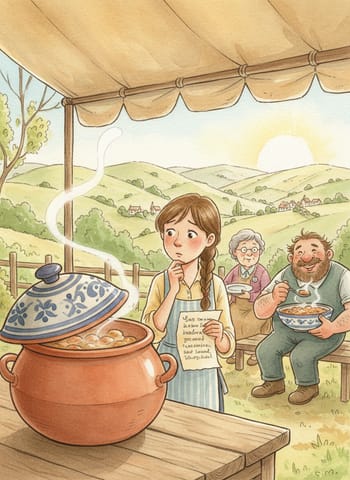
On Thursday, Tariq comes down from the roof and finds a pot on the kitchen table. It is a dented green pot with a tin lid that does not fit. The lid sits crooked on top, and a thin line of steam escapes from one side. Beside it lies a note on yellow paper.
Na quinta, Tariq desce do telhado e encontra uma panela na mesa da cozinha. É uma panela verde amassada, com uma tampa de lata que não encaixa. A tampa fica torta em cima, e um fio fino de vapor escapa por um lado. Ao lado há um bilhete em papel amarelo.
The note says, "For the one who reads the dials at six. Be careful, it is hot."
O bilhete diz: "Para quem lê os mostradores às seis. Cuidado, está quente."
Tariq reads it twice. He reads the dials at six. Everyone on the hill knows that, because it is his job. But Tariq also knows that the visiting scientist sometimes reads the dials at six when she stays overnight. And he thinks she is staying tonight.
Tariq lê duas vezes. Ele lê os mostradores às seis. Todos na colina sabem disso, porque é o trabalho dele. Mas Tariq também sabe que a cientista visitante às vezes lê os mostradores às seis quando passa a noite. E acha que ela vai ficar esta noite.
"Of course," he says to the empty kitchen. "Of course it is for her."
"Claro", diz ele à cozinha vazia. "Claro que é para ela."
He feels something heavy settle in his chest. Esteban has cooked a meal for the scientist. It makes sense. She is clever and kind. She has been to places Tariq has only seen on maps. Tariq is just a boy with a notebook.
Ele sente algo pesado se assentar no peito. Esteban cozinhou para a cientista. Faz sentido. Ela é inteligente e gentil. Já foi a lugares que Tariq só viu em mapas. Tariq é só um garoto com um caderno.
He puts the lid back on the pot, carefully, and goes to the radio room. He does not want to be in the kitchen when Esteban arrives.
Ele recoloca a tampa na panela, com cuidado, e vai para a sala do rádio. Não quer estar na cozinha quando Esteban chegar.
Esteban arrives at ten, carrying a bag of tools. He goes straight to the kitchen and then stops in the doorway. The pot is still on the table, and the note is still beside it. Nobody has touched them.
Esteban chega às dez, carregando uma sacola de ferramentas. Vai direto para a cozinha e para na porta. A panela continua na mesa, e o bilhete continua ao lado. Ninguém mexeu em nada.
He looks around, puzzled, and then walks to the radio room. "Hey," he says. "Did you see the pot?"
Ele olha em volta, confuso, e então vai até a sala do rádio. "Ei", diz. "Você viu a panela?"
"I saw it," Tariq says without turning around. He keeps his eyes on the radio dial. "It looks great. I am sure she will love it."
"Vi", diz Tariq sem se virar. Mantém os olhos no mostrador do rádio. "Parece ótima. Tenho certeza de que ela vai adorar."
"She?" Esteban asks.
"Ela?", pergunta Esteban.
"The scientist." Tariq finally turns his head. "You left it for her, didn't you? I didn't want to eat it by mistake."
"A cientista." Tariq finalmente vira a cabeça. "Você deixou para ela, não foi? Não quis comer por engano."
Esteban stares at him. For a moment, he looks as if he will laugh. Then he sees Tariq's face and stops. "Wait. You think I cooked for the scientist?"
Esteban o encara. Por um momento, parece que vai rir. Então vê o rosto de Tariq e para. "Espera. Você acha que eu cozinhei para a cientista?"
"The note says the one who reads the dials at six."
"O bilhete diz para quem lê os mostradores às seis."
"Yes," Esteban says. "That is you."
"Sim", diz Esteban. "Esse é você."
"She reads them too, sometimes."
"Ela também lê, às vezes."
"Not this week, she doesn't. She left on Monday. She sent a message about it." Esteban rubs the back of his neck. "Tariq, I wrote that note for you. I did not use your name because I was nervous. I thought a name looked too serious."
"Esta semana não. Ela foi embora na segunda. Mandou mensagem avisando." Esteban esfrega a nuca. "Tariq, eu escrevi aquele bilhete para você. Não usei seu nome porque estava nervoso. Achei que um nome parecia sério demais."
Tariq says nothing. The radio hisses softly in the corner.
Tariq não diz nada. O rádio chia baixinho no canto.
"I do not cook well," Esteban goes on. "I made the stew three times at home. The first time I burned it. The second time I forgot the salt. The third time is in that pot. I borrowed it from my sister, and it came without its own lid. So I took the lid from another pot. That is why it looks so strange."
"Eu não cozinho bem", continua Esteban. "Fiz esse ensopado três vezes em casa. Na primeira, queimei. Na segunda, esqueci o sal. A terceira está naquela panela. Peguei emprestada da minha irmã, e ela veio sem a tampa própria. Então peguei a tampa de outra panela. Por isso está tão estranha."
"Oh," Tariq says. It is the only word he can find.
"Ah", diz Tariq. É a única palavra que consegue achar.
"I wanted to say thank you," Esteban says. "You always explain the instruments to me without making me feel stupid. Nobody else does that. And I thought, maybe, if I cooked something, you would stay for lunch."
"Eu queria agradecer", diz Esteban. "Você sempre me explica os instrumentos sem me fazer sentir burro. Ninguém mais faz isso. E pensei que, talvez, se eu cozinhasse alguma coisa, você ficaria para o almoço."
Tariq looks at the floor, then at the door, then at Esteban. His heart is beating much faster than the wind gauge ever does. "I thought you liked her," he says at last.
Tariq olha para o chão, depois para a porta, depois para Esteban. O coração dele bate bem mais rápido do que o anemômetro jamais gira. "Eu achei que você gostava dela", diz por fim.
"The scientist is very nice," Esteban says. "But I do not hum for her."
"A cientista é muito simpática", diz Esteban. "Mas eu não cantarolo para ela."
Tariq opens his mouth, and nothing comes out. Then he starts to laugh, a real laugh, loud enough to surprise both of them. Esteban laughs too, and the radio crackles as if it wants to join in.
Tariq abre a boca, e nada sai. Então começa a rir, uma risada de verdade, alta o bastante para surpreender os dois. Esteban também ri, e o rádio estala como se quisesse participar.
"I am such an idiot," Tariq says.
"Eu sou muito idiota", diz Tariq.
"No. I am. I could have just written your name."
"Não. Eu é que sou. Eu podia simplesmente ter escrito o seu nome."
They walk back to the kitchen together. The stew is still warm, and the steam still escapes from the side of the lid. Tariq lifts it and sniffs. It smells of garlic, tomatoes, and something sweet that he cannot name.
Eles voltam juntos para a cozinha. O ensopado ainda está morno, e o vapor ainda escapa pelo lado da tampa. Tariq a levanta e cheira. Tem cheiro de alho, tomate e algo doce que ele não consegue nomear.
"What is the sweet thing?" he asks.
"O que é a coisa doce?", pergunta.
"Cinnamon. My mother puts it in everything." Esteban looks worried. "Is it too much?"
"Canela. Minha mãe põe em tudo." Esteban parece preocupado. "É demais?"
"I don't know yet." Tariq finds two spoons in the drawer and gives one to Esteban. "We have to taste it to find out."
"Ainda não sei." Tariq encontra duas colheres na gaveta e dá uma a Esteban. "Temos que provar para descobrir."
They sit on two wobbly stools by the small window. From here, they can see the roof and the wind gauge turning. Below them, a long green slope runs down to the village. The first spoonful is hot, and Tariq burns his tongue a little. He does not say so.
Eles se sentam em dois bancos bambos junto à janelinha. Dali, veem o telhado e o anemômetro girando. Abaixo, uma longa encosta verde desce até o povoado. A primeira colherada está quente, e Tariq queima um pouco a língua. Não diz nada.
"It is good," he says. "It is really good."
"Está bom", diz ele. "Está muito bom mesmo."
"You are only saying that."
"Você só está dizendo isso."
"I am not. I would tell you if it was bad. I tell everyone the truth about numbers." Tariq takes a second spoonful. "It needs a little more salt. But the cinnamon works."
"Não estou. Eu diria se estivesse ruim. Eu digo a verdade a todo mundo sobre números." Tariq toma uma segunda colherada. "Precisa de um pouco mais de sal. Mas a canela funciona."
Esteban lets out a long breath and grins. He looks younger when he grins, and Tariq has to look at his bowl for a moment.
Esteban solta um longo suspiro e abre um sorriso. Parece mais novo quando sorri, e Tariq precisa olhar para o prato por um momento.
They eat in the easy silence of two people who no longer have to pretend. Outside, the wind gauge keeps spinning, and the afternoon readings wait on the roof. Neither of them moves to go up.
Eles comem no silêncio tranquilo de duas pessoas que não precisam mais fingir. Lá fora, o anemômetro continua girando, e as leituras da tarde esperam no telhado. Nenhum dos dois se mexe para subir.
When the bowls are empty, Tariq picks up the green pot to wash it. The tin lid slides sideways and clatters onto the table. He puts it back on top, and it sits crooked again, just like before.
Quando os pratos estão vazios, Tariq pega a panela verde para lavar. A tampa de lata escorrega para o lado e bate na mesa. Ele a coloca de volta em cima, e ela fica torta de novo, igualzinho a antes.
"It is a terrible lid," Esteban says.
"É uma tampa horrível", diz Esteban.
"It is the worst lid I have ever seen." Tariq turns it around, trying to make it fit. It will not fit, however he turns it. He sets it down gently and looks up.
"É a pior tampa que já vi." Tariq a gira, tentando fazê-la encaixar. Não encaixa, por mais que ele a vire. Ele a coloca com delicadeza no lugar e levanta os olhos.
"Do you think," he asks, "that the two of us fit any better?"
"Você acha", pergunta, "que nós dois encaixamos melhor?"