The Knight Drawn on a Bean
Uma história gratuita em inglês de nível B2 para estudantes, para ler online em 7 idiomas, com opção de ouvir no app gratuito Storyteller.
A beginner at chess helps a visiting captain find a stand-in for a lost piece among the packets of a village seed library.
Essa foi a prévia! Ouça a história completa no app gratuito Storyteller. Baixar o app
O áudio não está disponível no momento.
The seed library lives in the back room of the village hall, inside an old wooden cabinet with forty small drawers. Each drawer holds paper envelopes of seeds that people have saved from their gardens, and anyone can borrow a packet for free. The only rule is to bring back seeds from the plants that grow.
A biblioteca de sementes fica nos fundos do salão da vila, dentro de um velho armário de madeira com quarenta gavetinhas. Cada gaveta guarda envelopes de papel com sementes que as pessoas guardaram de seus jardins, e qualquer um pode pegar um pacotinho emprestado de graça. A única regra é devolver sementes das plantas que nascerem.
Hari has volunteered here for three weeks. His job is simple. He writes names on envelopes, keeps the ledger up to date and tells visitors that yes, this really is free. Most afternoons he does his homework at the front desk and listens to the radio.
Hari é voluntário aqui há três semanas. O trabalho dele é simples. Escreve nomes nos envelopes, mantém o registro em dia e diz aos visitantes que sim, é de graça mesmo. Na maioria das tardes, faz o dever de casa na mesa da frente e escuta o rádio.
Today, the radio is off, because a stranger is standing at the desk with a small wooden box under one arm.
Hoje o rádio está desligado, porque alguém desconhecido está parado diante da mesa com uma caixinha de madeira debaixo do braço.
"Hi," says the stranger. "Do you have a pen?"
"Oi", diz a pessoa. "Você tem uma caneta?"
"Of course." Hari holds out his own. The stranger is about his age, with short dark hair, a green scarf and the tired look of someone who has travelled a long way. "Are you looking for seeds?"
"Claro." Hari estende a sua. A pessoa tem a idade dele, cabelo escuro e curto, um cachecol verde e o ar cansado de quem veio de longe. "Está procurando sementes?"
"Not exactly." The stranger opens the box on the desk. Inside is a travelling chess set, the folding kind, with tiny magnetic pieces tucked into little holes. "I'm Zia. I have a match in two hours, in the next village. I just checked the box, and the white knight is gone. I must have dropped it on the bus."
"Na verdade, não." A pessoa abre a caixa sobre a mesa. Dentro há um jogo de xadrez de viagem, do tipo dobrável, com peças magnéticas minúsculas encaixadas em pequenos buracos. "Eu sou Zia. Tenho uma partida daqui a duas horas, na próxima vila. Acabei de olhar a caixa, e o cavalo branco sumiu. Devo ter deixado cair no ônibus."
Hari looks at the board. The white pieces stand in a neat line, and between the bishop and the rook there is an empty hole.
Hari olha o tabuleiro. As peças brancas estão em fila arrumada, e entre o bispo e a torre há um buraco vazio.
"That's bad," he says.
"Que ruim", diz.
"It's terrible. I'm the captain, and the other club is very strict." Zia sighs and runs a hand through their hair. "I thought a shop might sell a single piece. But every shop in the village is closed for lunch, and I've walked past all of them."
"É terrível. Quem comanda o time sou eu, e o outro clube é muito rigoroso." Zia suspira e passa a mão pelo cabelo. "Pensei que uma loja talvez vendesse uma peça avulsa. Mas todas as lojas da vila estão fechadas para o almoço, e passei por todas."
Hari is about to say that he is sorry. Then he thinks of the book he has been reading in the evenings, a thick paperback called Chess for Complete Beginners. He is not good. He loses to his little cousin. But he has memorised the section on the rules, because it was the one part that felt like solving a puzzle.
Hari está prestes a dizer que sente muito. Então se lembra do livro que vem lendo à noite, um brochura grosso chamado Xadrez para Iniciantes Absolutos. Ele não joga bem. Perde para o primo pequeno. Mas decorou a seção das regras, porque foi a parte que pareceu resolver um quebra-cabeça.
"Wait," he says. "I think there is a rule about this."
"Espere", diz. "Acho que existe uma regra sobre isso."
He pulls the paperback out of his bag and flips to the right page. After a minute he reads aloud. "'A damaged or missing piece may be replaced by any object of similar size, provided both players agree and the object is easy to recognise.' It's in the section on the rules."
Tira o livro da mochila e folheia até a página certa. Depois de um minuto, lê em voz alta. "'Uma peça danificada ou perdida pode ser substituída por qualquer objeto de tamanho semelhante, desde que ambos os jogadores concordem e o objeto seja fácil de reconhecer.' Está na seção das regras."
Zia stares at him. "You know the rules that well?"
Zia o encara. "Você conhece as regras tão bem assim?"
"I know three pages of them," says Hari. "I'm much better at the rules than at the game."
"Conheço três páginas delas", diz Hari. "Sou muito melhor nas regras do que no jogo."
For the first time, Zia smiles properly, and the tired look vanishes. "That is the most useful thing anyone has said to me all day. And I've played chess for nine years."
Pela primeira vez, Zia sorri de verdade, e o ar cansado some. "Foi a coisa mais útil que alguém me disse o dia todo. E eu jogo xadrez há nove anos."
"Then you can teach me something later," says Hari, and immediately wishes he had stayed quiet. But Zia only nods.
"Então você pode me ensinar alguma coisa depois", diz Hari, e logo deseja ter ficado quieto. Mas Zia apenas assente.
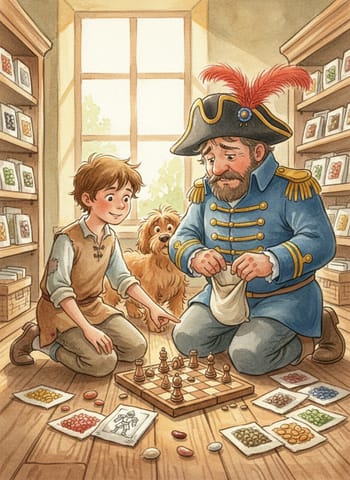
The difficult part is the replacement. They search the room together. A bottle cap is too big. A piece of chalk is too thin. A button from Hari's jacket looks exactly like a pawn, which would be dangerous.
A parte difícil é a substituição. Eles procuram juntos pela sala. Uma tampinha de garrafa é grande demais. Um pedaço de giz é fino demais. Um botão da jaqueta de Hari parece exatamente um peão, o que seria perigoso.
Then Hari turns to the cabinet. He opens the drawer marked B and lifts out an envelope labelled broad beans, early variety. He tips one onto his palm. It is pale and flat and about the size of a thumbnail, with a dark scar on one side.
Então Hari se volta para o armário. Abre a gaveta marcada com B e tira um envelope com a etiqueta favas, variedade precoce. Despeja uma na palma da mão. É clara e achatada e do tamanho de uma unha de polegar, com uma cicatriz escura de um lado.
"It's the right colour," he says. "It's almost white. And it stands up if you set it on its edge."
"É da cor certa", diz. "É quase branca. E fica em pé se você a apoiar de lado."
"It doesn't look like a knight," says Zia.
"Não parece um cavalo", diz Zia.
"That's because nobody has drawn on it yet."
"É porque ninguém desenhou nela ainda."
He finds a fine black pen in his bag and, with his tongue between his teeth, draws a small horse's head on the bean. He gives it a curved neck, two pointed ears and a single dot for an eye. It takes him four attempts to get the nose right. The three failed beans go into a small, silent pile.
Ele acha uma caneta preta fina na mochila e, com a língua entre os dentes, desenha uma pequena cabeça de cavalo na fava. Dá a ela um pescoço curvo, duas orelhas pontudas e um único ponto como olho. Precisa de quatro tentativas para acertar o focinho. As três favas que deram errado vão para uma pequena pilha silenciosa.
Zia leans over the desk to watch, so close that their shoulders touch. Neither of them moves away.
Zia se debruça sobre a mesa para olhar, tão perto que os ombros se tocam. Nenhum dos dois se afasta.
"That is amazing," says Zia, when Hari holds up the finished piece. "It looks like it is thinking about something."
"Isso é incrível", diz Zia, quando Hari ergue a peça pronta. "Parece que está pensando em alguma coisa."
"It is thinking about dinner," says Hari. "It's a bean."
"Está pensando no jantar", diz Hari. "É uma fava."
Zia laughs so loudly that a man in the corridor looks in to check on them. Then Zia takes the bean carefully between two fingers and presses it into the empty hole. The magnet is too weak to hold it, but a small piece of tape from the desk does the job.
Zia ri tão alto que um homem no corredor espia para ver o que houve. Então Zia pega a fava com cuidado entre dois dedos e a encaixa no buraco vazio. O ímã é fraco demais para segurá-la, mas um pedacinho de fita da mesa resolve.
They look at the board. Seven white pieces stand in a row, and in the middle of them a tiny pale horse watches the empty squares ahead.
Os dois olham o tabuleiro. Sete peças brancas em fila e, no meio delas, um minúsculo cavalo claro observa as casas vazias à frente.
"If they refuse it, I'll show them the rule," says Zia. "And I'll tell them who found it."
"Se não aceitarem, vou mostrar a regra", diz Zia. "E vou contar quem a encontrou."
"You can leave my name out," says Hari.
"Pode deixar meu nome de fora", diz Hari.
"No chance." Zia checks the clock on the wall. "I have to run to the bus stop. Can I borrow something from the cabinet? As a thank you. It seems wrong to leave without borrowing something."
"Nem pensar." Zia confere o relógio da parede. "Tenho que correr para o ponto de ônibus. Posso pegar alguma coisa emprestada do armário? Como agradecimento. Parece errado ir embora sem pegar nada."
"You have to bring seeds back," Hari says.
"Você tem que devolver sementes", diz Hari.
"Then I'll have to grow something."
"Então vou ter que cultivar alguma coisa."
Hari hesitates, then opens a drawer at the very bottom. In the back, behind a row of tidy envelopes, there is one that has been there since he arrived. The paper has gone soft. On the front is a faded drawing of a flower and a single question mark, in handwriting nobody can identify.
Hari hesita, depois abre uma gaveta bem embaixo. No fundo, atrás de uma fileira de envelopes arrumados, há um que está ali desde que ele chegou. O papel ficou macio. Na frente há o desenho desbotado de uma flor e um único ponto de interrogação, numa letra que ninguém sabe identificar.
"Nobody has ever borrowed this one," he says. "Nobody knows what it is. The woman who started the library left it behind, and it just stayed."
"Ninguém nunca pegou este emprestado", diz. "Ninguém sabe o que é. A mulher que começou a biblioteca o deixou aqui, e ele simplesmente ficou."
Zia takes the envelope with both hands. "Perfect," Zia says. "I like a puzzle."
Zia pega o envelope com as duas mãos. "Perfeito", diz Zia. "Gosto de um enigma."
Hari opens the ledger and writes the date. Under Name he writes Zia. Under Plant he stops for a long moment, with the pen above the page, and then writes: Unknown.
Hari abre o registro e escreve a data. Em Nome escreve Zia. Em Planta para por um longo momento, com a caneta acima da página, e então escreve: Desconhecida.
Zia hurries out of the door with the chess box under one arm and the envelope in a pocket. The green scarf disappears around the corner of the hall. Hari sits at the desk and looks at the open drawer, at the pile of ruined beans and at the pen still in his hand.
Zia sai apressada pela porta com a caixa de xadrez debaixo do braço e o envelope no bolso. O cachecol verde desaparece na esquina do salão. Hari se senta à mesa e olha para a gaveta aberta, para a pilha de favas estragadas e para a caneta ainda em sua mão.
Neither of them has any idea what will grow.
Nenhum dos dois faz ideia do que vai nascer.