The Knight Drawn on a Bean
Una historia gratuita en inglés de nivel B2 para estudiantes, para leer en línea en 7 idiomas, con opción de escucharla en la app gratuita Storyteller.
A beginner at chess helps a visiting captain find a stand-in for a lost piece among the packets of a village seed library.
¡Ese fue el avance! Escucha la historia completa en la app gratuita Storyteller. Descargar la app
El audio no está disponible en este momento.
The seed library lives in the back room of the village hall, inside an old wooden cabinet with forty small drawers. Each drawer holds paper envelopes of seeds that people have saved from their gardens, and anyone can borrow a packet for free. The only rule is to bring back seeds from the plants that grow.
La biblioteca de semillas vive en el cuarto trasero del salón comunal del pueblo, dentro de un viejo armario de madera con cuarenta cajoncitos. Cada cajón guarda sobres de papel con semillas que la gente ha conservado de sus jardines, y cualquiera puede llevarse un paquete gratis. La única regla es devolver semillas de las plantas que crezcan.
Hari has volunteered here for three weeks. His job is simple. He writes names on envelopes, keeps the ledger up to date and tells visitors that yes, this really is free. Most afternoons he does his homework at the front desk and listens to the radio.
Hari lleva tres semanas como voluntario aquí. Su trabajo es sencillo. Escribe nombres en los sobres, mantiene al día el registro y les dice a los visitantes que sí, que de verdad es gratis. La mayoría de las tardes hace la tarea en el escritorio de la entrada y escucha la radio.
Today, the radio is off, because a stranger is standing at the desk with a small wooden box under one arm.
Hoy la radio está apagada, porque una persona desconocida está de pie frente al escritorio con una cajita de madera bajo el brazo.
"Hi," says the stranger. "Do you have a pen?"
«Hola», dice la persona desconocida. «¿Tienes un bolígrafo?».
"Of course." Hari holds out his own. The stranger is about his age, with short dark hair, a green scarf and the tired look of someone who has travelled a long way. "Are you looking for seeds?"
«Claro». Hari le extiende el suyo. La persona desconocida tiene más o menos su edad, con el pelo oscuro y corto, una bufanda verde y la mirada cansada de quien ha viajado mucho. «¿Buscas semillas?».
"Not exactly." The stranger opens the box on the desk. Inside is a travelling chess set, the folding kind, with tiny magnetic pieces tucked into little holes. "I'm Zia. I have a match in two hours, in the next village. I just checked the box, and the white knight is gone. I must have dropped it on the bus."
«No exactamente». Abre la caja sobre el escritorio. Dentro hay un juego de ajedrez de viaje, de los plegables, con diminutas piezas magnéticas encajadas en pequeños huecos. «Soy Zia. Tengo una partida en dos horas, en el pueblo de al lado. Acabo de revisar la caja y falta el caballo blanco. Debo de haberlo dejado caer en el autobús».
Hari looks at the board. The white pieces stand in a neat line, and between the bishop and the rook there is an empty hole.
Hari mira el tablero. Las piezas blancas están en una fila ordenada, y entre el alfil y la torre hay un hueco vacío.
"That's bad," he says.
«Qué mal», dice.
"It's terrible. I'm the captain, and the other club is very strict." Zia sighs and runs a hand through their hair. "I thought a shop might sell a single piece. But every shop in the village is closed for lunch, and I've walked past all of them."
«Es terrible. Soy quien lidera el equipo, y el otro club es muy estricto». Zia suspira y se pasa una mano por el cabello. «Pensé que alguna tienda vendería una sola pieza. Pero todas las tiendas del pueblo están cerradas por el almuerzo, y ya pasé frente a todas».
Hari is about to say that he is sorry. Then he thinks of the book he has been reading in the evenings, a thick paperback called Chess for Complete Beginners. He is not good. He loses to his little cousin. But he has memorised the section on the rules, because it was the one part that felt like solving a puzzle.
Hari está a punto de decir que lo siente. Entonces piensa en el libro que ha estado leyendo por las noches, un grueso libro de bolsillo llamado Ajedrez para principiantes absolutos. No es bueno. Pierde contra su primito. Pero se ha memorizado la sección de las reglas, porque era la única parte que se sentía como resolver un acertijo.
"Wait," he says. "I think there is a rule about this."
«Espera», dice. «Creo que hay una regla sobre esto».
He pulls the paperback out of his bag and flips to the right page. After a minute he reads aloud. "'A damaged or missing piece may be replaced by any object of similar size, provided both players agree and the object is easy to recognise.' It's in the section on the rules."
Saca el libro de su mochila y busca la página correcta. Después de un minuto, lee en voz alta. «"Una pieza dañada o ausente puede reemplazarse por cualquier objeto de tamaño similar, siempre que ambos jugadores estén de acuerdo y el objeto sea fácil de reconocer". Está en la sección de las reglas».
Zia stares at him. "You know the rules that well?"
Zia lo mira fijamente. «¿Te sabes tan bien las reglas?».
"I know three pages of them," says Hari. "I'm much better at the rules than at the game."
«Me sé tres páginas», dice Hari. «Soy mucho mejor en las reglas que en el juego».
For the first time, Zia smiles properly, and the tired look vanishes. "That is the most useful thing anyone has said to me all day. And I've played chess for nine years."
Por primera vez, Zia sonríe de verdad, y la mirada cansada desaparece. «Es lo más útil que me han dicho en todo el día. Y llevo nueve años jugando ajedrez».
"Then you can teach me something later," says Hari, and immediately wishes he had stayed quiet. But Zia only nods.
«Entonces después puedes enseñarme algo», dice Hari, y de inmediato desea haberse quedado callado. Pero Zia solo asiente.
The difficult part is the replacement. They search the room together. A bottle cap is too big. A piece of chalk is too thin. A button from Hari's jacket looks exactly like a pawn, which would be dangerous.
La parte difícil es el reemplazo. Buscan juntos por la sala. Una tapa de botella es demasiado grande. Un trozo de tiza es demasiado delgado. Un botón de la chaqueta de Hari se parece exactamente a un peón, lo cual sería peligroso.
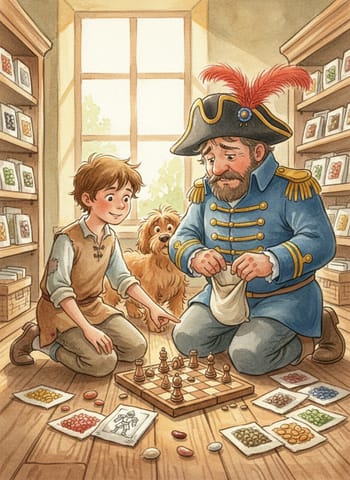
Then Hari turns to the cabinet. He opens the drawer marked B and lifts out an envelope labelled broad beans, early variety. He tips one onto his palm. It is pale and flat and about the size of a thumbnail, with a dark scar on one side.
Entonces Hari se vuelve hacia el armario. Abre el cajón marcado con la B y saca un sobre rotulado habas, variedad temprana. Vuelca una en la palma de su mano. Es pálida y plana y del tamaño de la uña de un pulgar, con una cicatriz oscura en un lado.
"It's the right colour," he says. "It's almost white. And it stands up if you set it on its edge."
«Es del color correcto», dice. «Es casi blanca. Y se sostiene de pie si la pones de canto».
"It doesn't look like a knight," says Zia.
«No parece un caballo», dice Zia.
"That's because nobody has drawn on it yet."
«Eso es porque nadie ha dibujado sobre ella todavía».
He finds a fine black pen in his bag and, with his tongue between his teeth, draws a small horse's head on the bean. He gives it a curved neck, two pointed ears and a single dot for an eye. It takes him four attempts to get the nose right. The three failed beans go into a small, silent pile.
Encuentra un bolígrafo negro fino en su mochila y, con la lengua entre los dientes, dibuja una pequeña cabeza de caballo en el haba. Le hace el cuello curvo, dos orejas puntiagudas y un solo punto por ojo. Le toma cuatro intentos acertar con el hocico. Las tres habas fallidas van a un pequeño montón silencioso.
Zia leans over the desk to watch, so close that their shoulders touch. Neither of them moves away.
Zia se inclina sobre el escritorio para mirar, tan cerca que sus hombros se tocan. Ninguno de los dos se aparta.
"That is amazing," says Zia, when Hari holds up the finished piece. "It looks like it is thinking about something."
«Es increíble», dice Zia, cuando Hari levanta la pieza terminada. «Parece que está pensando en algo».
"It is thinking about dinner," says Hari. "It's a bean."
«Está pensando en la cena», dice Hari. «Es un haba».
Zia laughs so loudly that a man in the corridor looks in to check on them. Then Zia takes the bean carefully between two fingers and presses it into the empty hole. The magnet is too weak to hold it, but a small piece of tape from the desk does the job.
Zia se ríe tan fuerte que un hombre del pasillo se asoma a ver qué pasa. Luego Zia toma el haba con cuidado entre dos dedos y la presiona en el hueco vacío. El imán es demasiado débil para sostenerla, pero un trocito de cinta del escritorio hace el trabajo.
They look at the board. Seven white pieces stand in a row, and in the middle of them a tiny pale horse watches the empty squares ahead.
Miran el tablero. Siete piezas blancas están en fila, y en medio de ellas un diminuto caballo pálido observa las casillas vacías de adelante.
"If they refuse it, I'll show them the rule," says Zia. "And I'll tell them who found it."
«Si la rechazan, les mostraré la regla», dice Zia. «Y les diré quién la encontró».
"You can leave my name out," says Hari.
«Puedes dejar mi nombre fuera», dice Hari.
"No chance." Zia checks the clock on the wall. "I have to run to the bus stop. Can I borrow something from the cabinet? As a thank you. It seems wrong to leave without borrowing something."
«Ni hablar». Zia revisa el reloj de la pared. «Tengo que correr a la parada del autobús. ¿Puedo llevarme algo del armario? Como agradecimiento. Parece mal irme sin llevarme algo».
"You have to bring seeds back," Hari says.
«Tienes que traer semillas de vuelta», dice Hari.
"Then I'll have to grow something."
«Entonces tendré que cultivar algo».
Hari hesitates, then opens a drawer at the very bottom. In the back, behind a row of tidy envelopes, there is one that has been there since he arrived. The paper has gone soft. On the front is a faded drawing of a flower and a single question mark, in handwriting nobody can identify.
Hari duda, y luego abre un cajón del fondo. Atrás, detrás de una fila de sobres ordenados, hay uno que ha estado ahí desde que él llegó. El papel se ha puesto suave. En el frente hay un dibujo desteñido de una flor y un solo signo de interrogación, con una letra que nadie puede identificar.
"Nobody has ever borrowed this one," he says. "Nobody knows what it is. The woman who started the library left it behind, and it just stayed."
«Nadie se ha llevado nunca este», dice. «Nadie sabe qué es. La mujer que fundó la biblioteca lo dejó, y ahí se quedó».
Zia takes the envelope with both hands. "Perfect," Zia says. "I like a puzzle."
Zia toma el sobre con ambas manos. «Perfecto», dice Zia. «Me gustan los acertijos».
Hari opens the ledger and writes the date. Under Name he writes Zia. Under Plant he stops for a long moment, with the pen above the page, and then writes: Unknown.
Hari abre el registro y escribe la fecha. Bajo Nombre escribe Zia. Bajo Planta se detiene un largo momento, con el bolígrafo sobre la página, y luego escribe: Desconocida.
Zia hurries out of the door with the chess box under one arm and the envelope in a pocket. The green scarf disappears around the corner of the hall. Hari sits at the desk and looks at the open drawer, at the pile of ruined beans and at the pen still in his hand.
Zia sale apresuradamente por la puerta con la caja de ajedrez bajo el brazo y el sobre en un bolsillo. La bufanda verde desaparece tras la esquina del salón. Hari se queda sentado en el escritorio y mira el cajón abierto, el montón de habas arruinadas y el bolígrafo que aún tiene en la mano.
Neither of them has any idea what will grow.
Ninguno de los dos tiene idea de qué crecerá.