The Four-Day Week
Uma história gratuita em inglês de nível B2 para estudantes, para ler online em 4 idiomas, com opção de ouvir no app gratuito Storyteller.
Dragan has no idea what to do with his free Fridays until his grandfather's old sketchbook gives him something to learn.
Essa foi a prévia! Ouça a história completa no app gratuito Storyteller. Baixar o app
O áudio não está disponível no momento.
The announcement comes on a Monday: the company will trial a four-day week for three months. Dragan claps politely with everyone else, then goes back to his desk and wonders what he will do with a free Friday.
O anúncio vem numa segunda-feira: a empresa fará um teste de semana de quatro dias durante três meses. Dragan bate palmas educadamente com todo mundo, depois volta à mesa e se pergunta o que fará com uma sexta-feira livre.
By the first Friday, he has been checking his email since eight o'clock. There is nothing urgent. Nothing is ever urgent on Fridays, which he now realizes is the whole point. He answers a message that could easily have waited until Monday and feels faintly ridiculous.
Na primeira sexta, ele já está checando o e-mail desde as oito horas. Não há nada urgente. Nunca há nada urgente às sextas, e agora ele percebe que esse é justamente o ponto. Responde a uma mensagem que poderia muito bem esperar até segunda e se sente vagamente ridículo.
"You're supposed to rest," his sister tells him on the phone. "Do something with your hands, not your inbox."
"Você devia descansar", diz a irmã dele ao telefone. "Faça algo com as mãos, não com a caixa de entrada."
"Like what?" he asks.
"Tipo o quê?", pergunta ele.
"Like anything. Didn't you use to draw on everything when we were kids? Mum had to hide the wallpaper from you."
"Tipo qualquer coisa. Você não vivia desenhando em tudo quando a gente era criança? A mamãe tinha que esconder o papel de parede de você."
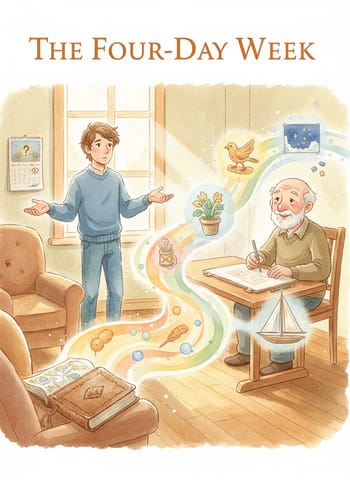
He had forgotten that. After lunch, he climbs into the attic and finds a box his grandfather left him. Inside are a flat tin of pencils, worn down to different lengths, and a sketchbook with half its pages still empty. The full half is street scenes: a tram stop, a market awning, a man asleep on a bench with his hat over his face.
Ele tinha esquecido disso. Depois do almoço, sobe ao sótão e encontra uma caixa que o avô lhe deixou. Dentro há uma lata achatada de lápis, gastos em tamanhos diferentes, e um caderno de desenho com metade das páginas ainda em branco. A metade preenchida tem cenas de rua: um ponto de bonde, um toldo de feira, um homem dormindo num banco com o chapéu sobre o rosto.
The second Friday, he sits at the kitchen window with the tin open and tries to draw the bakery across the road. The result looks like a bakery that has been in an accident. The roof slopes the wrong way, and the door would only fit a child. He borrows a library book on perspective and learns that he has been drawing what he expects to see, not what is actually there.
Na segunda sexta, ele se senta à janela da cozinha com a lata aberta e tenta desenhar a padaria do outro lado da rua. O resultado parece uma padaria que sofreu um acidente. O telhado inclina para o lado errado, e a porta só caberia uma criança. Ele pega emprestado na biblioteca um livro sobre perspectiva e descobre que vinha desenhando o que esperava ver, não o que de fato estava lá.
At work, his colleagues swap stories. One of them has been sleeping until ten. Another has repainted a bedroom. Dragan says he is "learning something," and when they ask what, he finds he doesn't want to explain. It feels too private, like admitting that he enjoys it.
No trabalho, os colegas trocam histórias. Um deles tem dormido até as dez. Outro repintou um quarto. Dragan diz que está "aprendendo uma coisa", e quando perguntam o quê, percebe que não quer explicar. Parece íntimo demais, como admitir que gosta.
By the third Friday, he has stopped looking at his phone. He pushes it into a kitchen drawer at eight o'clock and forgets it. He draws the bakery four more times. The roof straightens. He shades the shadows under the awning with the side of the pencil. Judging by the smudges on every page, his grandfather must have done the same.
Na terceira sexta, ele já parou de olhar o celular. Enfia o aparelho numa gaveta da cozinha às oito horas e o esquece. Desenha a padaria mais quatro vezes. O telhado se endireita. Sombreia as sombras sob o toldo com a lateral do lápis. A julgar pelas manchas em cada página, o avô devia fazer o mesmo.
On the last Thursday of the month, his manager stops by his desk. She says the trial is going well. Productivity hasn't dropped, and several people have reportedly never felt so rested. "Anything you'd change?" she asks.
Na última quinta-feira do mês, a gerente passa pela mesa dele. Diz que o teste está indo bem. A produtividade não caiu, e várias pessoas dizem nunca ter se sentido tão descansadas. "Mudaria alguma coisa?", pergunta.
"If it were up to me," Dragan says, "I'd make it permanent."
"Se dependesse de mim", diz Dragan, "eu tornaria permanente."
The next morning, he sits at the kitchen window with the phone shut away in its drawer. The baker comes out to lower the awning, as she does every Friday at nine. She stands for a moment with her hands on her hips. Dragan draws her quickly, before she can move.
Na manhã seguinte, ele se senta à janela da cozinha com o celular guardado na gaveta. A padeira sai para baixar o toldo, como faz toda sexta às nove. Fica um instante parada, com as mãos na cintura. Dragan a desenha depressa, antes que ela se mexa.
When he has finished, he opens his grandfather's sketchbook at the first empty page. He copies her in carefully, next to the man asleep on the bench.
Quando termina, abre o caderno do avô na primeira página em branco. Copia o desenho com cuidado, ao lado do homem dormindo no banco.