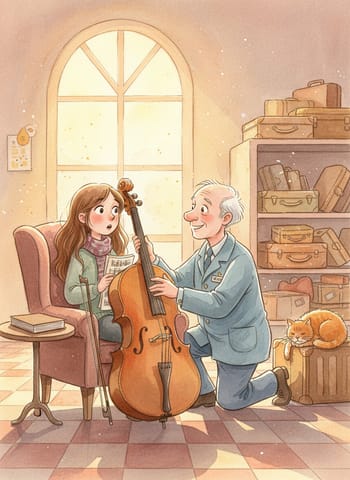
The Cello That Waited All Day
Cerita bahasa Inggris gratis level B2 untuk pelajar, bisa dibaca online dalam 7 bahasa, dengan pilihan untuk mendengarkannya di aplikasi Storyteller gratis.
A baggage clerk finally asks why a music student leaves her cello in the same room every day.
Itu cuplikannya! Dengarkan cerita lengkapnya di aplikasi Storyteller gratis. Unduh aplikasi
Audio belum tersedia saat ini.
The left-luggage room at the back of the bus station had no windows, and Sade liked it that way. The air was cool and still, and the shelves ran in tidy rows to the ceiling. The noise of departing engines reached her only as a distant hum. She had worked there for six years. In that time she had learned that people leave a surprising number of things behind, and that almost none of them ever explain why.
Ruang penitipan barang di bagian belakang terminal bus itu tidak berjendela, dan Sade menyukainya begitu. Udaranya sejuk dan tenang, dan rak-raknya berjajar rapi sampai ke langit-langit. Bising mesin bus yang berangkat hanya sampai kepadanya sebagai dengung jauh. Ia sudah bekerja di sana selama enam tahun. Selama itu ia belajar bahwa orang meninggalkan begitu banyak barang, dan hampir tak satu pun dari mereka menjelaskan alasannya.
There was one piece of furniture in the room that Sade had never managed to improve. It was a small wooden table by the door, where customers signed the ledger and counted their coins. One of its legs was shorter than the others, and the whole table rocked whenever anybody leaned on it. She had slid a folded card under the leg more than once, but the card always worked its way out.
Ada satu perabot di ruangan itu yang tak pernah berhasil diperbaiki Sade. Sebuah meja kayu kecil di dekat pintu, tempat pelanggan menandatangani buku catatan dan menghitung koin mereka. Salah satu kakinya lebih pendek daripada yang lain, dan seluruh meja bergoyang setiap kali ada yang bersandar. Ia pernah beberapa kali menyelipkan kartu terlipat di bawah kaki itu, tetapi kartunya selalu keluar lagi.
The cello arrived on a Monday, a little before eight.
Selo itu datang pada hari Senin, sedikit sebelum pukul delapan.
It came in a battered black case that was almost as tall as the girl who carried it. She was perhaps twenty, with a thin face and a heavy coat. She stood like someone used to apologising for taking up space. She set the case upright against the counter and pushed a ticket across the wood.
Selo itu datang dalam sebuah kotak hitam yang penyok dan hampir setinggi gadis yang membawanya. Gadis itu mungkin berusia dua puluh tahun, berwajah kurus dan berjaket tebal. Ia berdiri seperti orang yang terbiasa meminta maaf karena memakan tempat. Ia menegakkan kotak itu di dekat meja dan mendorong sebuah karcis melintasi kayunya.
"One bag, please," she said. "Until six this evening."
"Satu tas, tolong," katanya. "Sampai pukul enam sore."
"Name?" asked Sade.
"Nama?" tanya Sade.
"Safiya."
"Safiya."
Sade wrote it in the ledger and handed her a numbered tag. The table rocked as the girl signed her name. Safiya steadied it with one hand, without comment, as people do with a rocking table they have no hope of fixing.
Sade menulisnya di buku catatan dan menyerahkan label bernomor. Meja itu bergoyang saat gadis itu menandatangani namanya. Safiya menahannya dengan satu tangan tanpa berkomentar, seperti orang yang menahan meja goyang yang tak ada harapan untuk diperbaiki.
At six she returned, collected the cello, and left. On Tuesday she came again, and on Wednesday, and on every day after that. She was always polite, always quick, and always on time. She said nothing to Sade that was not strictly necessary.
Pukul enam ia kembali, mengambil selonya, dan pergi. Pada hari Selasa ia datang lagi, begitu juga hari Rabu, dan setiap hari setelahnya. Ia selalu sopan, selalu cepat, dan selalu tepat waktu. Ia tidak mengatakan apa pun kepada Sade selain yang benar-benar perlu.
For three weeks, Sade said nothing either.
Selama tiga minggu, Sade pun tidak mengatakan apa-apa.
She was aware of a question growing in the room, quietly, like a plant in the corner. Who carries a cello to a bus station every morning and leaves it for ten hours? It could not be a commuter's habit, since a musician would want her instrument close. It could not be an accident, because accidents do not arrive on a timetable. Yet each time the girl appeared, Sade found a reason not to ask. It was not her business. People came and went, and the whole purpose of her job was to hold things without wondering about them.
Ia menyadari sebuah pertanyaan tumbuh di ruangan itu, diam-diam, seperti tanaman di sudut. Siapa yang membawa selo ke terminal bus setiap pagi dan meninggalkannya selama sepuluh jam? Itu tidak mungkin kebiasaan seorang komuter, sebab seorang pemusik tentu ingin alat musiknya dekat. Itu tidak mungkin kebetulan, sebab kebetulan tidak datang menurut jadwal. Namun setiap kali gadis itu muncul, Sade menemukan alasan untuk tidak bertanya. Itu bukan urusannya. Orang datang dan pergi, dan seluruh tujuan pekerjaannya adalah menyimpan barang tanpa bertanya-tanya.
Her colleague Dario had a theory. "She is a spy," he said, with total seriousness, over lunch one day. "Or she is smuggling something inside it."
Rekan kerjanya, Dario, punya teori. "Dia mata-mata," katanya dengan sangat serius saat makan siang suatu hari. "Atau dia menyelundupkan sesuatu di dalamnya."
"It's a cello," said Sade.
"Itu selo," kata Sade.
"That is exactly what a spy would say about a cello."
"Itulah persis yang akan dikatakan mata-mata tentang selo."
She did not laugh, though she wanted to. Instead she watched the clock on the wall, and she realised that she had started to look forward to eight o'clock.
Sade tidak tertawa, meskipun ia ingin. Sebaliknya ia memandangi jam di dinding, dan ia sadar bahwa ia mulai menantikan pukul delapan.
On the fourth Monday the girl was late. She came through the door at ten past eight, out of breath. The case bumped the table so hard that it rocked and almost tipped the ledger onto the floor. Safiya caught it, and for the first time her composure cracked.
Pada hari Senin keempat gadis itu terlambat. Ia masuk lewat pintu pukul delapan lewat sepuluh, terengah-engah. Kotak selo itu menabrak meja begitu keras hingga meja bergoyang dan nyaris menjatuhkan buku catatan ke lantai. Safiya menangkapnya, dan untuk pertama kalinya ketenangannya runtuh.
"I'm sorry," she said. "I'm so sorry. I always make a mess of this."
"Maaf," katanya. "Maaf sekali. Aku selalu membuat kekacauan di sini."
"You didn't," said Sade. "It's the table. It has been rocking for six years."
"Bukan kamu," kata Sade. "Ini mejanya. Sudah enam tahun meja ini bergoyang."
They both looked at it. The short leg tapped twice against the floor, as though it had heard.
Mereka berdua memandangi meja itu. Kaki yang pendek mengetuk lantai dua kali, seolah mendengar.
Something in that small silence made the question impossible to carry any longer. Sade put down her pen.
Sesuatu dalam keheningan kecil itu membuat pertanyaan tadi mustahil dipendam lebih lama. Sade meletakkan penanya.
"Can I ask you something? You don't have to answer."
"Boleh aku bertanya sesuatu? Kamu tidak harus menjawab."
The girl's shoulders lifted slightly. "Of course."
Bahu gadis itu terangkat sedikit. "Tentu."
"Why do you leave your cello here? Every day, I mean. You obviously play. Wouldn't you want it with you?"
"Kenapa kamu menitipkan selomu di sini? Setiap hari, maksudku. Kamu jelas bermain musik. Bukankah kamu ingin selo itu bersamamu?"
For a moment Safiya said nothing, and Sade wondered whether she had made an enormous mistake. Then the girl let out a long breath, almost a laugh, as if she had been waiting a long time to be asked.
Sesaat Safiya tidak berkata apa-apa, dan Sade bertanya-tanya apakah ia telah membuat kesalahan besar. Lalu gadis itu menghela napas panjang, hampir seperti tawa, seakan ia sudah lama menunggu untuk ditanya.
"I live in a shared flat," she said. "Four people, one thin wall. My flatmates work nights, so they sleep through the day, and the neighbours complain if I play in the evening. I study at the music college across the river, but the practice rooms are always booked. I walk from home to this station, and the college is beyond it. The lecture buses are far too crowded for a cello. People stare. They shove. Last year somebody cracked the case." She glanced at the battered black lid. "So I leave it here during the day and collect it after the lectures end. I practise in a park beside the river, if the light is good."
"Aku tinggal di rumah kontrakan bersama," katanya. "Empat orang, satu dinding tipis. Teman-teman serumahku bekerja malam, jadi mereka tidur sepanjang hari, dan para tetangga mengeluh kalau aku bermain di malam hari. Aku kuliah di sekolah musik di seberang sungai, tetapi ruang latihannya selalu penuh dipesan. Aku berjalan dari rumah ke terminal ini, dan sekolah musiknya ada di seberangnya. Bus kuliah terlalu sesak untuk selo. Orang-orang menatap. Mereka mendorong. Tahun lalu seseorang membuat kotaknya retak." Ia melirik tutup hitam yang penyok itu. "Jadi aku menitipkannya di sini siang hari dan mengambilnya setelah kuliah selesai. Aku berlatih di taman di tepi sungai, kalau cahayanya bagus."
"And if it isn't?"
"Dan kalau tidak?"
"Then I sit by the bridge and pretend I'm playing in my head." She shrugged, and the shrug did not quite hide how tired she was. "I didn't tell you because it seemed silly. A grown woman who rents a locker for a cello."
"Maka aku duduk di dekat jembatan dan berpura-pura bermain dalam kepala." Ia mengangkat bahu, dan gerakan itu tidak sepenuhnya menyembunyikan betapa lelahnya ia. "Aku tidak bilang karena rasanya konyol. Perempuan dewasa yang menyewa loker untuk sebuah selo."
Sade looked at the case. She looked at the cool rows of silent luggage. She looked at the long empty space at the end of the room behind the last rack. Nobody ever used it, because the only socket in the wall had stopped working years ago.
Sade memandang kotak itu. Ia memandang deretan sejuk barang-barang yang sunyi. Ia memandang ruang kosong yang panjang di ujung ruangan, di belakang rak terakhir. Tidak pernah ada yang memakainya, karena satu-satunya stopkontak di dinding itu sudah mati bertahun-tahun lalu.
"Would the park be better in winter?" she asked.
"Apakah taman itu lebih nyaman di musim dingin?" tanyanya.
"No. It's freezing, and all the benches are cold iron." Safiya almost smiled. "Why?"
"Tidak. Dinginnya membekukan, dan semua bangkunya dari besi yang dingin." Safiya hampir tersenyum. "Kenapa?"
"Because this room is quiet." Sade spoke slowly, and she was surprised to find that her voice was steady. "The walls are thick. Nobody comes in after half past eight in the evening, and I close at ten. If you came after your lectures, and you didn't mind the shelves, you could play in the back."
"Karena ruangan ini tenang." Sade bicara pelan, dan ia heran mendapati suaranya mantap. "Dindingnya tebal. Tak ada yang masuk setelah pukul setengah sembilan malam, dan aku tutup pukul sepuluh. Kalau kamu datang setelah kuliah, dan kamu tidak keberatan dengan rak-rak itu, kamu bisa bermain di belakang."
Safiya stared at her. "I couldn't. It isn't allowed."
Safiya menatapnya. "Aku tidak bisa. Itu tidak diperbolehkan."
"The ledger doesn't say anything about cellos." Sade lifted a folded sheet of card from the counter, the same one she had tried so many times before, and crouched beside the table. "I'll need a witness, though. Somebody to sit at the table and tell me if the sound is too loud."
"Buku catatannya tidak menyebut apa pun tentang selo." Sade mengambil selembar kartu terlipat dari meja, kartu yang sama yang begitu sering ia coba sebelumnya, dan berjongkok di samping meja. "Tapi aku butuh saksi. Seseorang yang duduk di meja ini dan memberi tahu aku kalau suaranya terlalu keras."
Then she pressed the card firmly under the short leg and rose to her feet. The table stood perfectly still.
Lalu ia menekan kartu itu kuat-kuat di bawah kaki yang pendek dan berdiri. Meja itu berdiri diam sempurna.
"Sit," she said.
"Duduklah," katanya.