The Cello That Waited All Day
A free B2-level English story for language learners, readable online in 7 languages, with an option to listen via the free Storyteller app.
A baggage clerk finally asks why a music student leaves her cello in the same room every day.
That was the preview! Hear the full story in the free Storyteller app. Get the app
Audio isn't available right now.
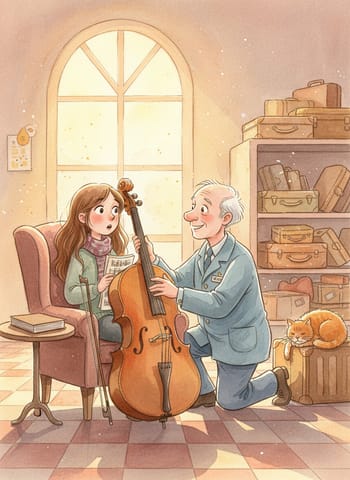
The left-luggage room at the back of the bus station had no windows, and Sade liked it that way. The air was cool and still, and the shelves ran in tidy rows to the ceiling. The noise of departing engines reached her only as a distant hum. She had worked there for six years. In that time she had learned that people leave a surprising number of things behind, and that almost none of them ever explain why.
There was one piece of furniture in the room that Sade had never managed to improve. It was a small wooden table by the door, where customers signed the ledger and counted their coins. One of its legs was shorter than the others, and the whole table rocked whenever anybody leaned on it. She had slid a folded card under the leg more than once, but the card always worked its way out.
The cello arrived on a Monday, a little before eight.
It came in a battered black case that was almost as tall as the girl who carried it. She was perhaps twenty, with a thin face and a heavy coat. She stood like someone used to apologising for taking up space. She set the case upright against the counter and pushed a ticket across the wood.
"One bag, please," she said. "Until six this evening."
"Name?" asked Sade.
"Safiya."
Sade wrote it in the ledger and handed her a numbered tag. The table rocked as the girl signed her name. Safiya steadied it with one hand, without comment, as people do with a rocking table they have no hope of fixing.
At six she returned, collected the cello, and left. On Tuesday she came again, and on Wednesday, and on every day after that. She was always polite, always quick, and always on time. She said nothing to Sade that was not strictly necessary.
For three weeks, Sade said nothing either.
She was aware of a question growing in the room, quietly, like a plant in the corner. Who carries a cello to a bus station every morning and leaves it for ten hours? It could not be a commuter's habit, since a musician would want her instrument close. It could not be an accident, because accidents do not arrive on a timetable. Yet each time the girl appeared, Sade found a reason not to ask. It was not her business. People came and went, and the whole purpose of her job was to hold things without wondering about them.
Her colleague Dario had a theory. "She is a spy," he said, with total seriousness, over lunch one day. "Or she is smuggling something inside it."
"It's a cello," said Sade.
"That is exactly what a spy would say about a cello."
She did not laugh, though she wanted to. Instead she watched the clock on the wall, and she realised that she had started to look forward to eight o'clock.
On the fourth Monday the girl was late. She came through the door at ten past eight, out of breath. The case bumped the table so hard that it rocked and almost tipped the ledger onto the floor. Safiya caught it, and for the first time her composure cracked.
"I'm sorry," she said. "I'm so sorry. I always make a mess of this."
"You didn't," said Sade. "It's the table. It has been rocking for six years."
They both looked at it. The short leg tapped twice against the floor, as though it had heard.
Something in that small silence made the question impossible to carry any longer. Sade put down her pen.
"Can I ask you something? You don't have to answer."
The girl's shoulders lifted slightly. "Of course."
"Why do you leave your cello here? Every day, I mean. You obviously play. Wouldn't you want it with you?"
For a moment Safiya said nothing, and Sade wondered whether she had made an enormous mistake. Then the girl let out a long breath, almost a laugh, as if she had been waiting a long time to be asked.
"I live in a shared flat," she said. "Four people, one thin wall. My flatmates work nights, so they sleep through the day, and the neighbours complain if I play in the evening. I study at the music college across the river, but the practice rooms are always booked. I walk from home to this station, and the college is beyond it. The lecture buses are far too crowded for a cello. People stare. They shove. Last year somebody cracked the case." She glanced at the battered black lid. "So I leave it here during the day and collect it after the lectures end. I practise in a park beside the river, if the light is good."
"And if it isn't?"
"Then I sit by the bridge and pretend I'm playing in my head." She shrugged, and the shrug did not quite hide how tired she was. "I didn't tell you because it seemed silly. A grown woman who rents a locker for a cello."
Sade looked at the case. She looked at the cool rows of silent luggage. She looked at the long empty space at the end of the room behind the last rack. Nobody ever used it, because the only socket in the wall had stopped working years ago.
"Would the park be better in winter?" she asked.
"No. It's freezing, and all the benches are cold iron." Safiya almost smiled. "Why?"
"Because this room is quiet." Sade spoke slowly, and she was surprised to find that her voice was steady. "The walls are thick. Nobody comes in after half past eight in the evening, and I close at ten. If you came after your lectures, and you didn't mind the shelves, you could play in the back."
Safiya stared at her. "I couldn't. It isn't allowed."
"The ledger doesn't say anything about cellos." Sade lifted a folded sheet of card from the counter, the same one she had tried so many times before, and crouched beside the table. "I'll need a witness, though. Somebody to sit at the table and tell me if the sound is too loud."
Then she pressed the card firmly under the short leg and rose to her feet. The table stood perfectly still.
"Sit," she said.