The Referee's Call
A free B2-level English story for language learners, readable online in 4 languages, with an option to listen via the free Storyteller app.
In the last minute of a youth match, a teenage referee must decide whether to give a penalty against a team coached by his own uncle.
That was the preview! Hear the full story in the free Storyteller app. Get the app
Audio isn't available right now.
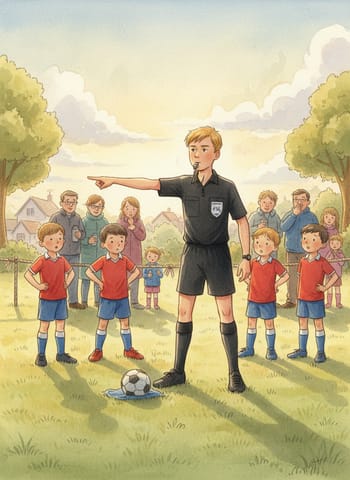
In the eighty-ninth minute, Clemens is standing exactly where a referee should be, near the edge of the penalty area. Then the defender's boot catches the striker's ankle. The striker falls. The sound of the contact is small, but it carries.
The score is one-all. The home supporters, gathered along the fence with flasks of tea, go quiet for half a second and then explode into shouting. The home team is coached by Clemens's uncle.
Clemens is sixteen. He has been refereeing under-fifteen games for a year, mostly on Saturday mornings, for a small fee and a free sandwich. His whistle hangs from a red lanyard. It was a birthday present, and his uncle gave it to him.
He learned the rules in his uncle's garden, using two jackets as goalposts. "Whatever the rule book says," his uncle told him once, "the game only works if someone is willing to be disliked." Clemens had thought it was a joke.
Now the striker looks up at him from the grass. Clemens replays the moment in his head. The defender never touched the ball. If it had been a closer call, he could have waved play on and nobody would have blamed him. But it wasn't close.
Along the touchline, his uncle has stopped moving. He doesn't shout. He just stands with his hands on his hips, looking at Clemens the way he looks at a puzzle he already knows the answer to.
Clemens blows the whistle and points to the spot. The noise is immediate. A parent calls him a disgrace. One of the players says that he must be joking.
"It was a foul," Clemens says, quietly, to nobody in particular. His voice shakes, although his arm does not.
The penalty is taken in a silence so complete that he can hear the net move. The ball goes in. Two minutes later the final whistle blows, and Clemens shakes hands with both captains and collects his sandwich.
He thinks about cycling past his uncle's house on the way home, and then thinks better of it. On Saturdays the whole family eats at his grandmother's table, and excuses are not accepted.
The soup is served. Nobody mentions the match. His cousin stares into her bowl as if there might be a message at the bottom of it. His uncle eats slowly, wipes his mouth and puts down his spoon.
"You were in the right place," he says at last. "Better placed than I would have been."
Clemens nods. He doesn't trust himself to say anything.
His uncle pushes the dish of potatoes across the table. "Eat, referee," he says. "You look like you've been running all day."