The Waiting Room
Una historia gratuita en inglés de nivel C1 para estudiantes, para leer en línea en 3 idiomas, con opción de escucharla en la app gratuita Storyteller.
Waiting alone while his girlfriend undergoes a medical scan, Felix realizes how long he has been postponing a conversation about their future and decides not to wait any longer to say it.
¡Ese fue el avance! Escucha la historia completa en la app gratuita Storyteller. Descargar la app
El audio no está disponible en este momento.
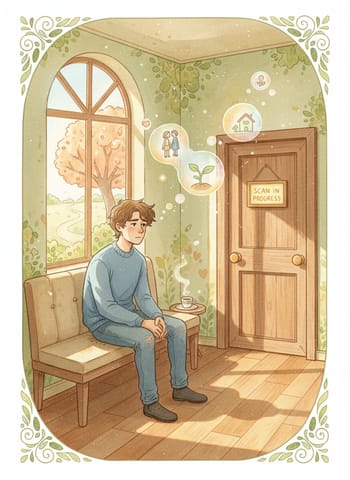
Nadia had been in the imaging room for forty minutes. That left Felix alone with a waiting-room chair, a muted television running a home-renovation show neither of them would ever watch, and roughly two years of things he had never gotten around to saying. They had been together long enough that "together" had started to feel like an insufficient word for it. They had also been together short enough, apparently, that he had convinced himself there was no urgency in finding a better one.
Nadia había estado en la sala de imágenes durante cuarenta minutos. Eso dejó a Felix solo con una silla de sala de espera, un televisor silenciado transmitiendo un programa de renovación de casas que ninguno de los dos vería jamás, y aproximadamente dos años de cosas que nunca se había animado a decir. Habían estado juntos el tiempo suficiente como para que "juntos" hubiera empezado a sentirse como una palabra insuficiente para describirlo. También habían estado juntos el tiempo suficientemente corto, al parecer, como para que él se hubiera convencido de que no había urgencia en encontrar una mejor palabra.
The referral had used the phrase "just to rule things out," which he understood, intellectually, to be the reassuring version of the sentence. It hadn't stopped him from spending the drive over doing the specific, useless arithmetic of a person imagining a future collapsing before there was any evidence it needed to.
La derivación médica había usado la frase "solo para descartar cosas", que él entendía, intelectualmente, como la versión tranquilizadora de la frase. Eso no le había impedido pasar todo el viaje en auto haciendo la aritmética específica e inútil de una persona que imagina un futuro derrumbándose antes de que hubiera alguna evidencia de que necesitara hacerlo.
What struck him most, sitting there, was not fear exactly — it was the sudden, unwelcome clarity of realizing how much he had been treating their relationship as a draft. Somewhere in the last two years he had begun thinking of the conversation about moving in together as a thing to have eventually. It would happen once his lease ended, once work settled down, once some vague and endlessly renewable "once" had finally arrived. Had he actually believed they had unlimited time, he supposed that postponing might have made some sense. Sitting in a plastic chair under fluorescent light, he no longer believed anything of the kind. Not once, in two years, had he actually said any of this to her plainly.
Lo que más le impactó, sentado ahí, no fue exactamente el miedo: fue la claridad repentina e indeseada de darse cuenta de cuánto había estado tratando su relación como un borrador. En algún momento de los últimos dos años, había empezado a pensar en la conversación sobre vivir juntos como algo que tendrían eventualmente. Sucedería una vez que terminara su contrato de alquiler, una vez que el trabajo se calmara, una vez que algún vago e infinitamente renovable "una vez" finalmente llegara. Si de verdad hubiera creído que tenían tiempo ilimitado, suponía que posponerlo habría tenido algún sentido. Sentado en una silla de plástico bajo luz fluorescente, ya no creía nada de eso. Ni una sola vez, en dos años, se lo había dicho a ella claramente.
She came out paler than she'd gone in, though she managed a small, tired smile before he could ask. "They want a follow-up scan next week. Probably nothing. The doctor used the word 'probably' four separate times, which either means she's very confident or very careful."
Ella salió más pálida de lo que había entrado, aunque logró una pequeña sonrisa cansada antes de que él pudiera preguntar. «Quieren una ecografía de seguimiento la próxima semana. Probablemente no sea nada. La doctora usó la palabra "probablemente" cuatro veces distintas, lo cual significa que está muy segura o que es muy cuidadosa».
"Which do you think it is?"
«¿Cuál crees que es?»
"I think it's a doctor covering herself. I try not to read too much into doctors' adverbs."
«Creo que es una doctora cubriéndose las espaldas. Trato de no darle demasiadas vueltas a los adverbios de los doctores».
He laughed, more from relief at her voice sounding like her own than at the joke itself. Then, before he could wait for a better moment — a nicer restaurant, a calmer week, some more cinematic version of this exact sentence — he said the thing he'd been rehearsing for two years.
Él se rió, más por el alivio de escuchar que su voz sonaba como ella misma que por el chiste en sí. Luego, antes de poder esperar un momento mejor —un restaurante más agradable, una semana más tranquila, alguna versión más cinematográfica de esta misma frase—, dijo lo que había estado ensayando durante dos años.
"I want us to actually live together. Not eventually. Not once my lease ends. I don't want to keep treating this like something we're still deciding on."
«Quiero que de verdad vivamos juntos. No eventualmente. No cuando termine mi contrato de alquiler. No quiero seguir tratando esto como algo que todavía estamos decidiendo».
Nadia looked at him for a long moment, in a waiting room that was, by any reasonable standard, an almost comically unromantic place to say something like that. "You're doing this now? In a room that smells like hand sanitizer?"
Nadia lo miró durante un largo momento, en una sala de espera que, según cualquier estándar razonable, era un lugar casi cómicamente poco romántico para decir algo así. «¿Vas a hacer esto ahora? ¿En una sala que huele a desinfectante de manos?»
"I don't think I trusted myself to do it anywhere nicer. I'd have found a reason to wait."
«Creo que no confiaba en mí mismo para hacerlo en ningún lugar más agradable. Habría encontrado una razón para esperar».
"Ask me again next week," she said, "once we actually know something." Then, quieter: "But don't wait longer than that."
«Pregúntame otra vez la próxima semana», dijo ella, «cuando de verdad sepamos algo». Luego, más bajo: «Pero no esperes más que eso».