The Last Box in the Apartment
Una historia gratuita en inglés de nivel C1 para estudiantes, para leer en línea en 4 idiomas, con opción de escucharla en la app gratuita Storyteller.
Over one weekend, a couple who have parted on good terms divide their shared apartment and find that the smallest things are the hardest to split.
¡Ese fue el avance! Escucha la historia completa en la app gratuita Storyteller. Descargar la app
El audio no está disponible en este momento.
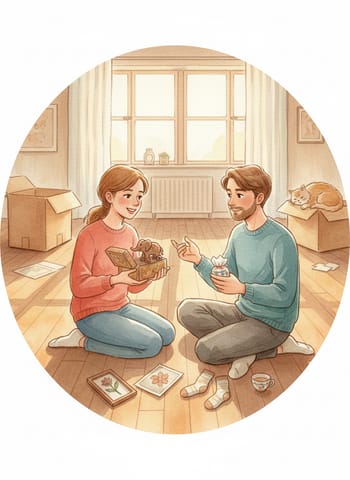
By Saturday noon the apartment has been divided so politely that it feels like a negotiation conducted by people who have never raised their voices. Teresa gets the bookshelves; he gets the stereo. She keeps the good frying pan, he takes the better knives, and the arrangement, announced over takeaway dumplings on Friday night, was so reasonable that neither of them admitted how much it hurt. They parted in March, without villains, which turns out to be the harder thing to pack.
Hacia el mediodía del sábado, el apartamento ha sido repartido con tanta cortesía que parece una negociación llevada por gente que nunca ha levantado la voz. Teresa se queda con las estanterías; él, con el equipo de música. Ella conserva la buena sartén, él se lleva los mejores cuchillos, y el arreglo, anunciado el viernes por la noche entre dumplings de comida para llevar, fue tan razonable que ninguno de los dos admitió cuánto dolía. Se separaron en marzo, sin villanos, lo que resulta ser lo más difícil de empacar.
The objects are not the problem; the sentences attached to them are. "That was your aunt's." "No, she gave it to both of us." The blue lamp, which they bought at a market in the rain after haggling for twenty minutes over a price neither can now remember, goes to him because he works late. The plant, which has survived four moves and a winter of neglect, goes to her because it has always leaned toward her side of the window. Taping the first boxes, Teresa notices that the labels alternate between her handwriting and his, as though they were still a single household being sent somewhere.
Los objetos no son el problema; lo son las frases que se les pegan. «Eso era de tu tía». «No, nos lo regaló a los dos». La lámpara azul, que compraron en un mercado bajo la lluvia tras regatear veinte minutos por un precio que ninguno recuerda ya, es para él porque trabaja hasta tarde. La planta, que ha sobrevivido a cuatro mudanzas y a un invierno de abandono, es para ella porque siempre se ha inclinado hacia su lado de la ventana. Al sellar las primeras cajas, Teresa nota que las etiquetas alternan entre su letra y la de él, como si aún fueran un solo hogar al que se despacha hacia alguna parte.
By Sunday afternoon the rooms have the faintly hollow sound of a place already left, and every voice comes out like an announcement. Only the kitchen drawer remains, the one everybody has and nobody can sort. It holds batteries of uncertain charge, string, a corkscrew, six menus from restaurants that have since closed, and a photo-booth strip of two people trying not to laugh. What Teresa had not expected was that this would be the hardest part. A drawer like that has no owner. It is simply what two people accumulate when they are not paying attention, and nobody ever decided it should be kept. Only now does Teresa see how much of a life is stored in places like this.
Hacia la tarde del domingo las habitaciones tienen el sonido ligeramente hueco de un lugar ya abandonado, y cada voz sale como un anuncio. Solo queda el cajón de la cocina, ese que todo el mundo tiene y nadie puede ordenar. Contiene pilas de carga incierta, cordel, un sacacorchos, seis cartas de restaurantes que han cerrado desde entonces y una tira de fotomatón con dos personas tratando de no reírse. Lo que Teresa no había esperado era que esta fuera la parte más difícil. Un cajón así no tiene dueño. Es simplemente lo que acumulan dos personas cuando no prestan atención, y nadie decidió jamás que debiera conservarse. Solo ahora ve Teresa cuánto de una vida se guarda en lugares como este.
He lifts out the strip and holds it at arm's length. "Do you want this?"
Él saca la tira y la sostiene a distancia de brazo. «¿La quieres?»
"I assumed you did," Teresa says.
«Supuse que tú sí», dice Teresa.
"That's what I assumed about you," he says, and they both laugh, a short, unconvincing sound. For a moment they stand there holding the question between them like a hot dish. Had they quarrelled, Teresa thinks, this would have been easy: one of them would have stormed out with the pictures, and the other would have thrown out the rest. Instead there is only the afternoon light, and the strip, and the politeness, which has begun to feel like a kind of weather.
«Eso supuse yo de ti», dice él, y ambos ríen, un sonido breve y poco convincente. Por un momento se quedan ahí sosteniendo la pregunta entre los dos como un plato caliente. Si se hubieran peleado, piensa Teresa, esto habría sido fácil: uno de los dos se habría marchado furioso con las fotos, y el otro habría tirado el resto. En cambio solo hay la luz de la tarde, y la tira, y la cortesía, que ha empezado a sentirse como una especie de clima.
In the end they cut the strip in two with the kitchen scissors, the last object in the apartment that nobody has claimed. Two frames each. His half has the frame where they are laughing; hers has the one where they are not, which is, she thinks, the more accurate picture and not the one she would have chosen. At the bottom of the drawer there is also a small brass key that neither of them can identify. They try it in the front door, the balcony door, the bicycle lock. It fits nothing.
Al final cortan la tira en dos con las tijeras de la cocina, el último objeto del apartamento que nadie ha reclamado. Dos cuadros cada uno. La mitad de él tiene el cuadro en que se ríen; la de ella, aquel en que no, que es, piensa, el retrato más fiel y no el que habría escogido. En el fondo del cajón hay también una llavecita de latón que ninguno de los dos sabe identificar. La prueban en la puerta de entrada, en la del balcón, en el candado de la bicicleta. No encaja en nada.
"Yours," he says, "since you'll go on wondering."
«Tuya», dice él, «ya que vas a seguir preguntándote».
"Mine," she agrees.
«Mía», concede ella.
She tapes the last box, writes nothing on it, and carries it down to the car. On the stairs she threads the key onto her own ring, between the apartment key she must hand back tonight and the one for her office, where it hangs, small and brass, opening nothing yet.
Sella la última caja, no escribe nada en ella y la lleva abajo, al coche. En la escalera enhebra la llave en su propio llavero, entre la del apartamento que debe devolver esta noche y la de su oficina, donde cuelga, pequeña y de latón, sin abrir todavía nada.