The Last Box in the Apartment
一个面向英语学习者的免费 C1 级英语故事,可用 7 种语言在线阅读,也可以在免费的 Storyteller 应用中收听。
Over one weekend, a couple who have parted on good terms divide their shared apartment and find that the smallest things are the hardest to split.
试听结束!在免费的 Storyteller 应用中收听完整故事。 下载应用
音频暂时无法播放。
By Saturday noon the apartment has been divided so politely that it feels like a negotiation conducted by people who have never raised their voices. Teresa gets the bookshelves; he gets the stereo. She keeps the good frying pan, he takes the better knives, and the arrangement, announced over takeaway dumplings on Friday night, was so reasonable that neither of them admitted how much it hurt. They parted in March, without villains, which turns out to be the harder thing to pack.
到周六中午,这套公寓已经被分得如此客气,感觉就像一场由从未提高过嗓门的人进行的谈判。特蕾莎得到书架;他得到音响。她留下好用的平底锅,他拿走更好的刀具,这个安排是周五晚上边吃外卖饺子边宣布的,合理得让两人都不肯承认它有多伤人。他们在三月分了手,没有谁是坏人,事实证明,这才是更难打包的东西。
The objects are not the problem; the sentences attached to them are. "That was your aunt's." "No, she gave it to both of us." The blue lamp, which they bought at a market in the rain after haggling for twenty minutes over a price neither can now remember, goes to him because he works late. The plant, which has survived four moves and a winter of neglect, goes to her because it has always leaned toward her side of the window. Taping the first boxes, Teresa notices that the labels alternate between her handwriting and his, as though they were still a single household being sent somewhere.
物品本身不是问题;问题是附在它们身上的话。“那是你姑妈的。”“不,她是送给我们俩的。”那盏蓝色的台灯,是他们在雨中的一个集市上买的,为一个现在谁也想不起来的价格讨价还价了二十分钟,因为他工作到很晚,所以归他。那盆植物,熬过了四次搬家和一个被忽视的冬天,归她,因为它一直朝着窗边她那一侧倾斜。贴第一批箱子的封条时,特蕾莎注意到,标签上的字迹在她的和他的之间交替出现,仿佛他们仍然是一个要被送往某处的家。
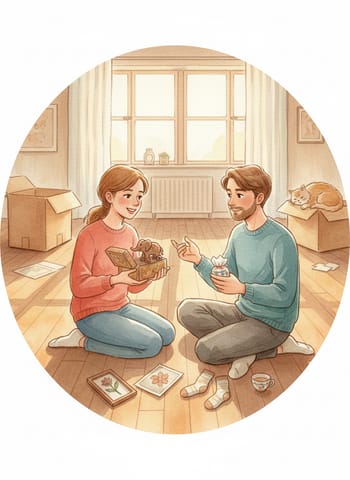
By Sunday afternoon the rooms have the faintly hollow sound of a place already left, and every voice comes out like an announcement. Only the kitchen drawer remains, the one everybody has and nobody can sort. It holds batteries of uncertain charge, string, a corkscrew, six menus from restaurants that have since closed, and a photo-booth strip of two people trying not to laugh. What Teresa had not expected was that this would be the hardest part. A drawer like that has no owner. It is simply what two people accumulate when they are not paying attention, and nobody ever decided it should be kept. Only now does Teresa see how much of a life is stored in places like this.
到周日下午,各个房间有了一种隐约空洞的回声,像是一个已经离开的地方,每个人的声音出口都像一则通告。只剩下厨房的抽屉了,就是那种人人都有、却没人能整理好的抽屉。里面有电量不明的电池、细绳、一只开瓶器、六份已经倒闭的餐厅的菜单,还有一条照相亭里拍的相纸条,上面是两个努力憋着不笑的人。特蕾莎没有想到,这会是最难的部分。这样的抽屉没有主人。它只是两个人在不留神时积攒下来的东西,从没有人决定过它应该被留下。直到现在,特蕾莎才看到,一个人生中有多少东西就存放在这样的地方。
He lifts out the strip and holds it at arm's length. "Do you want this?"
他把那条相纸取出来,伸直手臂拿着。“你想要这个吗?”
"I assumed you did," Teresa says.
“我以为你想要。”特蕾莎说。
"That's what I assumed about you," he says, and they both laugh, a short, unconvincing sound. For a moment they stand there holding the question between them like a hot dish. Had they quarrelled, Teresa thinks, this would have been easy: one of them would have stormed out with the pictures, and the other would have thrown out the rest. Instead there is only the afternoon light, and the strip, and the politeness, which has begun to feel like a kind of weather.
“我对你也是这么以为的。”他说,两人都笑了,那是一声短促而不太有说服力的声音。有那么一会儿,他们站在那里,把这个问题像一盘烫手的菜一样捧在两人之间。特蕾莎想,要是他们吵过架,这事就容易了:一个人会怒气冲冲地带着照片走掉,另一个会把剩下的全扔掉。可眼下只有午后的光线、那条相纸,以及那份客气,它已经开始像一种天气了。
In the end they cut the strip in two with the kitchen scissors, the last object in the apartment that nobody has claimed. Two frames each. His half has the frame where they are laughing; hers has the one where they are not, which is, she thinks, the more accurate picture and not the one she would have chosen. At the bottom of the drawer there is also a small brass key that neither of them can identify. They try it in the front door, the balcony door, the bicycle lock. It fits nothing.
最后,他们用厨房的剪刀把相纸条剪成了两半,这是公寓里最后一件没人认领的东西。每人两格。他那一半有他们在笑的那一格;她那一半有他们没笑的那一格,她想,那是更准确的画面,却不是她会选的那一张。抽屉的最底下还有一把小小的黄铜钥匙,两个人都认不出它是干什么的。他们试了试大门、阳台门、自行车锁。哪里都不合。
"Yours," he says, "since you'll go on wondering."
“归你,”他说,“因为你会一直琢磨它。”
"Mine," she agrees.
“归我。”她同意了。
She tapes the last box, writes nothing on it, and carries it down to the car. On the stairs she threads the key onto her own ring, between the apartment key she must hand back tonight and the one for her office, where it hangs, small and brass, opening nothing yet.
她给最后一只箱子贴上封条,什么也没写,把它搬下楼,放进车里。在楼梯上,她把那把钥匙穿到自己的钥匙圈上,夹在今晚必须交还的公寓钥匙和办公室钥匙之间,它在那里挂着,小小的,黄铜色,暂时还什么也打不开。