The Last Box in the Apartment
Cerita bahasa Inggris gratis level C1 untuk pelajar, bisa dibaca online dalam 5 bahasa, dengan pilihan untuk mendengarkannya di aplikasi Storyteller gratis.
Over one weekend, a couple who have parted on good terms divide their shared apartment and find that the smallest things are the hardest to split.
Itu cuplikannya! Dengarkan cerita lengkapnya di aplikasi Storyteller gratis. Unduh aplikasi
Audio belum tersedia saat ini.
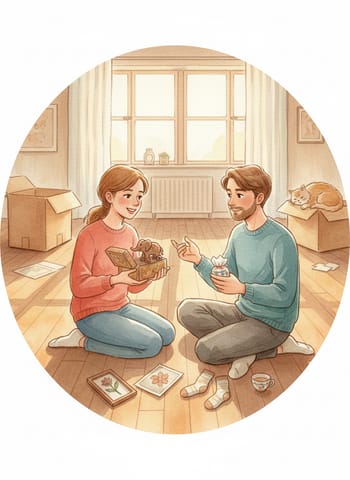
By Saturday noon the apartment has been divided so politely that it feels like a negotiation conducted by people who have never raised their voices. Teresa gets the bookshelves; he gets the stereo. She keeps the good frying pan, he takes the better knives, and the arrangement, announced over takeaway dumplings on Friday night, was so reasonable that neither of them admitted how much it hurt. They parted in March, without villains, which turns out to be the harder thing to pack.
Pada Sabtu siang, apartemen itu sudah dibagi dengan begitu sopan sehingga terasa seperti perundingan yang dilakukan orang-orang yang tak pernah meninggikan suara. Teresa mendapat rak buku; ia mendapat stereo. Teresa menyimpan wajan yang bagus, ia mengambil pisau-pisau yang lebih baik, dan pengaturan itu, diumumkan sambil makan pangsit bawa pulang pada Jumat malam, begitu masuk akal sehingga tak satu pun dari mereka mengakui betapa sakitnya. Mereka berpisah pada bulan Maret, tanpa penjahat, yang ternyata lebih sulit dikemas.
The objects are not the problem; the sentences attached to them are. "That was your aunt's." "No, she gave it to both of us." The blue lamp, which they bought at a market in the rain after haggling for twenty minutes over a price neither can now remember, goes to him because he works late. The plant, which has survived four moves and a winter of neglect, goes to her because it has always leaned toward her side of the window. Taping the first boxes, Teresa notices that the labels alternate between her handwriting and his, as though they were still a single household being sent somewhere.
Bukan barang-barangnya yang menjadi masalah; melainkan kalimat-kalimat yang menempel padanya. "Itu milik bibimu." "Bukan, dia memberikannya untuk kita berdua." Lampu biru, yang mereka beli di sebuah pasar saat hujan setelah menawar dua puluh menit untuk harga yang kini tak bisa diingat siapa pun, jatuh ke tangannya karena ia bekerja larut. Tanaman itu, yang telah selamat dari empat kali pindahan dan satu musim dingin penelantaran, jatuh ke tangan Teresa karena sejak dulu selalu condong ke sisi jendelanya. Sambil melakban kardus-kardus pertama, Teresa memperhatikan bahwa label-labelnya bergantian antara tulisan tangannya dan tulisan tangan pria itu, seakan mereka masih satu rumah tangga yang sedang dikirim ke suatu tempat.
By Sunday afternoon the rooms have the faintly hollow sound of a place already left, and every voice comes out like an announcement. Only the kitchen drawer remains, the one everybody has and nobody can sort. It holds batteries of uncertain charge, string, a corkscrew, six menus from restaurants that have since closed, and a photo-booth strip of two people trying not to laugh. What Teresa had not expected was that this would be the hardest part. A drawer like that has no owner. It is simply what two people accumulate when they are not paying attention, and nobody ever decided it should be kept. Only now does Teresa see how much of a life is stored in places like this.
Pada Minggu sore, ruangan-ruangan itu bergema hampa, seperti tempat yang sudah ditinggalkan, dan setiap suara terdengar seperti pengumuman. Tinggal laci dapur yang tersisa, laci yang dimiliki semua orang dan tak bisa dipilah siapa pun. Isinya baterai yang entah masih berdaya, seutas tali, sebuah pembuka botol, enam menu dari restoran yang kini sudah tutup, dan sehelai strip foto kotak foto dua orang yang berusaha menahan tawa. Yang tak Teresa duga adalah bahwa inilah bagian tersulit. Laci seperti itu tak punya pemilik. Isinya hanyalah apa yang terkumpul ketika dua orang tidak sedang memperhatikan, dan tak seorang pun pernah memutuskan bahwa isinya harus disimpan. Baru sekarang Teresa melihat betapa banyak kehidupan tersimpan di tempat-tempat seperti ini.
He lifts out the strip and holds it at arm's length. "Do you want this?"
Pria itu mengangkat strip tersebut dan memegangnya sejauh lengan. "Kau mau ini?"
"I assumed you did," Teresa says.
"Kukira kamu yang mau," kata Teresa.
"That's what I assumed about you," he says, and they both laugh, a short, unconvincing sound. For a moment they stand there holding the question between them like a hot dish. Had they quarrelled, Teresa thinks, this would have been easy: one of them would have stormed out with the pictures, and the other would have thrown out the rest. Instead there is only the afternoon light, and the strip, and the politeness, which has begun to feel like a kind of weather.
"Aku juga mengira begitu tentangmu," katanya, dan keduanya tertawa, bunyi singkat yang tidak meyakinkan. Sejenak mereka berdiri di sana, memegang pertanyaan itu di antara mereka seperti hidangan panas. Seandainya mereka bertengkar, pikir Teresa, ini akan mudah: salah satu akan pergi dengan marah membawa foto-foto itu, dan yang lain akan membuang sisanya. Alih-alih, yang ada hanya cahaya sore, strip foto itu, dan kesopanan, yang mulai terasa seperti semacam cuaca.
In the end they cut the strip in two with the kitchen scissors, the last object in the apartment that nobody has claimed. Two frames each. His half has the frame where they are laughing; hers has the one where they are not, which is, she thinks, the more accurate picture and not the one she would have chosen. At the bottom of the drawer there is also a small brass key that neither of them can identify. They try it in the front door, the balcony door, the bicycle lock. It fits nothing.
Akhirnya mereka memotong strip itu menjadi dua dengan gunting dapur, benda terakhir di apartemen yang belum diklaim siapa pun. Dua bingkai untuk masing-masing. Bagian miliknya memuat bingkai ketika mereka tertawa; bagian milik Teresa memuat yang ketika mereka tidak, yang menurutnya gambaran lebih akurat dan bukan yang akan ia pilih. Di dasar laci itu ada pula sebuah kunci kuningan kecil yang tak bisa dikenali keduanya. Mereka mencobanya di pintu depan, pintu balkon, gembok sepeda. Tak ada yang cocok.
"Yours," he says, "since you'll go on wondering."
"Untukmu," katanya, "karena kau akan terus bertanya-tanya."
"Mine," she agrees.
"Untukku," Teresa setuju.
She tapes the last box, writes nothing on it, and carries it down to the car. On the stairs she threads the key onto her own ring, between the apartment key she must hand back tonight and the one for her office, where it hangs, small and brass, opening nothing yet.
Ia melakban kardus terakhir, tidak menulis apa pun di atasnya, dan membawanya turun ke mobil. Di tangga ia menyelipkan kunci itu ke gantungan kuncinya sendiri, di antara kunci apartemen yang harus ia kembalikan malam ini dan kunci kantornya, tempat kunci itu tergantung, kecil dan kuning, belum membuka apa pun.