The Question on the Roof
Una historia gratuita en inglés de nivel A2 para estudiantes, para leer en línea en 7 idiomas, con opción de escucharla en la app gratuita Storyteller.
When a kite escapes, Willa finally asks the girl on the sidelines why she never plays.
¡Ese fue el avance! Escucha la historia completa en la app gratuita Storyteller. Descargar la app
El audio no está disponible en este momento.
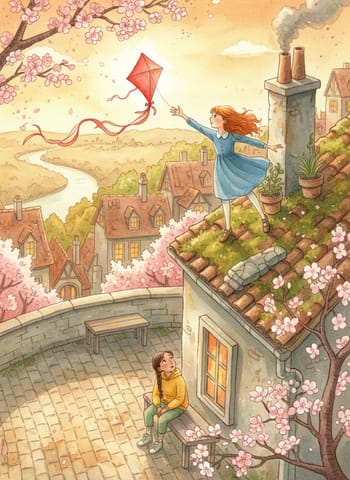
The kite string snaps with a small, sharp sound. Kira feels the pull in her hand go slack. Above her, the yellow kite wobbles once and drifts away.
El hilo del papalote se corta con un sonido pequeño y seco. Kira siente que el tirón en su mano se afloja. Sobre ella, el papalote amarillo se tambalea una vez y se aleja a la deriva.
"No," she whispers.
«No», susurra.
Willa sees it from the other end of the court. She drops the ball. The kite sails over the edge of the roof. It crosses the street.
Willa lo ve desde el otro extremo de la cancha. Suelta la pelota. El papalote pasa sobre el borde de la azotea. Cruza la calle.
"Stay there!" she shouts. She does not know if she means Kira or the kite.
«¡Quédate ahí!», grita. No sabe si se lo dice a Kira o al papalote.
The basketball court sits on top of an old parking building. A high fence runs around it. Every afternoon, a dozen teenagers come up the stairs to play. They play until the lights in the street come on.
La cancha de baloncesto está sobre un viejo edificio de estacionamiento. Una alta reja la rodea. Cada tarde, una docena de adolescentes suben las escaleras para jugar. Juegan hasta que se encienden las luces de la calle.
Kira comes too, but she never plays. She sits on a crate by the fence and flies her kite. It is a big yellow kite with a long blue tail. She holds the string with both hands. She watches the kite over the roofs.
Kira también viene, pero nunca juega. Se sienta en un cajón junto a la reja y vuela su papalote. Es un papalote amarillo grande con una larga cola azul. Sostiene el hilo con las dos manos. Mira el papalote por encima de los tejados.
Nobody asks her why. Everybody knows her name. Everybody knows she is Willa's neighbor. But when the boys choose sides, nobody says her name. She never asks to join.
Nadie le pregunta por qué. Todos saben su nombre. Todos saben que es vecina de Willa. Pero cuando los chicos eligen equipos, nadie dice su nombre. Ella nunca pide unirse.
For a month, Willa sees this and says nothing. It never seems the right time.
Durante un mes, Willa ve esto y no dice nada. Nunca parece el momento adecuado.
Now the kite is gone, and the right time is here.
Ahora el papalote se ha ido, y el momento adecuado ha llegado.
Willa runs to the stairs. She takes them two at a time. At the bottom, she turns left and sprints along the street. The kite floats ahead of her, small and bright against the sky. It dips over a row of flat roofs.
Willa corre hacia las escaleras. Las baja de dos en dos. Abajo, gira a la izquierda y corre a toda velocidad por la calle. El papalote flota delante de ella, pequeño y brillante contra el cielo. Se hunde sobre una hilera de techos planos.
"It lands on the shoe shop roof!" shouts a boy from the fence. He climbs up to watch.
«¡Aterriza en el techo de la zapatería!», grita un chico desde la reja. Se sube para mirar.
Willa does not answer. She knows the shoe shop roof. It is flat and wide. A low wall joins it to the old school. She cuts through a side door. She climbs a metal ladder. She comes out onto the roof, and her lungs burn.
Willa no responde. Conoce el techo de la zapatería. Es plano y ancho. Un muro bajo lo une con la vieja escuela. Se cuela por una puerta lateral. Sube por una escalera de metal. Sale al techo, y los pulmones le arden.
The kite lies on the tar. Its tail lies in the dust. One wing is bent, but it is whole.
El papalote yace sobre el alquitrán. Su cola está en el polvo. Una ala está doblada, pero está entero.
Willa picks it up. She hears steps behind her. Kira climbs over the top of the ladder, out of breath.
Willa lo levanta. Oye pasos detrás de ella. Kira pasa por encima del final de la escalera, sin aliento.
"You ran," says Kira.
«Corriste», dice Kira.
"You looked sad," says Willa.
«Te veías triste», dice Willa.
"I was not sad," says Kira. Then she looks at the kite. "I was a little sad."
«No estaba triste», dice Kira. Luego mira el papalote. «Estaba un poco triste».
Willa holds it out. Kira takes it and runs her thumb along the bent stick. She bends it back with a soft click.
Willa se lo extiende. Kira lo toma y pasa el pulgar por la varilla doblada. La endereza con un suave clic.
"My brother made it," she says. "He lives far away now. He sends me a new kite every year. This is the one from last year."
«Lo hizo mi hermano», dice. «Ahora vive lejos. Me manda un papalote nuevo cada año. Este es el del año pasado».
"I am sorry," says Willa.
«Lo siento», dice Willa.
"It is okay. I can fix the string." Kira sits on a low wall in the middle of the roof. Willa sits next to her. Far below, the street is full of cars and people. The sun is low and golden.
«Está bien. Puedo arreglar el hilo». Kira se sienta en un muro bajo en medio del techo. Willa se sienta a su lado. Muy abajo, la calle está llena de autos y gente. El sol está bajo y dorado.
Willa watches Kira tie a knot in the string. Her fingers are quick and sure. She makes the knot in three seconds.
Willa mira a Kira hacer un nudo en el hilo. Sus dedos son rápidos y seguros. Hace el nudo en tres segundos.
"Can I ask you something?" says Willa.
«¿Puedo preguntarte algo?», dice Willa.
"You just did," says Kira.
«Acabas de hacerlo», dice Kira.
"A real question."
«Una pregunta de verdad».
Kira shrugs. "Okay."
Kira se encoge de hombros. «Está bien».
Willa takes a deep breath. She practices this in her head every night. The words feel heavier now.
Willa respira hondo. Ensaya esto en su cabeza todas las noches. Las palabras pesan más ahora.
"Why do you never play?" she asks.
«¿Por qué nunca juegas?», pregunta.
Kira's hands stop. For a moment, she says nothing. A pigeon walks along the wall and looks at them.
Las manos de Kira se detienen. Por un momento, no dice nada. Una paloma camina por el muro y los mira.
"The boys never choose me," says Kira at last.
«Los chicos nunca me eligen», dice Kira por fin.
"You never ask."
«Tú nunca pides».
"I know." Kira looks at her shoes. "I am not good. I played once at school. I lost the ball three times. I think they will say no. So I do not ask."
«Lo sé». Kira se mira los zapatos. «No soy buena. Jugué una vez en la escuela. Perdí la pelota tres veces. Creo que dirán que no. Así que no pido».
Willa thinks about this. It makes sense, and it makes her a little angry.
Willa piensa en esto. Tiene sentido, y la enoja un poco.
"That is a silly plan," she says.
«Ese es un plan tonto», dice.
"It is a safe plan."
«Es un plan seguro».
"It is a lonely plan. You sit by the fence every day. And I never say anything either." Willa pulls her knees up. "For a month, I wanted to ask. I was afraid of your no."
«Es un plan solitario. Te sientas junto a la reja todos los días. Y yo tampoco digo nada nunca». Willa recoge las rodillas. «Durante un mes quise preguntarte. Tenía miedo de tu no».
Kira looks at her, surprised. "You were afraid of me?"
Kira la mira, sorprendida. «¿Me tenías miedo?».
"A little," says Willa. "You are very good at looking like you do not need anyone."
«Un poco», dice Willa. «Eres muy buena para parecer que no necesitas a nadie».
Kira laughs. It is a short, quiet laugh, but it is real. The pigeon flies off.
Kira se ríe. Es una risa corta y callada, pero es de verdad. La paloma se va volando.
"I am not good at basketball," says Kira. "Really."
«No soy buena para el baloncesto», dice Kira. «De verdad».
"Nobody is good at the start," says Willa. "I could not make a basket for a year. Ask anyone."
«Nadie es bueno al principio», dice Willa. «Yo no pude meter una canasta en un año. Pregúntale a cualquiera».
"A year?"
«¿Un año?».
"Eleven months. But I counted the days."
«Once meses. Pero conté los días».
They both laugh now. The sun slides lower. Somewhere down the street, a bell rings. The lights come on one by one.
Ahora se ríen las dos. El sol se desliza más abajo. En algún lugar de la calle, suena una campana. Las luces se encienden una por una.
Kira ties the last knot. She holds up the kite, and the string is whole again. She looks at it for a long time.
Kira ata el último nudo. Levanta el papalote, y el hilo está entero otra vez. Lo mira durante un buen rato.
"I can fly this later," she says. "It will wait."
«Puedo volarlo después», dice. «Esperará».
She stands up. She puts the kite under a stone.
Se pone de pie. Pone el papalote bajo una piedra.
"I will keep it safe," says Willa.
«Lo cuidaré», dice Willa.
Then Kira holds out a hand to help Willa up.
Entonces Kira extiende una mano para ayudar a Willa a levantarse.
They climb down the ladder and walk back to the court. The boys stand in the middle with the ball. They look up when the two girls come through the gate.
Bajan por la escalera y caminan de vuelta a la cancha. Los chicos están en el medio con la pelota. Levantan la vista cuando las dos chicas cruzan la reja.
Willa stops in front of them. She waits for Kira to stand beside her.
Willa se detiene frente a ellos. Espera a que Kira se pare a su lado.
"Did you get the kite?" asks one of the boys.
«¿Consiguieron el papalote?», pregunta uno de los chicos.
"We got it," says Willa. "Kira wants to play. Who is on my side?"
«Lo conseguimos», dice Willa. «Kira quiere jugar. ¿Quién está de mi lado?».
Nobody speaks. Kira's shoulders go stiff. Then a tall boy shrugs and throws her the ball.
Nadie habla. Los hombros de Kira se ponen rígidos. Entonces un chico alto se encoge de hombros y le lanza la pelota.
Kira catches it. She looks at it in her hands.
Kira la atrapa. La mira en sus manos.
"I am really bad at this," she says.
«Soy malísima en esto», dice.
"So was I," says Willa. "Throw it to me."
«Yo también lo era», dice Willa. «Pásamela».