The Postcard Without a Street
Una historia gratuita en inglés de nivel A2 para estudiantes, para leer en línea en 7 idiomas, con opción de escucharla en la app gratuita Storyteller.
A campsite worker with careful English helps a guest find the missing address for her postcard.
¡Ese fue el avance! Escucha la historia completa en la app gratuita Storyteller. Descargar la app
El audio no está disponible en este momento.
Dov worked at the campsite shop for the summer. He sold ice, matches and fishing line. He also practiced his English on every guest.
Dov trabajaba en la tienda del campamento durante el verano. Vendía hielo, fósforos y hilo de pescar. También practicaba su inglés con cada huésped.
His English was slow and careful. Sometimes it was also very funny. He said, "I speak English like a duck with a dictionary." He did not smile.
Su inglés era lento y cuidadoso. A veces también era muy gracioso. Decía: «Hablo inglés como un pato con diccionario». No sonreía.
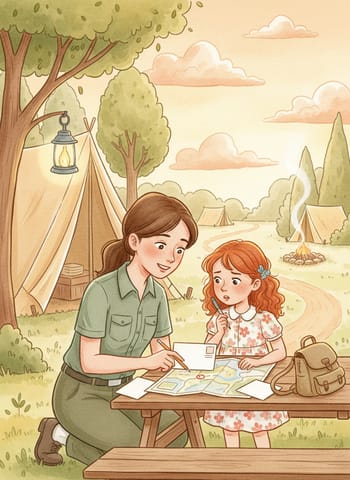
On a quiet morning, a woman came into the shop. Her name was Fenna. She had wet hair and a red nose. In her hand was a postcard.
Una mañana tranquila, una mujer entró en la tienda. Se llamaba Fenna. Tenía el pelo mojado y la nariz roja. En la mano llevaba una postal.
"Please help me," she said. "I need to send this card today. But I have a small problem."
«Por favor, ayúdame», dijo. «Necesito enviar esta tarjeta hoy. Pero tengo un pequeño problema».
"I like problems," said Dov. "They are good for my English."
«Me gustan los problemas», dijo Dov. «Son buenos para mi inglés».
Fenna put the card on the counter. On the front was a picture of the river. On the back was a long message in blue pen. It was funny and a little wild.
Fenna puso la tarjeta sobre el mostrador. Al frente había una foto del río. Atrás había un largo mensaje escrito con pluma azul. Era divertido y un poco descabellado.
"Dear sister," it said. "Happy birthday! Today I fell into a river. Not on purpose. A duck laughed at me."
«Querida hermana», decía. «¡Feliz cumpleaños! Hoy me caí a un río. No a propósito. Un pato se rio de mí».
"This is a good card," said Dov. "The duck is my favorite part."
«Es una buena tarjeta», dijo Dov. «Lo del pato es mi parte favorita».
"There is no address," said Fenna. "My sister moved to this country last month. I only know she lives in this town. My phone is dead, so I cannot look it up."
«No tiene dirección», dijo Fenna. «Mi hermana se mudó a este país el mes pasado. Solo sé que vive en este pueblo. Mi teléfono está sin batería, así que no puedo buscarla».
Dov looked at the card for a long time. "No address," he said. "This is a card for nobody."
Dov miró la tarjeta durante un buen rato. «Sin dirección», dijo. «Esta es una tarjeta para nadie».
"It is a card for my sister," said Fenna. "She just does not have a street."
«Es una tarjeta para mi hermana», dijo Fenna. «Solo que no tiene calle».
"What do you know about the house?" Dov asked. He took a pencil. He felt like a very serious police officer.
«¿Qué sabes de la casa?», preguntó Dov. Tomó un lápiz. Se sentía como un policía muy serio.
Fenna thought hard. "She told me three things on the phone," she said. "The gate is yellow. The door is the color of a lemon. And there is a goat."
Fenna pensó con esfuerzo. «Me dijo tres cosas por teléfono», dijo. «El portón es amarillo. La puerta es del color de un limón. Y hay una cabra».
"A goat?" Dov put down the pencil. "In the garden?"
«¿Una cabra?». Dov dejó el lápiz. «¿En el jardín?».
"In the garden. She says he is very famous."
«En el jardín. Dice que es muy famosa».
"Which goat?" said Dov. "This town has eleven goats. But only one very important goat."
«¿Cuál cabra?», dijo Dov. «Este pueblo tiene once cabras. Pero solo una cabra muy importante».
Fenna laughed. "How do you know which one is important?"
Fenna se rio. «¿Cómo sabes cuál es la importante?».
"Because he is on the town sign," said Dov. "And he eats paper."
«Porque está en el letrero del pueblo», dijo Dov. «Y come papel».
"He eats paper?"
«¿Come papel?».
"Only the white kind," said Dov. "The post lady gives him a carrot every day. Then he does not follow her."
«Solo del blanco», dijo Dov. «La cartera le da una zanahoria todos los días. Así no la sigue».
Fenna looked at the postcard in her hand. It was white. Her face became very serious.
Fenna miró la postal que tenía en la mano. Era blanca. Su rostro se puso muy serio.
"So I cannot just put it in that house's mailbox," she said.
«Entonces no puedo simplemente ponerla en el buzón de esa casa», dijo.
"The goat will read your message first," said Dov.
«La cabra leerá tu mensaje primero», dijo Dov.
They both laughed. A man came to buy ice. Dov gave him a bag and took his coins. The man left. Then Dov turned back to Fenna. He had a new look on his face.
Los dos se rieron. Un hombre vino a comprar hielo. Dov le dio una bolsa y recibió sus monedas. El hombre se fue. Luego Dov se volvió hacia Fenna. Tenía una expresión nueva en el rostro.
"The goat lives on Mill Road," he said. "I know it. It is near my school. The yellow gate belongs to a woman with a trumpet."
«La cabra vive en la calle Mill», dijo. «Lo sé. Queda cerca de mi escuela. El portón amarillo es de una mujer con una trompeta».
"My sister plays the trumpet," said Fenna slowly. "She says her new neighbors hate it."
«Mi hermana toca la trompeta», dijo Fenna despacio. «Dice que sus nuevos vecinos la odian».
"Then it is her house," said Dov. "No other house on Mill Road has a lemon door."
«Entonces esa es su casa», dijo Dov. «Ninguna otra casa de la calle Mill tiene una puerta de limón».
Fenna put both hands on the counter. "You just found my sister," she said. "With a goat."
Fenna puso las dos manos sobre el mostrador. «Acabas de encontrar a mi hermana», dijo. «Con una cabra».
"With a goat and a little English," said Dov. He looked proud.
«Con una cabra y un poco de inglés», dijo Dov. Se veía orgulloso.
"Now the card can go in the mail," said Fenna. "A birthday card must come in the mail. It is more fun."
«Ahora la tarjeta puede ir por correo», dijo Fenna. «Una tarjeta de cumpleaños tiene que llegar por correo. Es más divertido».
"I will write the address on the card," said Dov. "In my language. Then the post lady understands."
«Escribiré la dirección en la tarjeta», dijo Dov. «En mi idioma. Así la cartera entiende».
He took her pen. He wrote slowly, one letter at a time. First came the road, then the number, then the town. The number was fourteen. He knew it because it was painted on the gate.
Tomó su pluma. Escribió despacio, una letra a la vez. Primero la calle, luego el número, luego el pueblo. El número era catorce. Lo sabía porque estaba pintado en el portón.
"Is that all?" asked Fenna.
«¿Eso es todo?», preguntó Fenna.
"One more thing," said Dov. He wrote a few more words at the bottom of the card. "This says, 'Not for the goat.'"
«Una cosa más», dijo Dov. Escribió unas palabras más al pie de la tarjeta. «Esto dice: "No es para la cabra"».
Fenna laughed so hard that she had to hold the counter.
Fenna se rio tanto que tuvo que sujetarse del mostrador.
"We need a stamp," said Dov. "I have stamps in the drawer. Stamps are the only thing here that is not wet."
«Necesitamos un sello», dijo Dov. «Tengo sellos en el cajón. Los sellos son lo único de aquí que no está mojado».
He gave her a stamp. She put it on the corner of the card. Then she pressed it down.
Le dio un sello. Ella lo puso en la esquina de la tarjeta. Luego lo presionó.
"I owe you something," she said. "What can I give you?"
«Te debo algo», dijo. «¿Qué puedo darte?».
Dov thought. "Speak to me for ten minutes," he said. "Only English. Fast, like you always do. I want to hear it."
Dov pensó. «Háblame diez minutos», dijo. «Solo en inglés. Rápido, como siempre hablas. Quiero oírlo».
So Fenna talked. She told him about the river and the duck. Then she told him about her borrowed tent. She spoke fast and Dov listened with his whole face. Sometimes he did not understand. Then he asked, "What does 'borrow' mean?" She explained, and he wrote the word on his hand.
Así que Fenna habló. Le contó del río y del pato. Luego le contó de su tienda de campaña prestada. Hablaba rápido y Dov escuchaba con toda la cara. A veces no entendía. Entonces preguntaba: «¿Qué significa "borrow"?». Ella le explicaba, y él escribía la palabra en la mano.
When ten minutes ended, the sun was high. Fenna picked up the card.
Cuando terminaron los diez minutos, el sol estaba alto. Fenna recogió la tarjeta.
"The yellow mailbox is at the campsite gate," said Dov. "I walk with you."
«El buzón amarillo está en la entrada del campamento», dijo Dov. «Camino contigo».
They went out into the bright morning. The grass was warm. Near the river, a family played cards on a blanket. A small boat moved slowly along the far bank.
Salieron a la brillante mañana. El pasto estaba tibio. Cerca del río, una familia jugaba a las cartas sobre una manta. Un pequeño bote se movía lentamente por la orilla lejana.
At the gate stood the yellow mailbox. Fenna held the card to her chest for a moment. Then she put it in.
En la entrada estaba el buzón amarillo. Fenna sostuvo la tarjeta contra el pecho un momento. Luego la metió.
It fell with a soft sound. Dov nodded. The hard job was finished.
Cayó con un sonido suave. Dov asintió. El trabajo difícil había terminado.
On the river, a duck pulled a thin line across the water. Neither of them said anything for a while. Then Dov looked at his hand.
En el río, un pato trazó una delgada línea sobre el agua. Ninguno de los dos dijo nada durante un rato. Luego Dov se miró la mano.
"Borrow," he said quietly, to practice. "Borrow, borrow, borrow."
«Borrow», dijo en voz baja, para practicar. «Borrow, borrow, borrow».