The Snow Globe That Wandered
Una historia gratuita en inglés de nivel A2 para estudiantes, para leer en línea en 7 idiomas, con opción de escucharla en la app gratuita Storyteller.
A snow globe moves a little every night, and two candle makers follow three clues to find out why.
¡Ese fue el avance! Escucha la historia completa en la app gratuita Storyteller. Descargar la app
El audio no está disponible en este momento.
On Monday morning, the snow globe was on the wrong shelf.
El lunes por la mañana, la bola de nieve estaba en el estante equivocado.
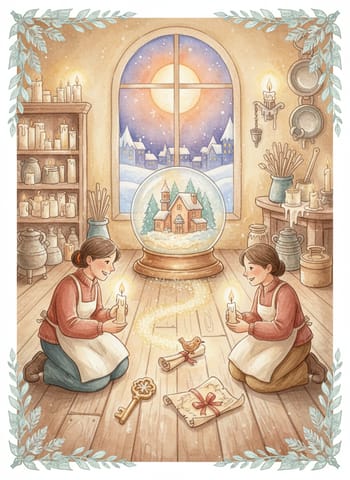
Luca saw it at once. He opened the door of his candle workshop at seven. The room smelled of warm wax. Everything stood in its place, except the snow globe.
Luca lo notó de inmediato. Abrió la puerta de su taller de velas a las siete. La habitación olía a cera tibia. Todo estaba en su lugar, menos la bola de nieve.
"Asha," he called. "Did you move my globe?"
«Asha», llamó. «¿Moviste mi bola?».
Asha came in from the back room with a box of wicks. "No. Why?"
Asha entró desde el cuarto de atrás con una caja de mechas. «No. ¿Por qué?».
"It lives on the high shelf by the window. Look. It is on the table by the wax pot."
«Vive en el estante alto junto a la ventana. Mira. Está en la mesa junto a la olla de cera».
Asha put the box down and looked. Inside the glass, a tiny blue house stood under a tree. White snow slowly fell around it. Luca bought the globe at a market when he opened the workshop. It was the only thing in the room not for sale.
Asha dejó la caja y miró. Dentro del vidrio, una diminuta casa azul se alzaba bajo un árbol. La nieve blanca caía lentamente a su alrededor. Luca había comprado la bola en un mercado cuando abrió el taller. Era lo único de la habitación que no estaba a la venta.
"Maybe you moved it yourself," she said. "You were tired on Friday."
«Quizá la moviste tú mismo», dijo ella. «Estabas cansado el viernes».
"I never touch it. It is a rule."
«Yo nunca la toco. Es una regla».
Asha smiled. "Then we have a ghost."
Asha sonrió. «Entonces tenemos un fantasma».
"Do not joke," said Luca. He put the globe back on its shelf. He turned the little house to face the room. Then he went to work.
«No bromees», dijo Luca. Devolvió la bola a su estante. Giró la casita para que mirara hacia la habitación. Luego se puso a trabajar.
On Tuesday morning, the globe was gone again.
El martes por la mañana, la bola había desaparecido otra vez.
This time, it stood on the low shelf near the pouring room. Luca stared at it with his mouth open. The little house still faced the room. It seemed to watch him work.
Esta vez estaba en el estante bajo, cerca del cuarto de vertido. Luca la miró con la boca abierta. La casita seguía mirando hacia la habitación. Parecía observarlo trabajar.
"This is not funny," he said.
«Esto no tiene gracia», dijo.
"I did not laugh," said Asha. But her eyes were bright. She loved puzzles more than anyone he knew. She took a pencil from behind her ear. "Let us find out what happens here. We need clues."
«Yo no me reí», dijo Asha. Pero sus ojos brillaban. Le gustaban los acertijos más que a nadie que él conociera. Sacó un lápiz de detrás de la oreja. «Vamos a averiguar qué pasa aquí. Necesitamos pistas».
They drew a plan of the workshop on brown paper. Asha marked the high shelf with a cross. Then she marked the table. Then she marked the low shelf.
Dibujaron un plano del taller en papel marrón. Asha marcó el estante alto con una cruz. Luego marcó la mesa. Luego marcó el estante bajo.
"Look at the path," she said. "The globe does not go in a straight line. But every night it moves a little closer to the middle."
«Mira el recorrido», dijo. «La bola no va en línea recta. Pero cada noche se acerca un poco más al centro».
"What is in the middle?"
«¿Qué hay en el centro?».
"The big melting stove."
«La gran estufa de fundir».
Luca rubbed his chin. "A ghost that likes warm places?"
Luca se frotó la barbilla. «¿Un fantasma al que le gustan los lugares cálidos?».
"Maybe." Asha drew a line around the stove. "That is our first clue. The globe walks toward the heat."
«Tal vez». Asha dibujó una línea alrededor de la estufa. «Esa es nuestra primera pista. La bola camina hacia el calor».
Luca checked the door and every window. They were all locked. He climbed the ladder and looked at the roof. It was shut, with dust on the handle. He even looked in the cellar, behind the sacks of wax. Nobody was there.
Luca revisó la puerta y todas las ventanas. Estaban cerradas con llave. Subió por la escalera y miró el techo. Estaba cerrado, con polvo en la manija. Hasta miró en el sótano, detrás de los sacos de cera. No había nadie.
"Maybe a thief," he said. "A thief with a strange hobby."
«Quizá un ladrón», dijo. «Un ladrón con un pasatiempo extraño».
"A thief takes things," said Asha. "He does not carry them three steps and leave them."
«Un ladrón se lleva las cosas», dijo Asha. «No las carga tres pasos y las deja».
On Tuesday evening, they made a trap. Luca put the globe on the high shelf. Asha spread a thin layer of white chalk dust over its glass. The dust showed every touch.
El martes por la tarde, armaron una trampa. Luca puso la bola en el estante alto. Asha extendió una fina capa de polvo blanco de tiza sobre su vidrio. El polvo mostraría cualquier roce.
Then they locked the door and went home.
Luego cerraron la puerta con llave y se fueron a casa.
On Wednesday morning, they ran in together. The globe stood on the corner of the stove table. The glass was still covered in chalk dust, with no finger marks.
El miércoles por la mañana, entraron corriendo juntos. La bola estaba en la esquina de la mesa de la estufa. El vidrio seguía cubierto de polvo de tiza, sin marcas de dedos.
"That is impossible," said Luca. His voice was small.
«Eso es imposible», dijo Luca. Su voz era pequeña.
Asha did not answer. She looked at the globe. Under its round glass base, a short grey thread stuck out. She pulled it gently into the light.
Asha no respondió. Miró la bola. Bajo la base redonda de vidrio asomaba un corto hilo gris. Lo sacó con suavidad a la luz.
"Look," she said. "Wool."
«Mira», dijo. «Lana».
"We do not own grey wool."
«No tenemos lana gris».
"No. And ghosts do not wear sweaters." She held it up. "This is our second clue. Somebody carried it in a grey scarf. That is why the glass has no marks."
«No. Y los fantasmas no usan suéteres». Lo levantó. «Esta es nuestra segunda pista. Alguien la cargó en una bufanda gris. Por eso el vidrio no tiene marcas».
"But the door was locked!"
«¡Pero la puerta estaba cerrada con llave!».
"Two people have a key. You, and me." Asha stopped. "Wait. Does anyone else come in here at night?"
«Dos personas tienen llave. Tú y yo». Asha se detuvo. «Espera. ¿Entra alguien más aquí por la noche?».
Luca opened his mouth and closed it again. Then he looked slowly at the nail beside the door.
Luca abrió la boca y la cerró otra vez. Luego miró despacio el clavo junto a la puerta.
A thick grey book hung there on a string. It was the cleaning book. The owner of the building wrote the rules inside the cover. A cleaner came every weekday night at ten. He washed the floor and emptied the bins. Luca never talked to him. They only met on the stairs, once, with a nod.
Allí colgaba un grueso libro gris atado a un cordel. Era el libro de la limpieza. El dueño del edificio escribía las reglas en el interior de la cubierta. Un limpiador venía cada noche entre semana a las diez. Lavaba el piso y vaciaba los botes de basura. Luca nunca hablaba con él. Solo se habían cruzado en las escaleras, una vez, con un saludo de cabeza.
"I never read this," he said.
«Nunca leí esto», dijo.
"Then read it now."
«Entonces léelo ahora».
He opened the book and ran his finger down the page. Date after date, the cleaner wrote one short line. Floor washed. Bins empty. Door locked. Then he came to Friday.
Abrió el libro y recorrió la página con el dedo. Fecha tras fecha, el limpiador escribía una breve línea. Piso lavado. Botes vacíos. Puerta cerrada con llave. Entonces llegó al viernes.
"Floor washed. Bins empty. Door locked," Luca read. "Little blue house looked cold. Moved it nearer the stove. Hope this is OK."
«Piso lavado. Botes vacíos. Puerta cerrada con llave», leyó Luca. «La casita azul parecía tener frío. La puse más cerca de la estufa. Espero que esté bien».
Asha leaned over his shoulder. She read the next line. Then she read the one after.
Asha se asomó por encima de su hombro. Leyó la línea siguiente. Luego la que seguía.
"Monday," she said. "The little house was cold again. I think it needs more heat. Moved it a bit further."
«Lunes», dijo. «La casita volvía a tener frío. Creo que necesita más calor. La moví un poco más lejos».
"And Tuesday." Luca laughed so hard that he sat down on a sack. "He put it by the stove again. He wrote, I tied a bit of scarf around it. It should be warm."
«Y el martes». Luca se rio tanto que se sentó en un saco. «Volvió a ponerla junto a la estufa. Escribió: Le até un pedazo de bufanda alrededor. Así estará calentita».
"The scarf," said Asha. "That is why there was wool. And the book is our third clue."
«La bufanda», dijo Asha. «Por eso había lana. Y el libro es nuestra tercera pista».
"A ghost," said Luca, wiping his eyes. "I called a polite man with a mop a ghost."
«Un fantasma», dijo Luca, secándose los ojos. «Llamé fantasma a un hombre amable con un trapeador».
"He is a very kind ghost."
«Es un fantasma muy amable».
They stopped laughing. Luca looked at the globe on the corner of the stove table. The little blue house sat close to the warm iron. The snow fell slowly around it.
Dejaron de reír. Luca miró la bola en la esquina de la mesa de la estufa. La casita azul estaba cerca del hierro caliente. La nieve caía lentamente a su alrededor.
"The house does not mind the heat," Asha said. "The cleaner thinks it is cold because it is made of snow."
«A la casa no le molesta el calor», dijo Asha. «El limpiador piensa que tiene frío porque está hecha de nieve».
"It is the kindest idea anyone ever had about my globe." Luca stood up and went to his desk. He found a clean card and a pen. He wrote a short note, then read it out loud.
«Es la idea más amable que alguien ha tenido sobre mi bola». Luca se puso de pie y fue a su escritorio. Encontró una tarjeta limpia y una pluma. Escribió una nota corta y luego la leyó en voz alta.
"Dear friend. Thank you. The little house is not cold. But we like that you worry. Please leave it by the stove."
«Querido amigo. Gracias. La casita no tiene frío. Pero nos gusta que se preocupe. Por favor, déjela junto a la estufa».
Asha smiled. "Sign it with your name."
Asha sonrió. «Fírmala con tu nombre».
"I think I will sign it from the little house."
«Creo que la firmaré de parte de la casita».
He put the card in the book. Then he lifted the globe and gave it a last shake. White snow rose and turned in the glass. Asha lit one candle on the table beside it.
Puso la tarjeta en el libro. Luego levantó la bola y le dio una última sacudida. La nieve blanca se elevó y giró dentro del vidrio. Asha encendió una vela en la mesa, a su lado.
The flame bent and stood up again. Light fell across the glass. In the quiet room, the tiny house sat warm in the glow. The snow came down slowly around its door.
La llama se dobló y volvió a erguirse. La luz cayó sobre el vidrio. En la habitación silenciosa, la diminuta casa estaba tibia en el resplandor. La nieve caía lentamente alrededor de su puerta.