The Night of Odd Shoes
Una historia gratuita en inglés de nivel B1 para estudiantes, para leer en línea en 7 idiomas, con opción de escucharla en la app gratuita Storyteller.
A dumpling cook at a night market answers a customer's wish about her mismatched shoes in a surprising way.
¡Ese fue el avance! Escucha la historia completa en la app gratuita Storyteller. Descargar la app
El audio no está disponible en este momento.
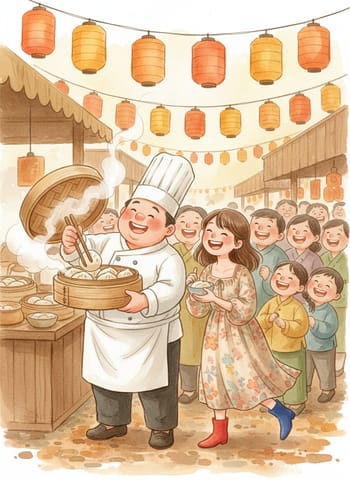
The food row at the night market starts to wake up at six. Malika lights the gas under her big pot of dumplings. Then she checks the paper lanterns above her stall. Each one is yellow and slightly crooked. She hung them herself three years ago, and she likes them crooked.
La hilera de comida del mercado nocturno empieza a despertar a las seis. Malika enciende el gas bajo su olla grande de dumplings. Luego revisa los faroles de papel sobre su puesto. Cada uno es amarillo y está algo torcido. Ella misma los colgó hace tres años, y le gusta que estén torcidos.
Around her, the other cooks do the same small jobs. The noodle man stacks his bowls. The woman who sells grilled corn blows on her coals. By seven, smoke and steam fill the whole row, and the first crowds arrive.
A su alrededor, los otros cocineros hacen las mismas pequeñas tareas. El hombre de los fideos apila sus tazones. La mujer que vende maíz asado sopla sobre sus brasas. A las siete, el humo y el vapor llenan toda la hilera, y llegan las primeras multitudes.
Malika knows most of her customers by their orders. The boy with the headphones always wants six pork dumplings. The two nurses share one plate and argue about the sauce. Tonight, however, a new face walks up to her counter, and the face looks upset.
Malika conoce a la mayoría de sus clientes por sus pedidos. El chico con los audífonos siempre quiere seis dumplings de cerdo. Las dos enfermeras comparten un plato y discuten sobre la salsa. Esta noche, sin embargo, una cara nueva se acerca a su mostrador, y la cara parece alterada.
The woman is about thirty, with a neat jacket and a tired smile. Malika looks at her face, and then she looks down. She cannot stop herself.
La mujer tiene unos treinta años, con una chaqueta pulcra y una sonrisa cansada. Malika le mira la cara, y luego mira hacia abajo. No puede evitarlo.
The woman wears one blue trainer on her left foot. On her right foot, she wears a gold sandal with a thin strap.
La mujer lleva un tenis azul en el pie izquierdo. En el pie derecho lleva una sandalia dorada de correa delgada.
"Please don't say anything," the woman says. "I know. I know."
«Por favor, no diga nada», dice la mujer. «Lo sé. Lo sé».
"I say nothing," Malika says. "Six dumplings?"
«No digo nada», dice Malika. «¿Seis dumplings?»
"Six dumplings, yes, and a big glass of water." The woman sits on the stool beside the counter and lets out a long breath. "My name is Brina. I work in an office near here. The power was off this morning. I dressed in the dark and put on two shoes without looking. I only noticed at lunchtime. By then it was too late to go home."
«Seis dumplings, sí, y un vaso grande de agua». La mujer se sienta en el banco junto al mostrador y suelta un largo suspiro. «Me llamo Brina. Trabajo en una oficina cerca de aquí. Esta mañana se fue la luz. Me vestí a oscuras y me puse dos zapatos sin mirar. Solo me di cuenta a la hora del almuerzo. Para entonces ya era tarde para ir a casa».
"Did anybody look?" Malika asks.
«¿Alguien miró?», pregunta Malika.
"Everybody looked," Brina says. "A child on the bus said, loudly, 'That lady has different feet.'"
«Todos miraron», dice Brina. «Un niño en el autobús dijo, en voz alta: “Esa señora tiene los pies diferentes”».
Malika laughs, and then she covers her mouth. "I am sorry. It is not funny."
Malika se ríe, y luego se tapa la boca. «Perdón. No es gracioso».
"It is a little funny," Brina says. "But tonight I have a dinner with my team, right here on the food row. They are all coming in an hour. Ten people, and every one of them will stare at my shoes. I just want to eat in peace."
«Es un poco gracioso», dice Brina. «Pero esta noche tengo una cena con mi equipo, justo aquí en la hilera de comida. Llegan todos en una hora. Diez personas, y cada una va a mirarme los zapatos. Solo quiero comer en paz».
Malika puts six dumplings on a plate and slides it across the counter. Brina takes a bite and closes her eyes. For a moment, the problem seems smaller.
Malika pone seis dumplings en un plato y lo desliza por el mostrador. Brina da un mordisco y cierra los ojos. Por un momento, el problema parece más pequeño.
"I wish I could do something about it," Brina says, with her mouth half full. "I wish nobody would look at my feet tonight. That's all. Just one evening."
«Ojalá pudiera hacer algo al respecto», dice Brina, con la boca medio llena. «Ojalá nadie me mirara los pies esta noche. Eso es todo. Solo una noche».
Malika wipes her hands on her apron. She has a habit of taking small wishes seriously. Over the years, people have asked her for stranger things than this. A man once asked for a dumpling that tasted like his mother's. She tried nine times.
Malika se limpia las manos en el delantal. Tiene la costumbre de tomarse en serio los deseos pequeños. A lo largo de los años, le han pedido cosas más extrañas que esta. Un hombre una vez pidió un dumpling que supiera como el de su madre. Lo intentó nueve veces.
"I cannot sell you new shoes," she says. "There is a shoe stall at the end of the row, but the owner closes early. And I cannot make people blind." She looks along the row of lanterns, and a slow smile appears on her face. "But maybe I can make everyone busy with their own feet."
«No puedo venderle zapatos nuevos», dice. «Hay un puesto de zapatos al final de la hilera, pero el dueño cierra temprano. Y no puedo dejar ciega a la gente». Mira a lo largo de la hilera de faroles, y una sonrisa lenta aparece en su rostro. «Pero quizá pueda lograr que todos estén ocupados con sus propios pies».
"What does that mean?" Brina asks.
«¿Qué quiere decir eso?», pregunta Brina.
"Eat your dumplings," Malika says. "I need to make a few phone calls."
«Coma sus dumplings», dice Malika. «Tengo que hacer unas llamadas».
She walks next door to the noodle man and speaks to him quietly. He frowns, then shrugs, then bends down and takes off his left shoe. Malika goes to the woman with the corn and does the same. Then she visits the juice seller, the man with the skewers, and the girl with the rice cakes. Each of them listens. Each of them looks at Brina's shoes. Then they look at each other, and one by one they start to grin.
Camina hasta el hombre de los fideos, al lado, y le habla en voz baja. Él frunce el ceño, luego se encoge de hombros, luego se agacha y se quita el zapato izquierdo. Malika va con la mujer del maíz y hace lo mismo. Luego visita al vendedor de jugos, al hombre de las brochetas y a la chica de los pasteles de arroz. Cada uno escucha. Cada uno mira los zapatos de Brina. Luego se miran entre ellos, y uno por uno empiezan a sonreír.
Brina watches from her stool and understands nothing. Then she sees the noodle man bring out a pair of old garden boots from under his counter. He puts one boot on his left foot. His right foot keeps its own black shoe.
Brina mira desde su banco y no entiende nada. Entonces ve al hombre de los fideos sacar un par de botas viejas de jardín de debajo de su mostrador. Se pone una bota en el pie izquierdo. El pie derecho conserva su propio zapato negro.
"What is he doing?" she whispers.
«¿Qué hace?», susurra.
"Wait," Malika says, and she holds up a finger.
«Espere», dice Malika, y levanta un dedo.
By eight o'clock, a strange thing is happening on the food row. The corn woman wears a pink slipper and a green clog. The juice seller has one tall boot and one tiny sandal he borrowed from his niece. The man with the skewers wears a work boot and a shower shoe. Even the man who sells phone cases joins in. He puts on a fluffy rabbit slipper and walks very seriously down the row.
Para las ocho, algo extraño ocurre en la hilera de comida. La mujer del maíz lleva una pantufla rosa y un zueco verde. El vendedor de jugos tiene una bota alta y una sandalia diminuta que le pidió prestada a su sobrina. El hombre de las brochetas lleva una bota de trabajo y una chancla de baño. Hasta el hombre que vende fundas de teléfono se une. Se pone una pantufla esponjosa de conejo y camina muy serio por la hilera.
Malika herself steps out from behind her counter. She wears one rubber shoe from the kitchen and one sandal from her bag. She bows to Brina like a queen.
La propia Malika sale de detrás de su mostrador. Lleva un zapato de goma de la cocina y una sandalia de su bolso. Hace una reverencia a Brina como una reina.
"Mismatched Night," she announces, in her loudest voice. "Tonight, every cook has two different shoes. If a customer finds a matching pair on the whole row, he gets a free dumpling."
«Noche de Zapatos Desparejos», anuncia, con su voz más fuerte. «Esta noche, todos los cocineros llevan dos zapatos distintos. Si un cliente encuentra un par igual en toda la hilera, se lleva un dumpling gratis».
People stop walking. They stare at the cooks, and then they look down at their own feet, just to be sure. A teenager laughs and points at the corn woman. A couple takes photos of the juice seller's tiny sandal. Soon a small crowd forms in the middle of the row, and everyone is bending down, searching.
La gente deja de caminar. Miran a los cocineros, y luego se miran sus propios pies, solo para estar seguros. Un adolescente se ríe y señala a la mujer del maíz. Una pareja toma fotos de la diminuta sandalia del vendedor de jugos. Pronto se forma una pequeña multitud en medio de la hilera, y todos se agachan, buscando.
"Look at that one!" a boy shouts. "He has a boot and a slipper!"
«¡Miren ese!», grita un chico. «¡Tiene una bota y una pantufla!»
"And that one has a sandal and a trainer!" says another voice.
«¡Y ese tiene una sandalia y un tenis!», dice otra voz.
"No, no, that is Brina," Malika says gently, and she points at the stool. "She is a judge tonight. She decides who has the most beautiful mistake."
«No, no, esa es Brina», dice Malika con suavidad, y señala el banco. «Esta noche es jueza. Ella decide quién tiene el error más bello».
Brina's mouth falls open. "I am a what?"
A Brina se le abre la boca. «¿Yo soy qué?»
"A judge," Malika whispers. "Sit up straight and look serious. It helps."
«Jueza», susurra Malika. «Siéntese derecha y póngase seria. Ayuda».
So Brina sits up straight. She looks at the cooks one by one. She gives each of them a score from one to ten. The crowd cheers whenever she speaks. The rabbit slippers get a nine. The garden boot gets an eight and a half, because it is very big.
Así que Brina se sienta derecha. Mira a los cocineros uno por uno. Le da a cada uno una puntuación del uno al diez. La multitud vitorea cada vez que habla. Las pantuflas de conejo reciben un nueve. La bota de jardín recibe un ocho y medio, porque es muy grande.
At half past eight, Brina's team arrives. Ten people walk down the row in their work clothes. They stop at the same moment, like fish. Nobody looks at Brina's feet. They look at the juice seller, then at the rabbit slippers, then at the customers checking their shoes.
A las ocho y media llega el equipo de Brina. Diez personas caminan por la hilera con su ropa de trabajo. Se detienen en el mismo instante, como peces. Nadie mira los pies de Brina. Miran al vendedor de jugos, luego a las pantuflas de conejo, luego a los clientes que revisan sus zapatos.
"What is going on here?" her manager asks.
«¿Qué está pasando aquí?», pregunta su jefe.
"It's a festival," Brina says calmly. "I am the judge."
«Es un festival», dice Brina con calma. «Yo soy la jueza».
Her manager looks at her for a long moment. Then he looks down at his own polished black shoes. "Do I need to enter?" he asks.
Su jefe la mira un largo momento. Luego mira sus propios zapatos negros bien lustrados. «¿Tengo que inscribirme?», pregunta.
"I think you do," Brina says.
«Creo que sí», dice Brina.
The team eats together at a long table beside Malika's stall. They talk about the day and laugh about the rabbit slippers. Nobody says a word about gold sandals. Two of them take off one shoe each and swap them, just for fun. By nine, half the row has joined the game, and the free dumplings run out twice.
El equipo cena junto en una mesa larga al lado del puesto de Malika. Hablan del día y se ríen de las pantuflas de conejo. Nadie dice una palabra sobre sandalias doradas. Dos de ellos se quitan un zapato cada uno y los intercambian, solo por diversión. Para las nueve, la mitad de la hilera se ha unido al juego, y los dumplings gratis se acaban dos veces.
When the crowd finally thins, Brina walks back to the counter. Her feet hurt, and her face hurts from smiling. She puts a folded note under the plate.
Cuando la multitud por fin se dispersa, Brina vuelve al mostrador. Le duelen los pies, y le duele la cara de tanto sonreír. Pone una nota doblada bajo el plato.
"You didn't make anyone blind," she says. "You made everyone look at everything else."
«Usted no dejó ciega a nadie», dice. «Hizo que todos miraran todo lo demás».
"That is how most wishes work," Malika says. She shrugs. "People get the thing they ask for, but not in the shape they expect."
«Así funcionan la mayoría de los deseos», dice Malika. Se encoge de hombros. «La gente recibe lo que pide, pero no con la forma que espera».
"What shape was mine?"
«¿Qué forma tuvo el mío?»
"A very odd one," Malika says. "With a rabbit on it."
«Una muy rara», dice Malika. «Con un conejo encima».
Later, when the last customer has gone, the lanterns still glow above the empty row. The cooks pack their pots and carry them away, one soft step at a time. Under the stalls, a line of odd shoes waits in the dust. Above them, one crooked lantern swings gently.
Más tarde, cuando se ha ido el último cliente, los faroles siguen brillando sobre la hilera vacía. Los cocineros guardan sus ollas y se las llevan, con un paso suave a la vez. Bajo los puestos, una fila de zapatos desparejos espera en el polvo. Sobre ellos, un farol torcido se balancea suavemente.