The Name Badge at the Toll Booth
Una historia gratuita en inglés de nivel B1 para estudiantes, para leer en línea en 7 idiomas, con opción de escucharla en la app gratuita Storyteller.
A trainee and a forgetful toll booth worker disagree about a missing name badge until they find a compromise neither expected.
¡Ese fue el avance! Escucha la historia completa en la app gratuita Storyteller. Descargar la app
El audio no está disponible en este momento.
Wanda arrived at the Long Bridge toll booth at ten to six. She had a coffee in one hand and a name badge in the other. The badge was blue plastic with white letters. It said WANDA, and under that, in smaller print, TRAINEE. She tried to pin it to her jacket, but the pin bent twice and fell on the floor.
Wanda llegó a la caseta de peaje del Puente Largo a las seis menos diez. Llevaba un café en una mano y una credencial con su nombre en la otra. La credencial era de plástico azul con letras blancas. Decía WANDA, y debajo, en letras más pequeñas, APRENDIZ. Trató de prenderla en su chaqueta, pero el alfiler se dobló dos veces y cayó al suelo.
"Let me help you," said the woman inside the booth. She was about forty, with short black hair and a mug that said WORLD'S OKAYEST COLLEAGUE. "I'm Dina. I've been here nine years, and I still bend my pins. Use a safety pin."
«Déjame ayudarte», dijo la mujer dentro de la caseta. Tenía unos cuarenta años, el pelo negro y corto y una taza que decía LA COLEGA MÁS REGULAR DEL MUNDO. «Soy Dina. Llevo nueve años aquí y todavía doblo mis alfileres. Usa un imperdible».
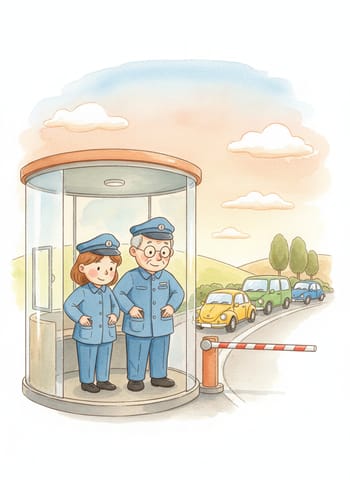
"Thank you," said Wanda. She stepped inside and looked around. The booth was smaller than she had expected. There was a cash tray, a screen for the card reader and a big button for the barrier. A little fridge hummed in the corner. Outside the window, the bridge stretched over the dark water like a long grey ribbon.
«Gracias», dijo Wanda. Entró y miró alrededor. La caseta era más pequeña de lo que esperaba. Había una bandeja de efectivo, una pantalla para el lector de tarjetas y un botón grande para la barrera. Un pequeño refrigerador zumbaba en la esquina. Afuera de la ventana, el puente se extendía sobre el agua oscura como una larga cinta gris.
Dina showed her the log book and the spare coins. She explained that cars paid at the window and lorries paid double. Nobody ever won an argument with the barrier. Then she stopped in the middle of a sentence. She put a hand on one jacket pocket, and then on the other.
Dina le mostró el libro de registro y las monedas de repuesto. Le explicó que los autos pagaban en la ventanilla y los camiones pagaban el doble. Nadie había ganado nunca una discusión con la barrera. Entonces se detuvo en medio de una frase. Se llevó una mano a un bolsillo de la chaqueta, y luego al otro.
"Oh no," she said.
«Ay, no», dijo.
"What's wrong?" asked Wanda.
«¿Qué pasa?», preguntó Wanda.
"My badge. It's on my kitchen table, next to my keys." Dina sat down heavily on the stool. "And a man from head office is coming at seven to check every booth."
«Mi credencial. Está sobre la mesa de mi cocina, junto a mis llaves». Dina se sentó pesadamente en el taburete. «Y un señor de la oficina central viene a las siete a revisar todas las casetas».
"Is that a problem?"
«¿Es un problema?»
"The rule is simple. Everyone in the booth wears a badge. I forgot mine in March, and again in June. After the third time, they move you to the night shift." Dina looked at the fridge. "I hate the night shift. The bridge is empty and that fridge hums at me."
«La regla es simple. Todos en la caseta llevan credencial. La olvidé en marzo, y otra vez en junio. Después de la tercera vez, te pasan al turno de noche». Dina miró el refrigerador. «Odio el turno de noche. El puente está vacío y ese refrigerador me zumba».
Wanda thought about it. She had been in the job for ten minutes, and she already wanted to fix something. "Then we should call the office," she said. "They can send a spare badge before seven."
Wanda lo pensó. Llevaba diez minutos en el trabajo, y ya quería arreglar algo. «Entonces deberíamos llamar a la oficina», dijo. «Pueden mandar una credencial de repuesto antes de las siete».
"A spare takes two hours," said Dina. "And they will ask why I need one."
«Una de repuesto tarda dos horas», dijo Dina. «Y me preguntarán para qué la necesito».
"Then you tell them why. It's only a badge."
«Entonces les dices por qué. Es solo una credencial».
"It's never only a badge." Dina shook her head. "I have a better plan. You work the window, and I wait in the supply cupboard. The man stays twelve minutes. He sees one person with one badge, and everybody is happy."
«Nunca es solo una credencial». Dina negó con la cabeza. «Tengo un plan mejor. Tú atiendes la ventanilla y yo espero en el armario de suministros. El señor se queda doce minutos. Ve a una persona con una credencial, y todos contentos».
"But that's a lie," said Wanda. "He will ask who is training me."
«Pero eso es mentira», dijo Wanda. «Preguntará quién me está capacitando».
"Then say I'm on my break."
«Entonces di que estoy en mi descanso».
"On the first morning of a new trainee?"
«¿La primera mañana de una nueva aprendiz?»
Dina laughed, but she did not look happy about it.
Dina se rio, pero no parecía contenta por ello.
They did not finish the argument, because the morning would not wait. At six, the cars began to line up on the bridge. Wanda counted coins, tapped cards and handed out receipts. A cyclist paid with a bag of small change and apologised twice. A lorry driver asked her to repeat the price, and then asked again.
No terminaron la discusión, porque la mañana no esperaba. A las seis, los autos empezaron a hacer fila en el puente. Wanda contó monedas, pasó tarjetas y entregó recibos. Un ciclista pagó con una bolsa de monedas sueltas y se disculpó dos veces. Un camionero le pidió que repitiera el precio, y luego volvió a pedírselo.
Between the cars, the two women talked in low voices, like people at a very polite meeting.
Entre un auto y otro, las dos mujeres hablaban en voz baja, como gente en una reunión muy educada.
"I don't want you to lose your job," said Dina.
«No quiero que pierdas tu trabajo», dijo Dina.
"I won't lose it. I haven't started it yet," said Wanda. "But I can't hide you in a cupboard. If he asks, I will have to say something, and I am a terrible liar."
«No lo voy a perder. Todavía no lo he empezado», dijo Wanda. «Pero no puedo esconderte en un armario. Si él pregunta, tendré que decir algo, y soy una pésima mentirosa».
"I have noticed," said Dina. "You blink when you almost say it."
«Ya lo noté», dijo Dina. «Parpadeas cuando estás por decirlo».
Wanda blinked and decided not to answer.
Wanda parpadeó y decidió no responder.
At twenty to seven, a delivery van stopped at the window. The driver counted out his coins one by one and looked from face to face. "You two look serious," he said. "Is this a robbery?"
A las siete menos veinte, una camioneta de reparto se detuvo en la ventanilla. El conductor contó sus monedas una por una y las miró a una y a otra. «Se ven serias», dijo. «¿Es un asalto?»
"We are planning a badge," said Dina.
«Estamos planeando una credencial», dijo Dina.
"That sounds harder." He glanced at the dashboard. A roll of white sticky labels lay there, next to a fat black marker. "I write on these all day. Take them, if they help."
«Eso suena más difícil». Echó un vistazo al tablero. Un rollo de etiquetas adhesivas blancas estaba allí, junto a un grueso marcador negro. «Escribo en estas todo el día. Llévenselas, si les sirven».
He pushed the roll and the marker through the window and drove off before they could thank him.
Empujó el rollo y el marcador por la ventanilla y se fue antes de que pudieran agradecerle.
Dina picked up the label roll and turned it over. "Here is my new plan," she said. "I write DINA on one. I stick it on my jacket. The man is in a hurry, and he will never look closely."
Dina recogió el rollo de etiquetas y le dio la vuelta. «Este es mi nuevo plan», dijo. «Escribo DINA en una. Me la pego en la chaqueta. El señor tiene prisa y nunca mirará de cerca».
"He will look. That is why he's coming," said Wanda.
«Mirará. Para eso viene», dijo Wanda.
"Then what do you suggest?"
«Entonces, ¿qué sugieres?»
Wanda took the marker. She tore off a label and held it flat against the edge of the cash tray. She wrote slowly, in neat capital letters, and then she held it up.
Wanda tomó el marcador. Arrancó una etiqueta y la sostuvo plana contra el borde de la bandeja de efectivo. Escribió despacio, con letras mayúsculas prolijas, y luego la levantó.
It said: DINA. REAL BADGE IS ON MY KITCHEN TABLE.
Decía: DINA. LA CREDENCIAL VERDADERA ESTÁ EN LA MESA DE MI COCINA.
Dina read it twice. "You want me to wear a sign that says I forgot?"
Dina la leyó dos veces. «¿Quieres que lleve un cartel que dice que me olvidé?»
"I want you to wear a sign that says the truth. It is better than a cupboard."
«Quiero que lleves un cartel que dice la verdad. Es mejor que un armario».
"A cupboard has a door," said Dina.
«Un armario tiene puerta», dijo Dina.
"A cupboard also has mops."
«Un armario también tiene trapeadores».
Dina made a noise that was half a laugh and half a groan. She took the label and looked at it for a long moment. Outside, two cars honked, and she pressed the button without looking.
Dina hizo un ruido mitad risa y mitad gruñido. Tomó la etiqueta y la miró un largo rato. Afuera, dos autos tocaron la bocina, y ella apretó el botón sin mirar.
"It's honest," she said at last. "But it makes me sound like a child who lost her gloves. If I wear this, it must say something else too."
«Es honesto», dijo por fin. «Pero me hace sonar como una niña que perdió sus guantes. Si lo llevo puesto, tiene que decir algo más también».
"Like what?"
«¿Como qué?»
Dina took the marker and wrote a second line, in her own sloping hand. Then she showed it to Wanda. It said: NINE YEARS, NEVER LATE.
Dina tomó el marcador y escribió una segunda línea, con su propia letra inclinada. Luego se la mostró a Wanda. Decía: NUEVE AÑOS, NUNCA TARDE.
Wanda smiled. "That's not a badge. That's a small speech."
Wanda sonrió. «Eso no es una credencial. Es un pequeño discurso».
"It's a very good speech," said Dina. "Nobody argues with it."
«Es un discurso muy bueno», dijo Dina. «Nadie lo discute».
Neither of them had expected this. Wanda had come with a plan to follow every rule. Dina had come with a plan to hide. Now they stood side by side with a piece of sticky paper that obeyed no rule at all.
Ninguna de las dos había esperado esto. Wanda había llegado con un plan de seguir todas las reglas. Dina había llegado con un plan para esconderse. Ahora estaban lado a lado con un pedazo de papel adhesivo que no obedecía ninguna regla.
Dina pressed the label onto her jacket and smoothed it down with her thumb. Wanda straightened her own crooked safety pin.
Dina presionó la etiqueta en su chaqueta y la alisó con el pulgar. Wanda enderezó su propio imperdible torcido.
At seven, a small tidy man in a dark coat stopped his car by the booth. He carried a clipboard and had the face of a person who had heard many excuses. He checked Wanda's badge and nodded. Then he looked at Dina's jacket, and his eyes stopped moving.
A las siete, un hombre pequeño y pulcro con un abrigo oscuro detuvo su auto junto a la caseta. Llevaba una tablilla con sujetapapeles y tenía la cara de una persona que ha oído muchas excusas. Revisó la credencial de Wanda y asintió. Luego miró la chaqueta de Dina, y sus ojos dejaron de moverse.
Dina held her breath. The fridge hummed in the corner.
Dina contuvo el aliento. El refrigerador zumbó en la esquina.
The man read the label from top to bottom. He read it a second time. Then he took out a pen and made a small tick on his list.
El hombre leyó la etiqueta de arriba abajo. La leyó por segunda vez. Luego sacó una pluma e hizo una pequeña marca en su lista.
"Nine years, never late," he said. "Is that true?"
«Nueve años, nunca tarde», dijo. «¿Es cierto?»
"Ask the log book," said Dina.
«Pregunte al libro de registro», dijo Dina.
"I will." He tapped his clipboard. "Bring the proper badge tomorrow, please. And I will say this once, as a favour. Your trainee has beautiful handwriting."
«Lo haré». Golpeó la tablilla con los dedos. «Traiga la credencial correcta mañana, por favor. Y diré esto una sola vez, como favor. Su aprendiz tiene una letra hermosa».
"Thank you," said Wanda. "It was a team effort."
«Gracias», dijo Wanda. «Fue un trabajo en equipo».
When the man had gone, the booth was very quiet. Dina let out a long breath and sat down on the stool. Then she took a safety pin from her pocket and fixed the label firmly to her jacket. She pressed the button for the next car.
Cuando el hombre se fue, la caseta quedó muy silenciosa. Dina soltó un largo suspiro y se sentó en el taburete. Luego sacó un imperdible de su bolsillo y fijó bien la etiqueta a su chaqueta. Apretó el botón para el siguiente auto.