The Hospice Gardener
Una historia gratuita en inglés de nivel C1 para estudiantes, para leer en línea en 4 idiomas, con opción de escucharla en la app gratuita Storyteller.
A hospice gardener plants spring bulbs she knows many residents will not live to see, until one of them asks her why she bothers.
¡Ese fue el avance! Escucha la historia completa en la app gratuita Storyteller. Descargar la app
El audio no está disponible en este momento.
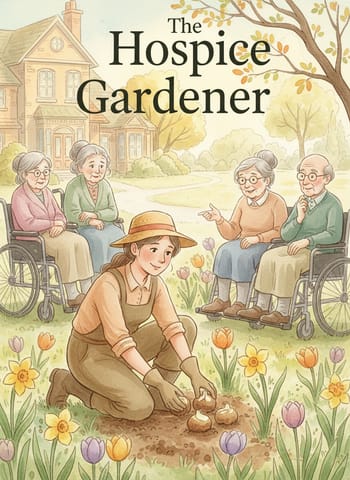
In October the ground at the hospice is cold on the surface and warm underneath. Timea, kneeling in the long bed beneath the east windows, has learned to tell by the smell of it whether the bulbs will take. This morning she has four hundred of them in a crate: daffodils, tulips, and the small blue squills that nobody notices until they have already won. She sets them in rows, pointed end up, a hand's width apart, and does not think about March.
En octubre, la tierra del hospicio está fría en la superficie y tibia por debajo. Timea, arrodillada en el largo parterre bajo las ventanas del este, ha aprendido a saber por el olor si los bulbos prenderán. Esta mañana tiene cuatrocientos en un cajón: narcisos, tulipanes y esas pequeñas escilas azules que nadie nota hasta que ya han ganado. Los coloca en hileras, con la punta hacia arriba, a un palmo de distancia, y no piensa en marzo.
That is not quite true. She thinks about March a great deal. She has worked here for six years, long enough to know the arithmetic. Most of the people who can see this bed from their pillows today will not be here when it flowers. She plants it regardless, every autumn, with the same slow care, like someone mending a coat for a journey she is not taking. What she has never managed to explain, even to herself, is why the care feels necessary rather than merely kind.
No es del todo cierto. Piensa mucho en marzo. Lleva seis años trabajando aquí, tiempo suficiente para conocer la aritmética. La mayoría de las personas que hoy pueden ver este parterre desde la almohada no estarán aquí cuando florezca. Ella lo planta de todos modos, cada otoño, con el mismo cuidado lento, como alguien que remienda un abrigo para un viaje que no hará. Lo que nunca ha logrado explicar, ni siquiera a sí misma, es por qué el cuidado le parece necesario y no simplemente amable.
The layout of the beds is her one eccentricity. When she was hired, she asked the matron for the keys to the empty rooms. She spent an afternoon lying on each bed in turn, head on every pillow, working out what a person who could not get up would see through each window. The answer was almost nothing: a section of hedge, a drainpipe, the sky. So she redrew the garden from the bottom up. Had she trusted the plans instead, the long bed would have gone beside the car park, where visitors would have admired it. It sits under the east windows because of that afternoon. So is the birch, which she moved herself one terrible weekend, with a borrowed trolley and a great deal of swearing.
La disposición de los parterres es su única excentricidad. Cuando la contrataron, le pidió a la matrona las llaves de las habitaciones vacías. Pasó una tarde tendida en cada cama por turno, con la cabeza en cada almohada, averiguando qué vería por cada ventana alguien que no pudiera levantarse. La respuesta era casi nada: un tramo de seto, un bajante, el cielo. Así que rediseñó el jardín desde abajo. Si se hubiera fiado de los planos, el parterre largo habría ido junto al estacionamiento, donde los visitantes lo habrían admirado. Está bajo las ventanas del este por culpa de aquella tarde. Lo mismo el abedul, que movió ella misma un terrible fin de semana, con una carretilla prestada y muchas palabrotas.
"You've been at that a while," says a voice behind her. It belongs to the woman from the corner room, a retired geography teacher who arrived in August and has the precise, dry diction of someone used to being obeyed by children. She sits in the open French window in her wheelchair, a knitted blanket over her knees, watching Timea's hands.
«Lleva un buen rato en eso», dice una voz a su espalda. Es la de la mujer de la habitación de la esquina, una profesora de geografía jubilada que llegó en agosto y tiene la dicción precisa y seca de quien está acostumbrada a ser obedecida por niños. Está sentada en su silla de ruedas en el vano de la puerta vidriera abierta, con una manta de punto sobre las rodillas, mirando las manos de Timea.
For some time she says nothing more. Then: "May I ask you something? You can tell me to mind my own business." Timea sits back on her heels. "Why do you bother? You must know most of us won't see them." The words are not unkind. If anything, they are curious in the way of someone who has been asking the same question of herself for weeks and has finally found somebody else to put it to.
Durante un rato no dice nada más. Luego: «¿Puedo preguntarle algo? Puede decirme que no me meta». Timea se sienta sobre los talones. «¿Por qué se molesta? Debe de saber que la mayoría de nosotros no los veremos». Las palabras no son desagradables. Si acaso, son curiosas a la manera de quien lleva semanas haciéndose la misma pregunta y por fin ha encontrado a otra persona a quien hacérsela.
Rarely has she been asked so plainly. Timea considers lying. She has a few good answers ready, the kind that appear in leaflets, about legacy and the cycle of things. She can feel how they would sound in this air, which is to say like decorations. "Because it's October," she says instead. "It's what the ground is for in October." She turns a bulb over in her glove. "And because I don't know who will be at the window in March. Nobody does. I'd rather there was something to look at."
Pocas veces le han preguntado algo tan claramente. Timea considera mentir. Tiene a mano unas cuantas buenas respuestas, de las que aparecen en los folletos, sobre el legado y el ciclo de las cosas. Puede sentir cómo sonarían en este aire, es decir, como adornos. «Porque es octubre», dice en cambio. «Para eso sirve la tierra en octubre». Da vueltas a un bulbo en el guante. «Y porque no sé quién estará en la ventana en marzo. Nadie lo sabe. Prefiero que haya algo que mirar».
The woman receives this without comment. Her mouth moves slightly, which may be a smile or the beginning of a cough.
La mujer recibe esto sin comentarios. Su boca se mueve levemente, lo que puede ser una sonrisa o el comienzo de una tos.
"Which are those?" she asks, nodding at the crate. Timea tells her: the early daffodils, the mid-season tulips, and a late variety that flowers in the last week of April, if the spring is mean. "Mean springs suit the late ones best," she adds, and wishes at once that she had not.
«¿Cuáles son esos?», pregunta, señalando el cajón con la cabeza. Timea se lo dice: los narcisos tempranos, los tulipanes de media estación y una variedad tardía que florece en la última semana de abril, si la primavera es mala. «Las primaveras malas favorecen a las tardías», añade, y desea de inmediato no haberlo dicho.
"Late, then," says the woman. "Put the late ones under my window." She tucks the blanket tighter. "I've never been on time for anything. It seems only fair to back the one that isn't either."
«Tardías, entonces», dice la mujer. «Ponga las tardías bajo mi ventana». Se ajusta mejor la manta. «Nunca he llegado a tiempo a nada. Me parece justo apostar por la que tampoco lo hace».
Timea does not say that it is a bet she might lose. She takes up the trowel and starts to dig beneath the corner window, a row of small holes, a hand's width apart.
Timea no dice que es una apuesta que podría perder. Toma la paleta y empieza a cavar bajo la ventana de la esquina, una hilera de pequeños hoyos, a un palmo de distancia.