The Hospice Gardener
A free C1-level English story for language learners, readable online in 4 languages, with an option to listen via the free Storyteller app.
A hospice gardener plants spring bulbs she knows many residents will not live to see, until one of them asks her why she bothers.
That was the preview! Hear the full story in the free Storyteller app. Get the app
Audio isn't available right now.
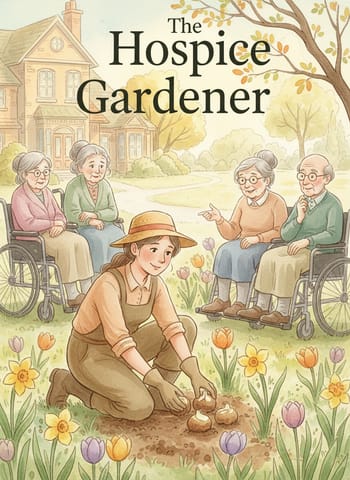
In October the ground at the hospice is cold on the surface and warm underneath. Timea, kneeling in the long bed beneath the east windows, has learned to tell by the smell of it whether the bulbs will take. This morning she has four hundred of them in a crate: daffodils, tulips, and the small blue squills that nobody notices until they have already won. She sets them in rows, pointed end up, a hand's width apart, and does not think about March.
That is not quite true. She thinks about March a great deal. She has worked here for six years, long enough to know the arithmetic. Most of the people who can see this bed from their pillows today will not be here when it flowers. She plants it regardless, every autumn, with the same slow care, like someone mending a coat for a journey she is not taking. What she has never managed to explain, even to herself, is why the care feels necessary rather than merely kind.
The layout of the beds is her one eccentricity. When she was hired, she asked the matron for the keys to the empty rooms. She spent an afternoon lying on each bed in turn, head on every pillow, working out what a person who could not get up would see through each window. The answer was almost nothing: a section of hedge, a drainpipe, the sky. So she redrew the garden from the bottom up. Had she trusted the plans instead, the long bed would have gone beside the car park, where visitors would have admired it. It sits under the east windows because of that afternoon. So is the birch, which she moved herself one terrible weekend, with a borrowed trolley and a great deal of swearing.
"You've been at that a while," says a voice behind her. It belongs to the woman from the corner room, a retired geography teacher who arrived in August and has the precise, dry diction of someone used to being obeyed by children. She sits in the open French window in her wheelchair, a knitted blanket over her knees, watching Timea's hands.
For some time she says nothing more. Then: "May I ask you something? You can tell me to mind my own business." Timea sits back on her heels. "Why do you bother? You must know most of us won't see them." The words are not unkind. If anything, they are curious in the way of someone who has been asking the same question of herself for weeks and has finally found somebody else to put it to.
Rarely has she been asked so plainly. Timea considers lying. She has a few good answers ready, the kind that appear in leaflets, about legacy and the cycle of things. She can feel how they would sound in this air, which is to say like decorations. "Because it's October," she says instead. "It's what the ground is for in October." She turns a bulb over in her glove. "And because I don't know who will be at the window in March. Nobody does. I'd rather there was something to look at."
The woman receives this without comment. Her mouth moves slightly, which may be a smile or the beginning of a cough.
"Which are those?" she asks, nodding at the crate. Timea tells her: the early daffodils, the mid-season tulips, and a late variety that flowers in the last week of April, if the spring is mean. "Mean springs suit the late ones best," she adds, and wishes at once that she had not.
"Late, then," says the woman. "Put the late ones under my window." She tucks the blanket tighter. "I've never been on time for anything. It seems only fair to back the one that isn't either."
Timea does not say that it is a bet she might lose. She takes up the trowel and starts to dig beneath the corner window, a row of small holes, a hand's width apart.