The Extra Eggs
Una historia gratuita en inglés de nivel A1 para estudiantes, para leer en línea en 7 idiomas, con opción de escucharla en la app gratuita Storyteller.
Edda has three hens but finds more and more eggs each morning, so she sits quietly in the garden to learn why.
¡Ese fue el avance! Escucha la historia completa en la app gratuita Storyteller. Descargar la app
El audio no está disponible en este momento.
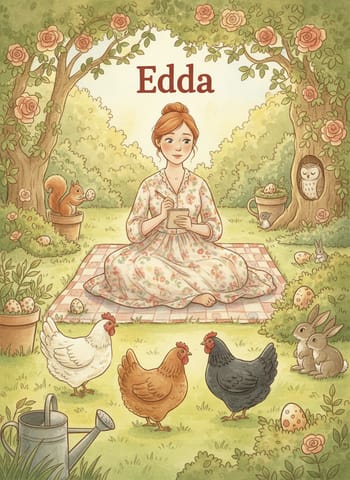
Edda lives in a small house. It is at the end of a quiet road. Behind the house there is a garden. In the garden there is a little wooden hen house. Three hens live in it. One is white, one is brown, and one is grey.
Edda vive en una casa pequeña. Está al final de un camino tranquilo. Detrás de la casa hay un jardín. En el jardín hay un pequeño gallinero de madera. Allí viven tres gallinas. Una es blanca, otra es marrón y otra es gris.
Every morning Edda walks to the hen house. She carries a basket. She opens the small door and counts the eggs. Three hens, three eggs. It is easy.
Cada mañana Edda va al gallinero. Lleva una canasta. Abre la puertecita y cuenta los huevos. Tres gallinas, tres huevos. Es fácil.
On Tuesday she opens the door. There are four eggs. She counts them again. One, two, three, four.
El martes abre la puerta. Hay cuatro huevos. Los cuenta otra vez. Uno, dos, tres, cuatro.
"That is strange," she says. "I have three hens."
«Qué raro», dice. «Tengo tres gallinas».
She looks at the hens. They look back at her. The white hen makes a small noise. It does not tell her anything.
Mira a las gallinas. Ellas la miran a ella. La gallina blanca hace un ruidito. No le dice nada.
On Wednesday there are four eggs again. On Thursday there are five. Edda stands in the garden with her basket. She is very surprised.
El miércoles vuelve a haber cuatro huevos. El jueves hay cinco. Edda se queda de pie en el jardín con su canasta. Está muy sorprendida.
"Do you have a secret?" she asks the hens. "Do you have a friend?"
«¿Tienen un secreto?», les pregunta a las gallinas. «¿Tienen una amiga?».
The hens only eat their corn.
Las gallinas solo comen su maíz.
Edda looks at the new eggs. Her own hens lay brown eggs. But two new eggs are small and light blue. They are very pretty.
Edda mira los huevos nuevos. Sus gallinas ponen huevos marrones. Pero dos de los huevos nuevos son pequeños y de un azul claro. Son muy bonitos.
"These are not your eggs," she says. "Who lays blue eggs?"
«Estos no son sus huevos», dice. «¿Quién pone huevos azules?».
At lunch she talks to her neighbor across the road. He is a tall man with a big beard.
A la hora del almuerzo habla con su vecino del otro lado del camino. Es un hombre alto con una barba grande.
"Do you have hens?" she asks.
«¿Tiene gallinas?», le pregunta.
"Yes, I have four," he says. "But I get no eggs these days. I do not know why. They look healthy."
«Sí, tengo cuatro», dice él. «Pero estos días no me dan huevos. No sé por qué. Se ven sanas».
"What color are your eggs?" asks Edda.
«¿De qué color son sus huevos?», pregunta Edda.
"Light blue," he says. "They are always blue."
«Azul claro», dice él. «Siempre son azules».
Edda starts to smile. "I think I have your eggs," she says.
Edda empieza a sonreír. «Creo que tengo sus huevos», dice.
"My eggs?" he says. "How?"
«¿Mis huevos?», dice él. «¿Cómo?».
"I do not know yet," says Edda. "But I will find out."
«Todavía no lo sé», dice Edda. «Pero lo voy a averiguar».
On Friday she gets up very early. The sun is not yet up. She makes a cup of tea. She sits on a chair near the hen house. She does not move. She does not make a sound.
El viernes se levanta muy temprano. El sol todavía no ha salido. Se prepara una taza de té. Se sienta en una silla cerca del gallinero. No se mueve. No hace ningún ruido.
The garden is cold and quiet. A bird sings in the apple tree. The grass is wet.
El jardín está frío y en silencio. Un pájaro canta en el manzano. El pasto está mojado.
After an hour, Edda sees something at the back fence. It is a small black hen. She is not one of Edda's hens. She pushes through a hole in the fence. She walks across the grass. She walks very fast, like a person late for work.
Después de una hora, Edda ve algo junto a la cerca del fondo. Es una gallina negra pequeña. No es una de las gallinas de Edda. Se mete por un hueco en la cerca. Camina por el pasto. Camina muy rápido, como una persona que llega tarde al trabajo.
The black hen goes straight to the hen house. She hops through the door. Edda waits. After ten minutes the black hen comes out. She walks back to the fence. She goes through the hole.
La gallina negra va derecho al gallinero. Salta por la puerta. Edda espera. A los diez minutos la gallina negra sale. Camina de vuelta hacia la cerca. Pasa por el hueco.
Edda opens the hen house. There is a new blue egg in the corner.
Edda abre el gallinero. Hay un huevo azul nuevo en el rincón.
She laughs so much that she spills her tea.
Se ríe tanto que derrama el té.
Later she walks across the road with her basket. The neighbor opens the door.
Más tarde cruza el camino con su canasta. El vecino abre la puerta.
"Good news and bad news," says Edda. "The bad news is this. Your black hen visits my garden every day. The good news is that I have your eggs."
«Buenas noticias y malas noticias», dice Edda. «La mala noticia es esta: su gallina negra visita mi jardín todos los días. La buena noticia es que tengo sus huevos».
The neighbor puts his hand on his head. "She is a thief!" he says. Then he laughs too.
El vecino se lleva la mano a la cabeza. «¡Es una ladrona!», dice. Luego se ríe también.
"I will fix the hole in the fence," he says.
«Voy a arreglar el hueco de la cerca», dice.
"Please do not fix it too fast," says Edda. "I like her. She is a hard worker."
«Por favor, no lo arregle muy rápido», dice Edda. «Me cae bien. Es muy trabajadora».
They put six blue eggs on the table. They share them in half.
Ponen seis huevos azules sobre la mesa. Los comparten por la mitad.
The next day the neighbor brings Edda a pie. It is warm and it smells of apples.
Al día siguiente el vecino le trae un pastel a Edda. Está caliente y huele a manzana.
"I made it with your eggs," he says. "Or with my eggs. I do not know anymore."
«Lo hice con sus huevos», dice él. «O con mis huevos. Ya no sé».