Lot Forty-One, a Scarf from the Night Boats
Una historia gratuita en inglés de nivel B2 para estudiantes, para leer en línea en 7 idiomas, con opción de escucharla en la app gratuita Storyteller.
A deckhand who knits on night watches enters his best scarf in the harbour fish auction, and it takes two attempts to find the right way to offer it.
¡Ese fue el avance! Escucha la historia completa en la app gratuita Storyteller. Descargar la app
El audio no está disponible en este momento.
The auction at the harbour begins before the sun is properly up, in a long concrete hall that smells of salt, diesel and wet ice. Boxes of fish stand in rows on the floor, silver and glassy-eyed, each with a numbered card tucked under the lid. Buyers walk slowly between them with their hands in their pockets, pretending not to be interested.
La subasta del puerto empieza antes de que el sol haya salido del todo, en un largo galpón de concreto que huele a sal, diésel y hielo mojado. Las cajas de pescado están en hileras sobre el piso, plateadas y de ojos vidriosos, cada una con una tarjeta numerada metida bajo la tapa. Los compradores caminan despacio entre ellas con las manos en los bolsillos, fingiendo no tener ningún interés.
Vasco stands at the high desk at the end of the hall. He is the auctioneer's clerk, which means he keeps the list and holds the bell. On mornings when the real auctioneer has a cold, he does the shouting too. Today the real auctioneer has a cold. Vasco has been awake since four, and his voice has the rough, flat edge of a man who has not yet had breakfast.
Vasco está de pie en el alto escritorio del fondo del galpón. Es el asistente del subastador, lo que significa que lleva la lista y sostiene la campana. En las mañanas en que el subastador de verdad está resfriado, también se encarga de los gritos. Hoy el subastador de verdad está resfriado. Vasco lleva despierto desde las cuatro, y su voz tiene el filo áspero y plano de un hombre que todavía no ha desayunado.
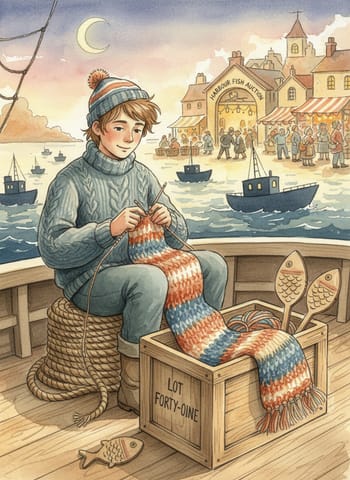
Uri arrives at twenty past five, carrying something under his arm. He is a deckhand from one of the night boats, a broad, quiet man with salt-cracked knuckles. Usually he goes straight home to sleep after unloading. This morning he stops in front of the desk and puts a roll of wool on the wood.
Uri llega a las cinco y veinte, con algo bajo el brazo. Es un marinero de cubierta de una de las embarcaciones nocturnas, un hombre corpulento y callado, con los nudillos agrietados por la sal. Normalmente se va directo a casa a dormir después de descargar. Esta mañana se detiene frente al escritorio y deja un rollo de lana sobre la madera.
"I would like to enter a lot," he says.
«Quisiera inscribir un lote», dice.
Vasco looks at the roll. It unrolls a little on its own, and he sees that it is a scarf. It is very long, knitted in a close grey-blue pattern like the surface of the sea.
Vasco mira el rollo. Se desenrolla un poco solo, y ve que es una bufanda. Es muy larga, tejida en un punto apretado de gris azulado, como la superficie del mar.
"We sell fish," Vasco says.
«Aquí vendemos pescado», dice Vasco.
"I know. But the rules say anything can be entered if the owner pays the fee." Uri pushes a coin across the desk. "It is a good scarf. I made it myself."
«Lo sé. Pero el reglamento dice que se puede inscribir cualquier cosa si el dueño paga la cuota». Uri empuja una moneda por el escritorio. «Es una buena bufanda. La hice yo mismo».
"On the boat?"
«¿En el barco?».
"On the night watches. Two hours each, when the engine is steady and there is nothing to do but look at the dark. The needles keep my hands busy." Uri shrugs, a little embarrassed. "I have knitted nine of these. I give most of them away. But this one is the best, and I would like to see what it is worth."
«En las guardias de noche. Dos horas cada una, cuando el motor va estable y no hay nada que hacer salvo mirar la oscuridad. Las agujas me mantienen las manos ocupadas». Uri se encoge de hombros, un poco avergonzado. «He tejido nueve así. La mayoría las regalo. Pero esta es la mejor, y me gustaría ver cuánto vale».
"Who is it for?"
«¿Para quién es?».
"Nobody in particular," Uri says. "That is the point."
«Para nadie en particular», dice Uri. «Ese es el punto».
Vasco has worked at the harbour for nineteen years, and he has learned that some questions are better not to ask twice. He writes the entry in his book: LOT 41, ONE SCARF, WOOL. Then he sets it on the end of a table between a crate of mackerel and a box of brown crabs. The crabs are still moving their claws, very slowly, in the cold.
Vasco lleva diecinueve años trabajando en el puerto, y ha aprendido que a algunas preguntas es mejor no repetirlas. Anota la entrada en su libro: LOTE 41, UNA BUFANDA, LANA. Luego la deja en el extremo de una mesa, entre un cajón de caballa y una caja de cangrejos pardos. Los cangrejos todavía mueven las pinzas, muy despacio, en el frío.
At six o'clock the bell rings and the buyers gather. Lot after lot goes by in a rapid chant of numbers. Vasco keeps his eyes on the paper, but when he reaches forty-one, he cannot stop himself from hesitating.
A las seis suena la campana y los compradores se reúnen. Un lote tras otro pasa en un rápido cántico de números. Vasco mantiene los ojos en el papel, pero cuando llega al cuarenta y uno, no puede evitar titubear.
"Lot forty-one," he calls. "One scarf. Hand-knitted. Who will start me at ten?"
«Lote cuarenta y uno», anuncia. «Una bufanda. Tejida a mano. ¿Quién me ofrece diez para empezar?».
For a moment the hall is entirely silent. Then somebody at the back begins to laugh. It is a friendly laugh, not a cruel one, but it spreads through the room like a draught. Soon half the buyers are grinning at each other.
Por un momento el galpón queda en completo silencio. Entonces alguien al fondo empieza a reírse. Es una risa amistosa, no cruel, pero se extiende por la sala como una corriente de aire. Pronto la mitad de los compradores se sonríen entre sí.
"What does it catch?" a man calls. "Is it for the crabs?"
«¿Qué pesca?», grita un hombre. «¿Es para los cangrejos?».
"A coin," another man says. "I bid a coin."
«Una moneda», dice otro. «Ofrezco una moneda».
"One coin," Vasco says, flatly. "Do I hear two?"
«Una moneda», dice Vasco, sin entonación. «¿Alguien da dos?».
Nobody does. The bell rings, and the scarf is sold for the price of a cup of coffee to a restaurant cook who does not want it. The buyers return to the mackerel. Uri stands at the edge of the hall with his hands behind his back. He does not say anything. The cook tries to hand the scarf back with a half-apologetic smile. Uri nods once and takes it, and then walks out into the pale light on the quay.
Nadie da. Suena la campana, y la bufanda se vende por el precio de una taza de café a un cocinero de restaurante que no la quiere. Los compradores vuelven a la caballa. Uri se queda al borde del galpón con las manos a la espalda. No dice nada. El cocinero intenta devolverle la bufanda con una sonrisa mitad disculpa. Uri asiente una vez y la recibe, y luego sale a la pálida luz del muelle.
Vasco watches him go. He is not a sentimental man, but he has a bad conscience, and a bad conscience at six in the morning is difficult to ignore. He finishes the auction in a daze. When the last box has been carried away, the hall is empty except for the noise of the hoses. He takes off his apron and goes to look for Uri.
Vasco lo ve irse. No es un hombre sentimental, pero tiene mala conciencia, y una mala conciencia a las seis de la mañana es difícil de ignorar. Termina la subasta como aturdido. Cuando se llevan la última caja, el galpón queda vacío salvo por el ruido de las mangueras. Se quita el delantal y va a buscar a Uri.
He finds him sitting on a bollard at the end of the quay, with the scarf folded on his knees.
Lo encuentra sentado en un noray al final del muelle, con la bufanda doblada sobre las rodillas.
"The mistake was mine," Vasco says. "We put it among the fish, and fish are priced by weight. Nobody knows how to price a scarf in that room."
«El error fue mío», dice Vasco. «La pusimos entre el pescado, y el pescado se cotiza por peso. En esa sala nadie sabe cómo poner precio a una bufanda».
"Nobody wants a scarf," Uri says. "It is fine."
«Nadie quiere una bufanda», dice Uri. «Está bien».
"That is not true. Nobody wants a scarf that is presented as a joke. It is different if they understand what it is." Vasco sits down beside him on the cold concrete. "What if we do it again, tomorrow, but not the same way? No bell. No lot number. You tell them what you told me."
«Eso no es cierto. Nadie quiere una bufanda que se presenta como una broma. Es distinto si entienden lo que es». Vasco se sienta a su lado sobre el concreto frío. «¿Y si lo hacemos de nuevo mañana, pero de otra manera? Sin campana. Sin número de lote. Les dices lo que me dijiste a mí».
"That I made it on night watches?"
«¿Que la hice en las guardias de noche?».
"That you made it for whoever needs it. And you do not sell it for money. You give it to the person who asks for it first."
«Que la hiciste para quien la necesite. Y no la vendes por dinero. Se la das a la primera persona que la pida».
Uri turns the idea over for a long time. A gull lands on the bollard, considers them both and leaves.
Uri le da vueltas a la idea durante un buen rato. Una gaviota se posa en el noray, los considera a ambos y se va.
"All right," he says.
«De acuerdo», dice.
The next morning, before the first bell, Vasco clears a space at the end of the hall. He puts down no table and no card. When the buyers arrive, Uri stands in front of them holding the scarf, and he speaks slowly, in his low voice, without looking at anyone.
A la mañana siguiente, antes de la primera campana, Vasco despeja un espacio en el extremo del galpón. No pone mesa ni tarjeta. Cuando llegan los compradores, Uri se para frente a ellos con la bufanda en las manos y habla despacio, con su voz grave, sin mirar a nadie.
He says that he made it on the boat, two hours a night, for sixteen nights. He says that he has no sister or mother who needs it, and that he did not make it for anybody he knows. He says that anyone who is cold at work may ask for it, and that nobody has to pay.
Dice que la hizo en el barco, dos horas por noche, durante dieciséis noches. Dice que no tiene una hermana ni una madre que la necesite, y que no la hizo para nadie que conozca. Dice que cualquiera que tenga frío en el trabajo puede pedirla, y que nadie tiene que pagar.
This time nobody laughs.
Esta vez nadie se ríe.
A buyer in a white apron looks at his shoes. Another coughs and pretends to read his list. For a long time the only sound is the soft, constant drip of melting ice from the boxes.
Un comprador de delantal blanco se mira los zapatos. Otro tose y finge leer su lista. Durante un buen rato, el único sonido es el goteo suave y constante del hielo que se derrite en las cajas.
Then a voice from the side door says, "I would like it, if that is allowed."
Entonces una voz desde la puerta lateral dice: «Yo la quisiera, si se puede».
It belongs to a young woman in a thin jacket, who works the ice machine at the back of the hall. She has stood in its white breath every morning for a year, and nobody has ever thought to ask whether she was warm. She stands in the doorway with her arms folded tightly against her ribs, as if she is not sure she should have spoken.
Es una joven de chaqueta delgada, que atiende la máquina de hielo del fondo del galpón. Lleva un año de pie en su aliento blanco todas las mañanas, y a nadie se le ha ocurrido preguntarle si tenía calor. Está en el umbral con los brazos cruzados con fuerza contra las costillas, como si no estuviera segura de haber debido hablar.
Uri walks across the hall without hurrying. The buyers part to let him through, and nobody says a word. He stops in front of her, shakes out the long grey-blue wool, and lifts it over her head.
Uri cruza el galpón sin prisa. Los compradores se abren para dejarlo pasar, y nadie dice una palabra. Se detiene frente a ella, sacude la larga lana gris azulada y se la pasa por encima de la cabeza.
Then he winds it twice around her neck, and tucks in the ends.
Luego se la enrolla dos veces alrededor del cuello y le acomoda las puntas.