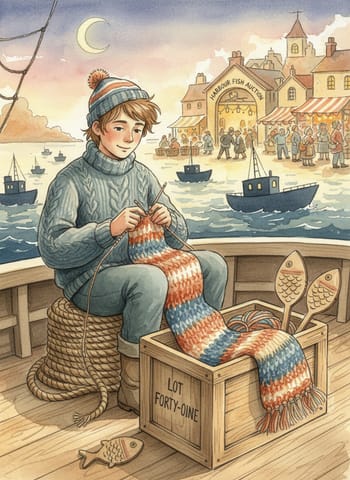
Lot Forty-One, a Scarf from the Night Boats
一个面向英语学习者的免费 B2 级英语故事,可用 7 种语言在线阅读,也可以在免费的 Storyteller 应用中收听。
A deckhand who knits on night watches enters his best scarf in the harbour fish auction, and it takes two attempts to find the right way to offer it.
试听结束!在免费的 Storyteller 应用中收听完整故事。 下载应用
音频暂时无法播放。
The auction at the harbour begins before the sun is properly up, in a long concrete hall that smells of salt, diesel and wet ice. Boxes of fish stand in rows on the floor, silver and glassy-eyed, each with a numbered card tucked under the lid. Buyers walk slowly between them with their hands in their pockets, pretending not to be interested.
港口的拍卖会在太阳还没完全升起之前就开始了,地点是一间长长的混凝土大厅,里面弥漫着盐、柴油和湿冰的气味。一箱箱鱼一排排摆在地上,银闪闪的,眼睛像玻璃,每个箱盖下都塞着一张编了号的卡片。买家们双手插在口袋里,在鱼箱之间慢悠悠地走着,假装自己并不感兴趣。
Vasco stands at the high desk at the end of the hall. He is the auctioneer's clerk, which means he keeps the list and holds the bell. On mornings when the real auctioneer has a cold, he does the shouting too. Today the real auctioneer has a cold. Vasco has been awake since four, and his voice has the rough, flat edge of a man who has not yet had breakfast.
瓦斯科站在大厅尽头的高台前。他是拍卖师的文书,也就是负责记名单、摇铃铛的人。要是真正的拍卖师感冒了,他连吆喝也一并代劳。今天,真正的拍卖师感冒了。瓦斯科从四点起就没睡,嗓音带着一个还没吃早饭的人那种粗哑而平板的味道。
Uri arrives at twenty past five, carrying something under his arm. He is a deckhand from one of the night boats, a broad, quiet man with salt-cracked knuckles. Usually he goes straight home to sleep after unloading. This morning he stops in front of the desk and puts a roll of wool on the wood.
乌里在五点二十分到了,腋下夹着什么东西。他是一条夜班渔船上的水手,身材宽厚,沉默寡言,指关节被盐渍得皲裂。卸完货后,他通常会直接回家睡觉。可今天早上,他在高台前停了下来,把一卷毛线放在木台上。
"I would like to enter a lot," he says.
“我想登记一件拍品,”他说。
Vasco looks at the roll. It unrolls a little on its own, and he sees that it is a scarf. It is very long, knitted in a close grey-blue pattern like the surface of the sea.
瓦斯科看着那卷东西。它自己松开了一点,他这才看出那是一条围巾。围巾很长,织着细密的灰蓝色花纹,像海面一样。
"We sell fish," Vasco says.
“我们卖的是鱼,”瓦斯科说。
"I know. But the rules say anything can be entered if the owner pays the fee." Uri pushes a coin across the desk. "It is a good scarf. I made it myself."
“我知道。可规矩上说,只要物主交了费用,什么都可以登记。”乌里把一枚硬币推过桌面。“这是条好围巾,是我自己织的。”
"On the boat?"
“在船上织的?”
"On the night watches. Two hours each, when the engine is steady and there is nothing to do but look at the dark. The needles keep my hands busy." Uri shrugs, a little embarrassed. "I have knitted nine of these. I give most of them away. But this one is the best, and I would like to see what it is worth."
“在夜班的时候织的。每次两个小时,那时候引擎很平稳,除了看着黑夜也没别的事可做。织针能让我的手有事做。”乌里耸耸肩,有些不好意思。“这样的围巾,我织过九条,大多都送人了。但这一条是最好的,我想看看它值多少钱。”
"Who is it for?"
“是给谁的?”
"Nobody in particular," Uri says. "That is the point."
“不是给特定的人,”乌里说,“这正是关键。”
Vasco has worked at the harbour for nineteen years, and he has learned that some questions are better not to ask twice. He writes the entry in his book: LOT 41, ONE SCARF, WOOL. Then he sets it on the end of a table between a crate of mackerel and a box of brown crabs. The crabs are still moving their claws, very slowly, in the cold.
瓦斯科在港口工作了十九年,他早就明白,有些问题最好不要问第二遍。他在簿子上写下登记:第41号拍品,围巾一条,羊毛。然后他把它放在一张桌子的一端,夹在一箱鲭鱼和一盒棕色螃蟹之间。螃蟹在寒冷中还在非常缓慢地挥动着钳子。
At six o'clock the bell rings and the buyers gather. Lot after lot goes by in a rapid chant of numbers. Vasco keeps his eyes on the paper, but when he reaches forty-one, he cannot stop himself from hesitating.
六点钟,铃声一响,买家们聚拢过来。一件又一件拍品在一连串飞快的报数声中过去。瓦斯科的目光一直盯着纸,但轮到四十一号时,他还是忍不住迟疑了一下。
"Lot forty-one," he calls. "One scarf. Hand-knitted. Who will start me at ten?"
“第四十一号拍品,”他喊道,“围巾一条,手工编织。谁愿意从十块起价?”
For a moment the hall is entirely silent. Then somebody at the back begins to laugh. It is a friendly laugh, not a cruel one, but it spreads through the room like a draught. Soon half the buyers are grinning at each other.
一时间,大厅里一片寂静。接着后面有人笑了起来。那是友善的笑,不是恶意的,却像一阵穿堂风一样在大厅里传开。很快,半数买家都互相咧嘴笑着。
"What does it catch?" a man calls. "Is it for the crabs?"
“它能钓到什么?”一个男人喊道,“是给螃蟹用的吗?”
"A coin," another man says. "I bid a coin."
“一枚硬币,”另一个男人说,“我出一枚硬币。”
"One coin," Vasco says, flatly. "Do I hear two?"
“一枚硬币,”瓦斯科平平地说,“有人出两枚吗?”
Nobody does. The bell rings, and the scarf is sold for the price of a cup of coffee to a restaurant cook who does not want it. The buyers return to the mackerel. Uri stands at the edge of the hall with his hands behind his back. He does not say anything. The cook tries to hand the scarf back with a half-apologetic smile. Uri nods once and takes it, and then walks out into the pale light on the quay.
没有人出价。铃声响起,围巾以一杯咖啡的价钱卖给了一位并不想要它的餐馆厨师。买家们回到鲭鱼那边去了。乌里背着手,站在大厅边上,什么也没说。厨师带着半是歉意的笑容想把围巾还给他。乌里点了点头,接了过来,然后走出去,走进码头上苍白的晨光里。
Vasco watches him go. He is not a sentimental man, but he has a bad conscience, and a bad conscience at six in the morning is difficult to ignore. He finishes the auction in a daze. When the last box has been carried away, the hall is empty except for the noise of the hoses. He takes off his apron and goes to look for Uri.
瓦斯科看着他走远。他不是个多愁善感的人,可他有些愧疚,而清晨六点的愧疚是很难不理会的。他迷迷糊糊地把拍卖办完了。等最后一箱鱼被搬走,大厅里除了水管的哗哗声,空空荡荡。他摘下围裙,去找乌里。
He finds him sitting on a bollard at the end of the quay, with the scarf folded on his knees.
他在码头尽头的一个系缆桩上找到了他。乌里坐在那儿,膝盖上叠放着那条围巾。
"The mistake was mine," Vasco says. "We put it among the fish, and fish are priced by weight. Nobody knows how to price a scarf in that room."
“错在我,”瓦斯科说,“我们把它放进了鱼堆里,而鱼是按重量定价的。在那间屋子里,谁也不知道怎么给一条围巾定价。”
"Nobody wants a scarf," Uri says. "It is fine."
“没人想要围巾,”乌里说,“没关系的。”
"That is not true. Nobody wants a scarf that is presented as a joke. It is different if they understand what it is." Vasco sits down beside him on the cold concrete. "What if we do it again, tomorrow, but not the same way? No bell. No lot number. You tell them what you told me."
“不是这样的。要是把围巾当成笑话摆出来,当然没人想要。如果他们明白这是什么,就不一样了。”瓦斯科在冰冷的水泥地上坐到他身边。“我们明天再来一次,但不能用同样的方式,怎么样?不摇铃,不编号。你把对我说过的话告诉他们。”
"That I made it on night watches?"
“说我是在夜班时织的?”
"That you made it for whoever needs it. And you do not sell it for money. You give it to the person who asks for it first."
“说你是为任何需要它的人织的。而且不卖钱,谁先开口要,就给谁。”
Uri turns the idea over for a long time. A gull lands on the bollard, considers them both and leaves.
乌里把这个想法翻来覆去想了很久。一只海鸥落在系缆桩上,打量了他们两个一番,又飞走了。
"All right," he says.
“好吧,”他说。
The next morning, before the first bell, Vasco clears a space at the end of the hall. He puts down no table and no card. When the buyers arrive, Uri stands in front of them holding the scarf, and he speaks slowly, in his low voice, without looking at anyone.
第二天早晨,第一声铃响之前,瓦斯科在大厅尽头清出了一块空地。他没摆桌子,也没放卡片。买家们到了以后,乌里拿着围巾站在他们面前,用低沉的嗓音缓缓地说着,没有看任何人。
He says that he made it on the boat, two hours a night, for sixteen nights. He says that he has no sister or mother who needs it, and that he did not make it for anybody he knows. He says that anyone who is cold at work may ask for it, and that nobody has to pay.
他说,他是在船上织的,每晚两个小时,一共织了十六个晚上。他说,他没有需要这条围巾的姐姐或母亲,也不是为任何认识的人织的。他说,任何人只要在工作时觉得冷,都可以来要,谁也不用付钱。
This time nobody laughs.
这一回,没有人笑。
A buyer in a white apron looks at his shoes. Another coughs and pretends to read his list. For a long time the only sound is the soft, constant drip of melting ice from the boxes.
一个系白围裙的买家低头看着自己的鞋。另一个人咳嗽了一声,假装在看自己的单子。很长一段时间里,唯一的声音是鱼箱里融化的冰水轻轻而不停的滴答声。
Then a voice from the side door says, "I would like it, if that is allowed."
接着,侧门那边传来一个声音:“如果可以的话,我想要。”
It belongs to a young woman in a thin jacket, who works the ice machine at the back of the hall. She has stood in its white breath every morning for a year, and nobody has ever thought to ask whether she was warm. She stands in the doorway with her arms folded tightly against her ribs, as if she is not sure she should have spoken.
说话的是一位穿着薄外套的年轻女子,她在大厅后面操作制冰机。一年来,每天早晨她都站在它白色的寒气里,从来没有人想过问问她冷不冷。她站在门口,双臂紧紧抱在肋骨前,仿佛不确定自己是否该开口。
Uri walks across the hall without hurrying. The buyers part to let him through, and nobody says a word. He stops in front of her, shakes out the long grey-blue wool, and lifts it over her head.
乌里不慌不忙地穿过大厅。买家们让开一条路,谁也没有出声。他在她面前停下,抖开那条长长的灰蓝色围巾,从她头上套了下去。
Then he winds it twice around her neck, and tucks in the ends.
然后他把围巾在她脖子上绕了两圈,把两头掖好。