Lot Forty-One, a Scarf from the Night Boats
A free B2-level English story for language learners, readable online in 7 languages, with an option to listen via the free Storyteller app.
A deckhand who knits on night watches enters his best scarf in the harbour fish auction, and it takes two attempts to find the right way to offer it.
That was the preview! Hear the full story in the free Storyteller app. Get the app
Audio isn't available right now.
The auction at the harbour begins before the sun is properly up, in a long concrete hall that smells of salt, diesel and wet ice. Boxes of fish stand in rows on the floor, silver and glassy-eyed, each with a numbered card tucked under the lid. Buyers walk slowly between them with their hands in their pockets, pretending not to be interested.
Vasco stands at the high desk at the end of the hall. He is the auctioneer's clerk, which means he keeps the list and holds the bell. On mornings when the real auctioneer has a cold, he does the shouting too. Today the real auctioneer has a cold. Vasco has been awake since four, and his voice has the rough, flat edge of a man who has not yet had breakfast.
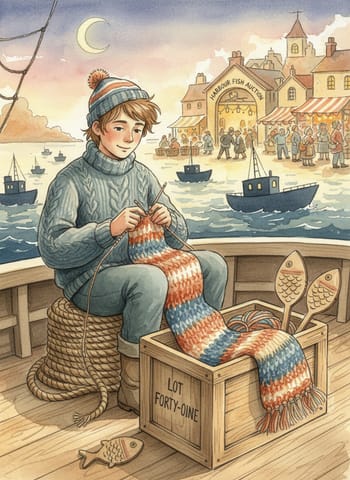
Uri arrives at twenty past five, carrying something under his arm. He is a deckhand from one of the night boats, a broad, quiet man with salt-cracked knuckles. Usually he goes straight home to sleep after unloading. This morning he stops in front of the desk and puts a roll of wool on the wood.
"I would like to enter a lot," he says.
Vasco looks at the roll. It unrolls a little on its own, and he sees that it is a scarf. It is very long, knitted in a close grey-blue pattern like the surface of the sea.
"We sell fish," Vasco says.
"I know. But the rules say anything can be entered if the owner pays the fee." Uri pushes a coin across the desk. "It is a good scarf. I made it myself."
"On the boat?"
"On the night watches. Two hours each, when the engine is steady and there is nothing to do but look at the dark. The needles keep my hands busy." Uri shrugs, a little embarrassed. "I have knitted nine of these. I give most of them away. But this one is the best, and I would like to see what it is worth."
"Who is it for?"
"Nobody in particular," Uri says. "That is the point."
Vasco has worked at the harbour for nineteen years, and he has learned that some questions are better not to ask twice. He writes the entry in his book: LOT 41, ONE SCARF, WOOL. Then he sets it on the end of a table between a crate of mackerel and a box of brown crabs. The crabs are still moving their claws, very slowly, in the cold.
At six o'clock the bell rings and the buyers gather. Lot after lot goes by in a rapid chant of numbers. Vasco keeps his eyes on the paper, but when he reaches forty-one, he cannot stop himself from hesitating.
"Lot forty-one," he calls. "One scarf. Hand-knitted. Who will start me at ten?"
For a moment the hall is entirely silent. Then somebody at the back begins to laugh. It is a friendly laugh, not a cruel one, but it spreads through the room like a draught. Soon half the buyers are grinning at each other.
"What does it catch?" a man calls. "Is it for the crabs?"
"A coin," another man says. "I bid a coin."
"One coin," Vasco says, flatly. "Do I hear two?"
Nobody does. The bell rings, and the scarf is sold for the price of a cup of coffee to a restaurant cook who does not want it. The buyers return to the mackerel. Uri stands at the edge of the hall with his hands behind his back. He does not say anything. The cook tries to hand the scarf back with a half-apologetic smile. Uri nods once and takes it, and then walks out into the pale light on the quay.
Vasco watches him go. He is not a sentimental man, but he has a bad conscience, and a bad conscience at six in the morning is difficult to ignore. He finishes the auction in a daze. When the last box has been carried away, the hall is empty except for the noise of the hoses. He takes off his apron and goes to look for Uri.
He finds him sitting on a bollard at the end of the quay, with the scarf folded on his knees.
"The mistake was mine," Vasco says. "We put it among the fish, and fish are priced by weight. Nobody knows how to price a scarf in that room."
"Nobody wants a scarf," Uri says. "It is fine."
"That is not true. Nobody wants a scarf that is presented as a joke. It is different if they understand what it is." Vasco sits down beside him on the cold concrete. "What if we do it again, tomorrow, but not the same way? No bell. No lot number. You tell them what you told me."
"That I made it on night watches?"
"That you made it for whoever needs it. And you do not sell it for money. You give it to the person who asks for it first."
Uri turns the idea over for a long time. A gull lands on the bollard, considers them both and leaves.
"All right," he says.
The next morning, before the first bell, Vasco clears a space at the end of the hall. He puts down no table and no card. When the buyers arrive, Uri stands in front of them holding the scarf, and he speaks slowly, in his low voice, without looking at anyone.
He says that he made it on the boat, two hours a night, for sixteen nights. He says that he has no sister or mother who needs it, and that he did not make it for anybody he knows. He says that anyone who is cold at work may ask for it, and that nobody has to pay.
This time nobody laughs.
A buyer in a white apron looks at his shoes. Another coughs and pretends to read his list. For a long time the only sound is the soft, constant drip of melting ice from the boxes.
Then a voice from the side door says, "I would like it, if that is allowed."
It belongs to a young woman in a thin jacket, who works the ice machine at the back of the hall. She has stood in its white breath every morning for a year, and nobody has ever thought to ask whether she was warm. She stands in the doorway with her arms folded tightly against her ribs, as if she is not sure she should have spoken.
Uri walks across the hall without hurrying. The buyers part to let him through, and nobody says a word. He stops in front of her, shakes out the long grey-blue wool, and lifts it over her head.
Then he winds it twice around her neck, and tucks in the ends.