Lot Forty-One, a Scarf from the Night Boats
Uma história gratuita em inglês de nível B2 para estudantes, para ler online em 7 idiomas, com opção de ouvir no app gratuito Storyteller.
A deckhand who knits on night watches enters his best scarf in the harbour fish auction, and it takes two attempts to find the right way to offer it.
Essa foi a prévia! Ouça a história completa no app gratuito Storyteller. Baixar o app
O áudio não está disponível no momento.
The auction at the harbour begins before the sun is properly up, in a long concrete hall that smells of salt, diesel and wet ice. Boxes of fish stand in rows on the floor, silver and glassy-eyed, each with a numbered card tucked under the lid. Buyers walk slowly between them with their hands in their pockets, pretending not to be interested.
O leilão do porto começa antes de o sol estar bem alto, num longo galpão de concreto que cheira a sal, diesel e gelo molhado. Caixas de peixe ficam em fileiras no chão, prateadas e de olhos vidrados, cada uma com um cartão numerado enfiado sob a tampa. Os compradores caminham devagar entre elas, com as mãos nos bolsos, fingindo não ter interesse.
Vasco stands at the high desk at the end of the hall. He is the auctioneer's clerk, which means he keeps the list and holds the bell. On mornings when the real auctioneer has a cold, he does the shouting too. Today the real auctioneer has a cold. Vasco has been awake since four, and his voice has the rough, flat edge of a man who has not yet had breakfast.
Vasco está na mesa alta no fim do galpão. Ele é o escrivão do leiloeiro, o que significa que cuida da lista e segura o sino. Nas manhãs em que o leiloeiro de verdade está resfriado, ele também faz os pregões. Hoje o leiloeiro de verdade está resfriado. Vasco está acordado desde as quatro, e sua voz tem a aspereza seca de um homem que ainda não tomou café da manhã.
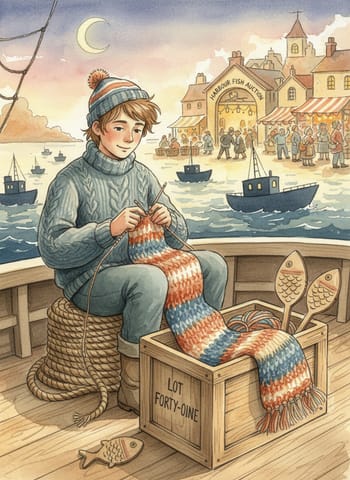
Uri arrives at twenty past five, carrying something under his arm. He is a deckhand from one of the night boats, a broad, quiet man with salt-cracked knuckles. Usually he goes straight home to sleep after unloading. This morning he stops in front of the desk and puts a roll of wool on the wood.
Uri chega às cinco e vinte, carregando algo debaixo do braço. Ele é um marinheiro de um dos barcos da noite, um homem robusto e calado, com os nós dos dedos rachados pelo sal. Normalmente vai direto para casa dormir depois de descarregar. Nesta manhã, para diante da mesa e põe um rolo de lã sobre a madeira.
"I would like to enter a lot," he says.
"Gostaria de inscrever um lote", diz ele.
Vasco looks at the roll. It unrolls a little on its own, and he sees that it is a scarf. It is very long, knitted in a close grey-blue pattern like the surface of the sea.
Vasco olha para o rolo. Ele se desenrola um pouco sozinho, e Vasco vê que é um cachecol. É muito longo, tricotado num padrão cerrado de cinza-azulado, como a superfície do mar.
"We sell fish," Vasco says.
"Nós vendemos peixe", diz Vasco.
"I know. But the rules say anything can be entered if the owner pays the fee." Uri pushes a coin across the desk. "It is a good scarf. I made it myself."
"Eu sei. Mas as regras dizem que qualquer coisa pode ser inscrita se o dono pagar a taxa." Uri empurra uma moeda pela mesa. "É um bom cachecol. Eu mesmo fiz."
"On the boat?"
"No barco?"
"On the night watches. Two hours each, when the engine is steady and there is nothing to do but look at the dark. The needles keep my hands busy." Uri shrugs, a little embarrassed. "I have knitted nine of these. I give most of them away. But this one is the best, and I would like to see what it is worth."
"Nos plantões da noite. Duas horas cada, quando o motor está firme e não há nada a fazer além de olhar para o escuro. As agulhas ocupam minhas mãos." Uri dá de ombros, um pouco constrangido. "Já tricotei nove destes. Dou a maioria. Mas este é o melhor, e eu gostaria de ver quanto vale."
"Who is it for?"
"É para quem?"
"Nobody in particular," Uri says. "That is the point."
"Para ninguém em particular", diz Uri. "É esse o ponto."
Vasco has worked at the harbour for nineteen years, and he has learned that some questions are better not to ask twice. He writes the entry in his book: LOT 41, ONE SCARF, WOOL. Then he sets it on the end of a table between a crate of mackerel and a box of brown crabs. The crabs are still moving their claws, very slowly, in the cold.
Vasco trabalha no porto há dezenove anos e aprendeu que algumas perguntas é melhor não fazer duas vezes. Escreve o registro no livro: LOTE 41, UM CACHECOL, LÃ. Depois o coloca na ponta de uma mesa, entre uma caixa de cavalas e uma caixa de caranguejos marrons. Os caranguejos ainda mexem as garras, bem devagar, no frio.
At six o'clock the bell rings and the buyers gather. Lot after lot goes by in a rapid chant of numbers. Vasco keeps his eyes on the paper, but when he reaches forty-one, he cannot stop himself from hesitating.
Às seis horas o sino toca e os compradores se reúnem. Lote após lote passa numa cantilena rápida de números. Vasco mantém os olhos no papel, mas ao chegar ao quarenta e um, não consegue evitar uma hesitação.
"Lot forty-one," he calls. "One scarf. Hand-knitted. Who will start me at ten?"
"Lote quarenta e um", chama. "Um cachecol. Tricotado à mão. Quem dá o primeiro lance de dez?"
For a moment the hall is entirely silent. Then somebody at the back begins to laugh. It is a friendly laugh, not a cruel one, but it spreads through the room like a draught. Soon half the buyers are grinning at each other.
Por um momento o galpão fica em completo silêncio. Então alguém no fundo começa a rir. É uma risada amistosa, não cruel, mas se espalha pela sala como uma corrente de ar. Logo metade dos compradores sorri uns para os outros.
"What does it catch?" a man calls. "Is it for the crabs?"
"O que ele pega?", grita um homem. "É para os caranguejos?"
"A coin," another man says. "I bid a coin."
"Uma moeda", diz outro homem. "Dou uma moeda."
"One coin," Vasco says, flatly. "Do I hear two?"
"Uma moeda", diz Vasco, sem emoção. "Ouço duas?"
Nobody does. The bell rings, and the scarf is sold for the price of a cup of coffee to a restaurant cook who does not want it. The buyers return to the mackerel. Uri stands at the edge of the hall with his hands behind his back. He does not say anything. The cook tries to hand the scarf back with a half-apologetic smile. Uri nods once and takes it, and then walks out into the pale light on the quay.
Ninguém dá. O sino toca, e o cachecol é vendido pelo preço de um café a um cozinheiro de restaurante que não o quer. Os compradores voltam às cavalas. Uri fica na beira do galpão, com as mãos atrás das costas. Não diz nada. O cozinheiro tenta devolver o cachecol com um sorriso meio pedindo desculpas. Uri assente uma vez e o pega, e depois sai para a luz pálida do cais.
Vasco watches him go. He is not a sentimental man, but he has a bad conscience, and a bad conscience at six in the morning is difficult to ignore. He finishes the auction in a daze. When the last box has been carried away, the hall is empty except for the noise of the hoses. He takes off his apron and goes to look for Uri.
Vasco o observa ir. Não é um homem sentimental, mas tem a consciência pesada, e uma consciência pesada às seis da manhã é difícil de ignorar. Ele termina o leilão como num transe. Quando a última caixa é levada, o galpão está vazio, exceto pelo barulho das mangueiras. Ele tira o avental e vai procurar Uri.
He finds him sitting on a bollard at the end of the quay, with the scarf folded on his knees.
Encontra-o sentado num cabeço no fim do cais, com o cachecol dobrado nos joelhos.
"The mistake was mine," Vasco says. "We put it among the fish, and fish are priced by weight. Nobody knows how to price a scarf in that room."
"O erro foi meu", diz Vasco. "Colocamos entre os peixes, e peixe se precifica por peso. Ninguém sabe dar preço a um cachecol naquela sala."
"Nobody wants a scarf," Uri says. "It is fine."
"Ninguém quer um cachecol", diz Uri. "Tudo bem."
"That is not true. Nobody wants a scarf that is presented as a joke. It is different if they understand what it is." Vasco sits down beside him on the cold concrete. "What if we do it again, tomorrow, but not the same way? No bell. No lot number. You tell them what you told me."
"Não é verdade. Ninguém quer um cachecol que é apresentado como piada. É diferente se entenderem o que ele é." Vasco senta ao lado dele no concreto frio. "E se fizéssemos de novo, amanhã, mas de outro jeito? Sem sino. Sem número de lote. Você conta a eles o que me contou."
"That I made it on night watches?"
"Que fiz nos plantões da noite?"
"That you made it for whoever needs it. And you do not sell it for money. You give it to the person who asks for it first."
"Que fez para quem precisar. E você não vende por dinheiro. Dá para a primeira pessoa que pedir."
Uri turns the idea over for a long time. A gull lands on the bollard, considers them both and leaves.
Uri revira a ideia por um longo tempo. Uma gaivota pousa no cabeço, olha os dois e vai embora.
"All right," he says.
"Está bem", diz ele.
The next morning, before the first bell, Vasco clears a space at the end of the hall. He puts down no table and no card. When the buyers arrive, Uri stands in front of them holding the scarf, and he speaks slowly, in his low voice, without looking at anyone.
Na manhã seguinte, antes do primeiro sino, Vasco abre um espaço no fim do galpão. Não coloca mesa nem cartão. Quando os compradores chegam, Uri fica diante deles segurando o cachecol, e fala devagar, com sua voz grave, sem olhar para ninguém.
He says that he made it on the boat, two hours a night, for sixteen nights. He says that he has no sister or mother who needs it, and that he did not make it for anybody he knows. He says that anyone who is cold at work may ask for it, and that nobody has to pay.
Diz que o fez no barco, duas horas por noite, durante dezesseis noites. Diz que não tem irmã nem mãe que precise dele, e que não o fez para ninguém que conheça. Diz que qualquer pessoa que sinta frio no trabalho pode pedi-lo, e que ninguém precisa pagar.
This time nobody laughs.
Desta vez ninguém ri.
A buyer in a white apron looks at his shoes. Another coughs and pretends to read his list. For a long time the only sound is the soft, constant drip of melting ice from the boxes.
Um comprador de avental branco olha para os sapatos. Outro tosse e finge ler a lista. Por muito tempo, o único som é o gotejar suave e constante do gelo derretendo nas caixas.
Then a voice from the side door says, "I would like it, if that is allowed."
Então uma voz vinda da porta lateral diz: "Eu gostaria dele, se for permitido."
It belongs to a young woman in a thin jacket, who works the ice machine at the back of the hall. She has stood in its white breath every morning for a year, and nobody has ever thought to ask whether she was warm. She stands in the doorway with her arms folded tightly against her ribs, as if she is not sure she should have spoken.
É de uma jovem de jaqueta fina, que trabalha na máquina de gelo no fundo do galpão. Ela fica no hálito branco da máquina todas as manhãs há um ano, e ninguém nunca pensou em perguntar se ela estava aquecida. Ela fica na porta com os braços apertados contra as costelas, como se não tivesse certeza de que devia ter falado.
Uri walks across the hall without hurrying. The buyers part to let him through, and nobody says a word. He stops in front of her, shakes out the long grey-blue wool, and lifts it over her head.
Uri atravessa o galpão sem pressa. Os compradores abrem caminho, e ninguém diz uma palavra. Ele para diante dela, sacode a longa lã cinza-azulada e a ergue sobre a cabeça dela.
Then he winds it twice around her neck, and tucks in the ends.
Depois a enrola duas vezes no pescoço dela e ajeita as pontas.