A Meadow in Two Thousand Pieces
Una historia gratuita en inglés de nivel A2 para estudiantes, para leer en línea en 7 idiomas, con opción de escucharla en la app gratuita Storyteller.
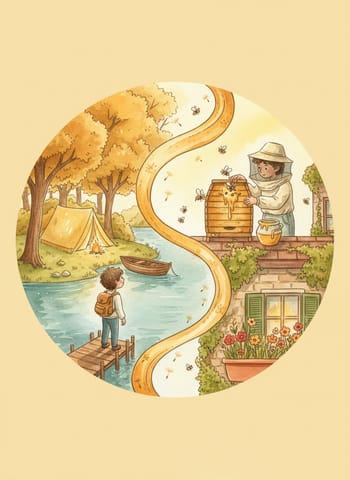
Anand must pick between a lake camp and the first honey harvest from his rooftop hive.
¡Ese fue el avance! Escucha la historia completa en la app gratuita Storyteller. Descargar la app
El audio no está disponible en este momento.
There is a beehive on the roof of Orchard Court. There is a table too. The hive is white and made of wood. The table holds a jigsaw puzzle under a sheet of plastic. Both of them belong to Anand and Nami now.
En el techo de Orchard Court hay una colmena. También hay una mesa. La colmena es blanca y de madera. La mesa tiene un rompecabezas bajo una lámina de plástico. Ahora ambas cosas pertenecen a Anand y a Nami.
Anand climbs the roof stairs every morning in the summer holidays. He puts on his gloves and lifts the lid of the hive. The bees hum like a small, busy city. The last keeper left town in March. She gave him the roof key.
Anand sube las escaleras del techo todas las mañanas durante las vacaciones de verano. Se pone los guantes y levanta la tapa de la colmena. Las abejas zumban como una pequeña ciudad ajetreada. La última apicultora se fue del pueblo en marzo. Ella le dio la llave del techo.
Nami lives on the third floor. She came last winter and knew no one. One day she follows the sound of the bees up the stairs. Now she comes to the roof every evening. She brings two glasses of juice.
Nami vive en el tercer piso. Llegó el invierno pasado y no conocía a nadie. Un día sigue el zumbido de las abejas escaleras arriba. Ahora viene al techo todas las tardes. Trae dos vasos de jugo.
The puzzle is her idea. A neighbor left it behind in a cardboard box. It shows a green meadow full of flowers. It has two thousand pieces. The sky is finished. The grass is nearly done. The flowers are the hard part. Every piece looks like every other piece.
El rompecabezas fue idea de ella. Un vecino lo dejó olvidado en una caja de cartón. Muestra una pradera verde llena de flores. Tiene dos mil piezas. El cielo está terminado. El pasto está casi listo. Las flores son la parte difícil. Cada pieza se parece a todas las demás.
"Yellow, yellow, yellow," says Nami. She holds up a piece and frowns at it. "Who needs this much yellow?"
«Amarillo, amarillo, amarillo», dice Nami. Levanta una pieza y la mira con el ceño fruncido. «¿Quién necesita tanto amarillo?».
"The bees do," says Anand.
«Las abejas», dice Anand.
This week, Anand has a problem. It is a good problem, but it is still a problem. He has two invitations, and both of them are for Saturday.
Esta semana, Anand tiene un problema. Es un buen problema, pero sigue siendo un problema. Tiene dos invitaciones, y las dos son para el sábado.
The first is from his cousin Dev. Dev goes to a lake camp for a week. There is swimming and boats. A long wooden raft floats in the lake. Three of Anand's school friends go too. Dev saves him a bed in the cabin. He sends a photo of the raft.
La primera es de su primo Dev. Dev va a un campamento en un lago durante una semana. Hay natación y botes. En el lago flota una larga balsa de madera. Tres amigos de la escuela de Anand también van. Dev le guarda una cama en la cabaña. Le manda una foto de la balsa.
The second invitation comes from the leader of the beekeepers' club. She sends a short message. The honey is ready on Saturday. Anand can run the harvest himself, for the first time. Nami can help him. The work takes the whole week. The honey must rest in buckets before the jars.
La segunda invitación viene de la líder del club de apicultores. Le manda un mensaje corto. La miel estará lista el sábado. Anand puede dirigir la cosecha él solo, por primera vez. Nami puede ayudarlo. El trabajo dura toda la semana. La miel debe reposar en cubetas antes de pasar a los frascos.
Anand reads both messages three times. He reads them again at lunch. He puts his phone face down on the table. Then he picks it up again.
Anand lee los dos mensajes tres veces. Los vuelve a leer a la hora del almuerzo. Pone el teléfono boca abajo sobre la mesa. Luego lo vuelve a tomar.
"What do I do?" he asks Nami that evening.
«¿Qué hago?», le pregunta a Nami esa tarde.
Nami fits a flower piece into the meadow. It snaps into place with a tiny click. "Both are good," she says. "You will have fun at camp. And you will learn something here."
Nami encaja una pieza de flor en la pradera. Entra con un clic diminuto. «Las dos opciones son buenas», dice. «Te divertirás en el campamento. Y aquí aprenderás algo».
"That is not helpful."
«Eso no ayuda».
"I know." She grins. "Go or stay, I'm fine. Really. I can find another helper without you."
«Ya lo sé». Sonríe. «Si te vas o te quedas, a mí me da igual. De verdad. Puedo encontrar otro ayudante sin ti».
"You can't lift the frames alone."
«No puedes levantar los marcos sola».
"Then I will find a strong person." She keeps her eyes on the puzzle, and her voice stays light.
«Entonces buscaré a una persona fuerte». Mantiene la vista en el rompecabezas, y su voz sigue ligera.
Anand does not answer. He picks up a piece and turns it over in his fingers. He cannot see where it goes. He puts it down and picks up another one.
Anand no responde. Toma una pieza y le da vueltas entre los dedos. No ve dónde va. La deja y toma otra.
On Friday morning, Anand has to decide by noon. He goes up to the roof early. The sun is already warm on the tar. The hive is loud. He puffs gentle smoke at the door. Then he lifts the lid.
El viernes por la mañana, Anand tiene que decidir antes del mediodía. Sube temprano al techo. El sol ya está tibio sobre el alquitrán. La colmena suena fuerte. Echa un poco de humo suave a la entrada. Luego levanta la tapa.
He pulls out the first frame. It is heavy and sticky. The honeycomb is gold from edge to edge. He pulls out a second frame. It is the same. Then a third.
Saca el primer marco. Es pesado y pegajoso. El panal es dorado de borde a borde. Saca un segundo marco. Es igual. Luego un tercero.
A bee walks across his glove. It stops at his thumb and cleans its wings. Anand stays very still. He knows this bee, or one just like her. She does not know what Saturday means. She only knows the work is done. The honey is ready.
Una abeja camina sobre su guante. Se detiene en su pulgar y se limpia las alas. Anand se queda muy quieto. Conoce a esta abeja, o a una igual a ella. Ella no sabe qué significa sábado. Solo sabe que el trabajo está hecho. La miel está lista.
He thinks about the lake. He thinks about the raft and the cabin. He thinks about the loud laughter at night. It all sounds wonderful. At camp, he will be one of fifty kids. Nobody will need him. Nobody will ask him anything.
Piensa en el lago. Piensa en la balsa y en la cabaña. Piensa en las risas fuertes por la noche. Todo suena maravilloso. En el campamento será uno de cincuenta niños. Nadie lo necesitará. Nadie le preguntará nada.
Then he thinks about this hive. He knows the sound of happy bees. He knows the sound of worried ones. He knows which frames to take. He knows which to leave for the winter. A stranger will open this lid. That person will not know these bees.
Luego piensa en esta colmena. Conoce el sonido de las abejas contentas. Conoce el sonido de las preocupadas. Sabe qué marcos sacar. Sabe cuáles dejar para el invierno. Un desconocido abrirá esta tapa. Esa persona no conocerá a estas abejas.
Anand puts the frame back, gently, and closes the lid. He takes out his phone. His thumbs move fast.
Anand vuelve a poner el marco con suavidad y cierra la tapa. Saca el teléfono. Sus pulgares se mueven rápido.
"Sorry, Dev. I can't come. Bee work. Say hello to the raft for me."
«Perdón, Dev. No puedo ir. Trabajo con las abejas. Saluda a la balsa de mi parte».
He sends it before he can change his mind. His chest feels light and a little sad at the same time.
Lo envía antes de poder cambiar de opinión. El pecho se le siente ligero y un poco triste a la vez.
When he turns around, Nami stands at the top of the stairs. She holds two glasses of juice and a flat black bag.
Cuando se da la vuelta, Nami está de pie en lo alto de las escaleras. Sostiene dos vasos de jugo y un bolso negro plano.
"You are here early," she says. "The club leader sent this. It has the honey knife."
«Llegaste temprano», dice. «La líder del club mandó esto. Trae el cuchillo para la miel».
"I stay," he says. "For the harvest."
«Me quedo», dice él. «Para la cosecha».
Nami puts the glasses on the table. Her smile starts small and gets wide. "You did not have to."
Nami pone los vasos sobre la mesa. Su sonrisa empieza pequeña y se ensancha. «No tenías por qué».
"I know. I want to." He looks at the hive and then at her. "At camp, I swim. Here, I make something. I like to make things."
«Ya lo sé. Quiero hacerlo». Mira la colmena y luego a ella. «En el campamento nado. Aquí hago algo. Me gusta hacer cosas».
"Good," says Nami. "Because the knife is very sharp. I'm afraid of it."
«Bien», dice Nami. «Porque el cuchillo está muy afilado. Me da miedo».
"You said you were fine alone."
«Dijiste que estarías bien sola».
"I am fine. I just like it better this way."
«Estoy bien. Solo que así me gusta más».
They sit down at the table. They peel the plastic from the meadow. Nami finds a corner piece. Anand finds three flowers that fit together. They work in the warm sun until the puzzle is almost full. Only one gap remains, near the middle. It sits between a blue flower and tall grass.
Se sientan a la mesa. Quitan el plástico de la pradera. Nami encuentra una pieza de esquina. Anand encuentra tres flores que encajan entre sí. Trabajan bajo el sol tibio hasta que el rompecabezas está casi lleno. Solo queda un hueco, cerca del medio. Está entre una flor azul y el pasto alto.
Nami checks the box. It is empty. She turns it upside down and shakes it. Nothing falls out. She looks under the table and inside her shoes.
Nami revisa la caja. Está vacía. La pone boca abajo y la sacude. No cae nada. Mira debajo de la mesa y dentro de sus zapatos.
"It was here yesterday," she says.
«Ayer estaba aquí», dice.
Anand leans over the gap. It is small, but the whole picture needs it. A bee comes in from the sky. She lands on the empty place. She walks across it in a slow circle. She cleans her wings, in no hurry at all.
Anand se inclina sobre el hueco. Es pequeño, pero toda la imagen lo necesita. Una abeja llega desde el cielo. Se posa en el lugar vacío. Camina sobre él en un lento círculo. Se limpia las alas, sin ninguna prisa.