The Ladder That Fell Short
A free B2-level English story for language learners, readable online in 7 languages, with an option to listen via the free Storyteller app.
On the last night of the season, two cousins try to free a glowing creature from the skylight of a seaside arcade before the shutters close.
That was the preview! Hear the full story in the free Storyteller app. Get the app
Audio isn't available right now.
The arcade at the end of the promenade is closing for the winter, and tonight is the last night. Remy has worked here all summer, and he knows every sound the place makes. There is the chime of the coin machines, the thump of the dance floor and the wet clatter of tokens in trays. At ten o'clock exactly, the owner's timer will shut the iron shutters over every window and skylight. After that, nobody comes in until spring.
At a quarter to nine, Remy is mopping around the air-hockey tables. His cousin Wes runs in from the back office with his phone in his hand.
"Come and see the skylight," Wes says. "Now. Do not ask me why."
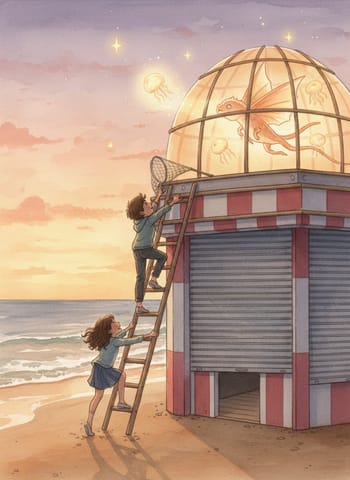
Remy leans the mop against the wall and follows him to the centre of the hall. High above them, four metres up, there is a round window of old glass. Something is moving behind it. It is small and blue, about the size of a pear, and it glows like a lamp turned very low.
"It is a bird," Remy says. "A bird with a light on it."
"Birds do not hum," Wes says. "Listen."
The blue shape bumps against the glass, again and again. Each time it makes a thin, sad note, like a finger running around the rim of a cup. Remy realises that he has heard that sound before. For two weeks he has been catching a faint singing in the evenings and blaming the speakers.
"It came in off the sea," Wes says. "The fishermen at the harbour talk about sea-lamps, little lights that follow the boats home. I always thought they were only stories."
"If it is real, it is trapped," Remy says. He looks at the clock above the prize counter. "And we have an hour and a quarter before the shutters close."
"Then we need the ladder," Wes says.
They fetch the old aluminium ladder from the cleaning cupboard and carry it under the skylight. Remy climbs first. The latch of the window is a small brass hook on the far side of the frame. He stretches as far as he can, with his fingertips trembling. He misses it by an arm's length.
"It is too short," he calls down. "At least a metre too short."
"The long ladder is in the harbour shed," Wes says. "That is ten minutes there and ten minutes back, if the shed key is where I think it is."
"And if it is not?"
Wes does not answer. They both look at the clock. It is ten past nine.
Remy climbs down and sits on the bottom step with his chin in his hands. Above him, the blue light has stopped bumping the glass. It hangs in the middle of the dome, dimmer than before. Its note is so quiet now that he has to hold his breath to hear it.
"It is getting weaker," he says.
"Then we run to the shed," Wes says.
"No." Remy frowns at the ceiling. "Think about what it does when it moves. This afternoon, when I switched on the big pinball machine, it went straight to the edge of the dome nearest to it. And when you waved your phone just now, it turned its head. If it is a bird at all, it is the kind that follows the brightest thing in the room."
"The brightest thing in the room is the moon," Wes says. "It is shining straight through that glass."
"Exactly. So we make something brighter than the moon." Remy stands up. "We do not climb to the sea-lamp. We bring it down to us."
Wes stares at him. Then, slowly, he begins to grin.
"You are going to switch on everything," he says.
"Everything," Remy says. "And we are going to build a staircase out of light."
It is eighteen minutes past nine. They split the hall between them and run.
Wes takes the left side, slamming his hand against the master panel one switch at a time. The pinball machines blaze into life, then the racing cars, then the shooting games with their flashing targets. Remy takes the right side. He kicks open the box under the dance platform. The floor strips come alive with pink and green chase lights that race towards the front doors. He sets the claw machine to its brightest setting. Then he drags the cable of the neon sign outside, so that it throws a wide white pool across the entrance.
Last of all, he runs to the great mirror ball hanging in the middle of the ceiling. Its motor is old and stiff, but when he presses the button it starts to turn. Hundreds of tiny reflections begin to crawl over the walls.
"It is not enough," Wes says, looking up. "The moon is still winning."
He is right. The blue light has stirred, but it is hovering where it was. It trembles between the glass and the glittering room, as if it cannot make up its mind. The clock says twenty-eight minutes past nine.
"We need a bridge," Remy says. "Something close to the ceiling that reflects the light back up. Wes, give me your phone."
He climbs the short ladder once more, and this time he does not try to reach the window. He aims the phone's torch at the mirror ball from the highest rung. The beam hits the spinning glass and breaks into a hundred beams. A line of tiny white stars climbs the wall, one after another, all the way to the skylight.
Then he holds his breath again.
The blue light shivers. It lifts its glow away from the moon and slides out into the room. It follows the stars down the wall, hesitant at first, then a little faster. Remy pulls the torch away from the ceiling, and the stars follow it. They slide down his arm and over his shoulder and out across the floor. The sea-lamp comes after them in a long, slow spiral.
"It is working," Wes whispers.
"Do not speak," Remy whispers back. "Do not move."
The sea-lamp passes within a hand's width of his face. Up close it is not a bird, or even a creature. It is a small ball of cold fire, with a pale ring spinning inside it like a coin on a table. It smells faintly of salt and of the inside of a shell. For a second it stops in front of him. Remy feels something very light brush across his thoughts, like a hand pressing a window from the other side.
Then it drifts away, down the floor strips, towards the doors.
The two boys follow it at a distance. The clock says forty minutes past nine, and the shutters will start to move at ten. The sea-lamp reaches the neon sign, and the white pool of light, and the dark open air beyond. It rises over the promenade railing and turns once, as if saying goodbye, and then it slips down to the black water and disappears.
For a long moment the promenade is silent, except for the waves against the stones.
"We should switch everything off," Remy says at last, "before the owner sees the electricity bill."
"We have twenty minutes," Wes says, and he is laughing now. "I would like to see him try to be angry about this."
They go back inside and begin to turn off the machines, one by one. The last light to go is the mirror ball, which spins down slowly until it is only a dark shape in the roof. In the new quiet, the clock ticks forward, and ten o'clock arrives exactly on time.
The two boys step out into the cool night and pull the front doors behind them. Somewhere above their heads, a motor wakes up, and the iron shutters begin to fall.
"Do you think it will come back in the spring?" Wes asks.
Remy watches the dark water for a while. "Ask me in April," he says, and they walk home along the promenade.