The Kite in the Ripest Tree
一个面向英语学习者的免费 B2 级英语故事,可用 7 种语言在线阅读,也可以在免费的 Storyteller 应用中收听。
Every picking season a kite with a broken string appears in a different apple tree, and a seasonal worker sets out to learn who moves it.
试听结束!在免费的 Storyteller 应用中收听完整故事。 下载应用
音频暂时无法播放。
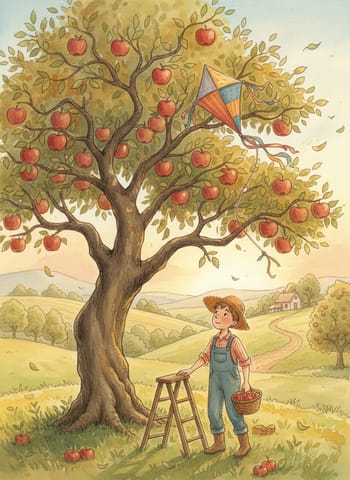
On the first morning of picking, Naveen finds the kite in the third tree of the lower row. It hangs from a high branch, its paper wings folded like a sleeping bird and its tail twisted around a cluster of apples. The string is broken a few feet below the kite, and the loose end swings gently without any help from the air.
采摘季的第一个早晨,纳文在下排第三棵树上发现了那只风筝。它挂在一根高高的树枝上,纸做的翅膀像睡着的鸟一样收拢着,尾巴缠在一簇苹果上。风筝线在离风筝几英尺的地方断了,断开的那一头轻轻晃动,没有风也在动。
"Don't touch it," says the foreman, Imre. "That means the orchard has chosen."
“别碰它,”工头伊姆雷说,“这说明果园已经选好了。”
Naveen has been coming to this orchard for four harvests, and he knows the old sayings. The trees here are said to be shy, and the pickers believe they lean toward whoever treats them well. If a kite appears in a tree overnight, that tree is picked first. Its fruit must be carried down by hand, not shaken into baskets. Nobody remembers who started the custom, but nobody has ever dared to break it.
纳文已经来这个果园干了四个收获季,知道这里的老规矩。人们说这里的树很害羞,采摘工相信它们会朝善待自己的人倾斜。如果一夜之间有只风筝出现在某棵树上,这棵树就先摘。它的果子必须用手一个个捧下来,不能摇进筐里。没人记得是谁开的这个头,可是从来没人敢破坏它。
What puzzles him is that no one has ever seen the kite arrive. There is no kite at the orchard, no children, and no field open enough to fly one. Each year the old kite is found in some tree on the morning of picking and gone again after the last apple is down.
让他想不通的是,从来没有人见过风筝是怎么来的。果园里没有风筝,没有孩子,也没有一块足够开阔、可以放风筝的空地。每年,采摘开始的那天早晨,人们总会发现那只旧风筝挂在某棵树上,等最后一只苹果摘下来,它又不见了。
"Maybe it's the orchard itself," Fabio says at breakfast. He is Naveen's bunk-mate, a quiet packer who has worked here for years and ties every box with the same neat, looping bow. "Maybe the trees pass it from branch to branch while we sleep."
“也许是果园自己干的,”早饭时法比奥说。他是纳文的同铺,一个安静的包装工,已经在这里干了很多年,每只箱子都用同样整齐的环形蝴蝶结捆扎。“也许是我们睡觉的时候,树一根枝一根枝地把它传过去的。”
"Trees can't carry things," Naveen says.
“树不会搬东西。”纳文说。
"These ones are special."
“这里的树不一样。”
"Special how?"
“怎么不一样?”
Fabio only smiles and stirs his porridge. He yawns twice before the plates are cleared.
法比奥只是笑笑,搅着他的粥。盘子还没收走,他就打了两个哈欠。
By lunchtime, the whole crew has picked the first tree and carried down its fruit with gentle, careful hands. The apples are sweeter than any Naveen has tasted. He cannot tell whether that is magic or simply the pleasure of eating fruit carried like eggs. He sits in the shade with a cup of cider and studies the kite, now lying on the grass at the foot of the tree.
到午饭时分,整个采摘队已经摘完了第一棵树,用轻柔而小心的手把果子捧了下来。这些苹果比纳文尝过的任何苹果都甜。他分不清这是魔法,还是仅仅因为吃的是像捧鸡蛋一样捧下来的果子,所以格外开心。他坐在树荫里,端着一杯苹果酒,端详着那只风筝,它现在躺在树脚下的草地上。
It is a plain, tired thing. The paper is soft from many seasons, and there is a patch of dark clay on one wing. He turns it over and notices that the string is not torn at all. It has been cut cleanly with a blade, and then tied again around a small stone.
它是一件朴素而疲惫的东西。纸张经过许多个季节,已经变软了,一只翅膀上有一块深色的黏土。他把它翻过来,发现风筝线根本不是被扯断的,而是被刀干净利落地割断,然后又系在了一块小石头上。
This is his first clue, and it makes him uneasy. A spirit in a tree would not need a knife.
这是他的第一条线索,也让他心里不安。树里的精灵不需要用刀。
On the second morning, the kite is in a different tree, and Naveen is already waiting beside it. He arrived before dawn, though he cannot explain exactly why. This time the kite hangs from a branch of a silver-leaf apple, the oldest tree in the middle row. The string trails down to the ground in a neat loop. The loop ends in a bow.
第二天早晨,风筝换了一棵树,而纳文已经等在旁边了。他天亮前就到了,虽然说不清为什么。这一次,风筝挂在一棵银叶苹果树的枝上,那是中间那排里最老的一棵。风筝线一直垂到地面,绕成整齐的圈,圈的末端打着一个蝴蝶结。
Naveen stares at it for a long time.
纳文盯着它看了很久。
It is a particular bow, a double loop with the tails tucked under. He has seen it every day since the start of the season. It is the knot that Fabio uses on the boxes. It is also the knot on Fabio's boots.
那是一个特别的结,双环,线头塞在下面。从采摘季开始以来,他每天都能看到。这是法比奥捆箱子用的结,也是法比奥靴子上的结。
"A coincidence," he murmurs. "A lot of people tie bows."
“巧合,”他喃喃自语,“很多人都会打蝴蝶结。”
But that evening, when he sits at the end of the bunkhouse table, he notices the second clue without wanting to. Fabio's boots, standing by the door, are wet. They are not dusty, as boots should be after a day of packing. They are dark with dew and covered in tiny, pale seeds from the long grass.
可是那天晚上,他坐在工棚长桌的末端,不由自主地注意到了第二条线索。放在门边的法比奥的靴子是湿的。它们不是干活一天后应有的满是灰尘的样子,而是被露水浸得发黑,沾满了长草上的细小的浅色草籽。
Naveen decides not to say anything yet. Instead, he draws a rough plan of the orchard on the back of a crate label. He marks the two trees where the kite has appeared. The first is close to the bunkhouse door, and the second is a little farther out. When he joins the dots with a line and carries it on, it does not wander randomly. It runs steadily and a little crookedly toward the pond, where one tall tree stands at the water's edge. It follows the path of someone who walks in a straight line while thinking about something else. If he is right, tomorrow's kite will hang in that tree.
纳文决定暂时什么也不说。他在一张箱子标签的背面画了一张果园的草图,标出风筝出现过的两棵树。第一棵靠近工棚门口,第二棵稍微远一点。他用一条线把这两个点连起来,再接着延长,这条线并不是随意乱晃的,而是稳稳地、略带弯曲地通向池塘,池塘边上立着一棵高大的树。它走的是一个边想着别的事、边走直线的人的路径。如果他是对的,明天的风筝就会挂在那棵树上。
That night, he does not sleep. He lies on his bunk with his eyes half closed and listens to the creak of the roof and the slow breathing of the crew. Around two o'clock, the third clue arrives.
那天夜里他没有睡。他躺在铺位上,半闭着眼睛,听着屋顶的吱嘎声和同伴们缓慢的呼吸。大约两点钟,第三条线索出现了。
The bunk beside his creaks. Fabio sits up, swings his legs to the floor, and stands. His eyes are open but empty, like windows in a house with nobody home. He takes a kite from under his bed. It is the same plain kite, with the patch of dark clay on one wing. Fabio must have gathered it from the silver-leaf tree at dusk. Then he walks toward the door with the quiet confidence of a man on his way to work.
他旁边的铺位吱呀作响。法比奥坐起来,把双腿甩到地板上,站了起来。他的眼睛睁着,却空空的,像一座没人在家的房子的窗户。他从床底下拿出一只风筝,还是那只朴素的风筝,翅膀上有那块深色的黏土。法比奥一定是黄昏时从银叶树上取下来的。然后他朝门口走去,步履平静而笃定,像一个正去上班的人。
Naveen follows him at a safe distance. Fabio crosses the yard, steps through the gate, and walks the line from the crate label without once looking down. It leads him to the tall tree at the pond, where the crew left a ladder leaning against the trunk. He climbs with perfect balance, humming softly. At the top, he hangs the kite on a branch and ties a bow in the string. He checks the knot twice, like a clerk finishing a form. Then he climbs down, brushes the leaves from his shirt, and walks back to the bunkhouse. In three minutes he is asleep again.
纳文远远地跟在他后面。法比奥穿过院子,走出大门,沿着箱子标签上那条线走去,一次也没有低头看路。线的尽头是池塘边那棵高树,采摘队的人把一架梯子靠在树干上。他爬得稳稳当当,嘴里轻轻哼着歌。到了顶上,他把风筝挂在一根树枝上,在线上打了一个蝴蝶结。他检查了两遍结,像个办完表格的办事员。然后他爬下来,拍掉衬衫上的树叶,走回工棚。三分钟后,他又睡着了。
Naveen waits in the dark for a very long time before he laughs.
纳文在黑暗里等了很久很久,才笑了出来。
In the morning, he sits across from Fabio at breakfast and says nothing until the porridge arrives.
早晨,他坐在法比奥对面吃早饭,直到粥端上来才开口。
"Did you sleep well?"
“睡得好吗?”
"Like a stone," Fabio says. "Although I had a strange dream. I was a ladder, and everyone kept standing on me."
“像块石头,”法比奥说,“不过我做了个奇怪的梦。我成了一架梯子,大家一直踩在我身上。”
"It's the extra boxes," says Naveen. "You carry too much."
“是多搬了箱子的缘故,”纳文说,“你扛得太多了。”
"That must be it."
“一定是这样。”
Naveen slides the crate label across the table with the dots and the line. He lets the silence do the explaining, and Fabio reads it with his mouth slowly falling open. First he looks at the map, and then at his own muddy boots by the door, and then out of the window. A small paper shape hangs in the tallest tree by the pond.
纳文把那张画着点和线的箱子标签推过桌子。他让沉默来做解释,法比奥一边读,一边嘴巴慢慢张大。他先看那张图,再看门边自己沾满泥的靴子,又看向窗外。池塘边最高的那棵树上,挂着一个小小的纸影子。
"You're telling me," Fabio says at last, "that the orchard has been choosing the trees with my feet?"
“你是想告诉我,”法比奥终于说,“果园一直在用我的脚选树?”
"I'm telling you that the orchard has terrible taste in colleagues."
“我是想告诉你,果园挑同事的眼光糟透了。”
For a moment they sit in silence, and then both of them burst out laughing. The foreman looks over from the next table, frowning, and they hide their faces in their cups.
他们沉默了一会儿,然后两个人同时大笑起来。工头在旁边那张桌子上皱着眉看过来,他们把脸埋进杯子里。
Later, Naveen suggests that they keep the answer between the two of them.
后来,纳文提议,答案就留在他们两个人之间。
"What will we tell the others?" Fabio asks.
“那我们怎么跟别人说?”法比奥问。
"That the orchard has chosen. It always has." Naveen thinks about the sweetness of the first apples and the care with which they were carried. "I don't think it matters who holds the kite, as long as someone does."
“就说果园选好了。它一向如此。”纳文想起第一批苹果的甜,想起它们被捧下来时的小心翼翼。“我觉得谁来拿风筝都不重要,只要有人拿就行。”
That evening, after the last basket is stacked, the two of them climb the ladder together. They tie the kite higher, to the highest branch of the pond tree. The light is long and golden. The kite turns once and settles, its paper wings glowing like a lantern. The broken string stirs gently, as if something is still pulling from the other end.
那天傍晚,最后一筐码放好之后,两个人一起爬上梯子。他们把风筝系得更高,系在池塘边那棵树的最高枝上。光线长而金黄。风筝转了一圈,安定下来,纸翅膀像一盏灯笼似的发着光。断了的风筝线轻轻晃动,好像另一头仍然有什么东西在拉着。