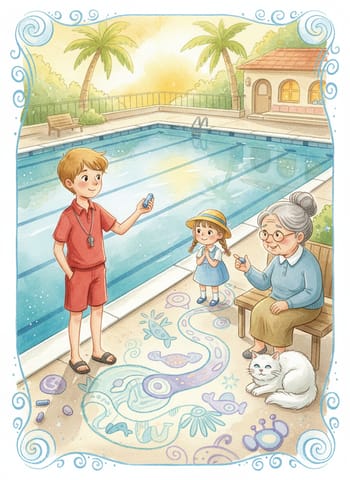
The city pool closes at nine, and by ten to nine it is almost empty. The last swimmers wrap themselves in towels and shuffle toward the changing rooms, leaving long wet footprints on the tiles. Ozan, nineteen years old, is in his second month as an evening lifeguard. He walks the length of the pool with a whistle he has never needed to blow.
市游泳馆九点关门,到八点五十分,馆里几乎已经空了。最后几位泳客裹着毛巾,拖着脚步走向更衣室,在瓷砖上留下一串长长的湿脚印。奥赞今年十九岁,在这里当晚班救生员刚满两个月。他拿着一只从来没用上过的哨子,沿着泳池从头走到尾。
His job at closing is simple. He checks the lanes, the toilets and the benches. Then he walks out through the side door to make sure that no child has been forgotten on the pavement. Tonight, in the orange light of the street lamp, he finds something else.
关门时他的活儿很简单:检查泳道、厕所和长椅,然后从侧门走出去,看看有没有哪个孩子被落在人行道上。今晚,在路灯橙黄的光里,他发现了别的东西。
On the grey stone beside the door, someone has drawn a large blue whale in chalk. It is a careful drawing. The whale has a white belly, a tiny eye, and a curved line of water rising from its back. Next to the whale lies a short stub of blue chalk, worn down almost to nothing.
门边的灰色石板上,有人用粉笔画了一条巨大的蓝鲸。画得很用心:鲸鱼有白色的肚皮、小小的眼睛,背上还喷出一道弯弯的水柱。鲸鱼旁边躺着一小截蓝粉笔,几乎已经磨光了。
Ozan crouches and picks it up. The chalk is warm from the lamp and leaves a blue powder on his fingers. He looks at the whale for a long moment. Then he checks his watch, because the cleaner will hose down the pavement at nine, and the whole drawing will be gone in ten minutes.
奥赞蹲下身,把它捡起来。粉笔被路灯烤得暖暖的,在他的手指上留下蓝色的粉末。他盯着那条鲸鱼看了好一会儿。然后他看了看表,因为清洁工九点要用水管冲洗人行道,再过十分钟,整幅画就会消失。
Edin, the cleaner, is already unrolling the hose when Ozan reaches the corner. He is a quiet man with a moustache and a bad knee, and he has worked at the pool longer than anyone can remember.
奥赞走到拐角时,清洁工埃丁已经在展开水管了。他是个安静的男人,留着胡子,膝盖不好,在这家游泳馆干了多久,谁也记不清了。
"Wait," Ozan says. "Please don't wash the pavement yet."
“等一等,”奥赞说,“请先别冲人行道。”
Edin looks at him over his glasses. "It is the same every night, my friend. I wash it at nine. Nothing important is ever on this pavement."
埃丁从眼镜上方看着他。“每天晚上都一样,伙计。我九点冲洗。这条人行道上从来没有什么重要的东西。”
"There is a whale," says Ozan.
“有一条鲸鱼,”奥赞说。
Edin sighs, walks to the door, and studies the drawing in silence. Then he turns off the water with a small, practical twist of his wrist. "Five minutes," he says. "After that, the whale goes to the sea."
埃丁叹了口气,走到门边,默默地端详那幅画。然后他手腕轻轻一拧,实用地把水关上了。“五分钟,”他说,“过了五分钟,鲸鱼就得回大海去了。”
Ozan understands that five minutes is a gift, and that he should use it well. He holds up the stub of chalk. "Somebody left this. I should return it to whoever owns it."
奥赞明白,这五分钟是一份礼物,他得好好利用。他举起那截粉笔。“有人把这个落下了。我应该把它还给它的主人。”
He takes it first to the front desk, where the receptionist is counting coins into a plastic tray. She is a cheerful woman who knows the name of every regular, and she glances at the chalk without much interest.
他先把它拿到前台,接待员正把硬币一枚枚数进塑料托盘里。她是个开朗的女人,认得每一位常客的名字,只瞥了一眼那截粉笔,兴趣不大。
"That belongs to the swimming instructor," she says. "She teaches the beginners on Tuesdays, and she draws on the pavement to explain strokes."
“那是游泳教练的,”她说,“她星期二教初学者,会在人行道上画画讲解泳姿。”
"It's a whale," Ozan says.
“这是一条鲸鱼,”奥赞说。
"She draws all kinds of animals. Take it to her, she's in the staff room."
“她什么动物都画。拿去给她吧,她在员工休息室。”
The instructor is sitting with her shoes off, eating an orange. She turns the chalk over in her fingers and shakes her head.
教练正脱了鞋坐着吃橘子。她把粉笔在指间翻来翻去,摇了摇头。
"I use white chalk, and I draw on a board, not on the ground. Besides, I am the worst drawer in the whole city." She laughs. "Whoever made your whale is much better than I am. Ask Edin. He knows who comes and goes around here."
“我用的是白粉笔,而且是画在黑板上,不是画在地上。再说,我是全城画得最差的人。”她笑了起来,“画你那条鲸鱼的人比我强多了。去问问埃丁吧,这一带谁来谁往,他都清楚。”
Ozan returns to the side door with the chalk still in his hand. Edin has moved a bench to the wall and sits down with a groan, his knee stretched out in front of him. He looks at the stub of chalk, then at the whale, then at Ozan.
奥赞手里还拿着粉笔,回到了侧门。埃丁已经把一条长椅挪到墙边,哼哼着坐下,伸直了那条伤膝盖。他看看那截粉笔,又看看鲸鱼,再看看奥赞。
"You went to the front desk and the staff room," Edin says. "Of course. People always look for an owner in the offices. The owner is usually outside, waiting for his mother."
“你去了前台,又去了休息室,”埃丁说,“当然啦。人们总是去办公室里找失主。可失主通常在外面,等他妈妈。”
"I don't understand."
“我不明白。”
"Neither did I, at first." Edin rubs the knee, and a slow smile appears under his moustache. "A boy comes here every evening with his mother. She works late in the café on the next street, and the boy waits outside the pool until she finishes. Last week I found a chalk heart on this pavement. The week before it was a bicycle. Each night I hose it away, and each night something new appears."
“我一开始也不明白。”埃丁揉着膝盖,胡子下慢慢浮起一丝笑意,“有个男孩每天傍晚都跟他妈妈一起来。她在隔壁街的咖啡馆干到很晚,男孩就在游泳馆外面等她下班。上个星期,我在这块人行道上看到过一颗粉笔画的心。再上个星期是一辆自行车。每天晚上我把它们冲掉,每天晚上又会出现新的东西。”
"So he draws them knowing you will wash them off?"
“那他是明知道你会冲掉,还照样画?”
"I think that is the point," says Edin. "A drawing that lasts is a thing to look at. A drawing that disappears is a thing you have to make again."
“我想这正是意义所在,”埃丁说,“一幅能留下来的画,是用来看的东西。一幅会消失的画,是你得再画一遍的东西。”
Ozan looks down at the stub of chalk in his palm. It is so short that it has almost no shape left. Whoever owns it has drawn a lot of whales and bicycles, and has probably never received a new piece.
奥赞低头看着掌心里的粉笔。它短得几乎已经没有形状了。它的主人画了很多鲸鱼和自行车,大概从来没有得到过一支新的。
At that moment, a small figure appears at the corner of the building. It is a boy of about nine, in a coat too large for him, with a school bag hanging off one shoulder. He stops dead when he sees two men standing over his whale.
就在这时,楼角处出现了一个小小的身影。那是个九岁左右的男孩,穿着一件对他来说太大的外套,肩上挂着书包。他看见两个男人站在他的鲸鱼上方,一下子愣住了。
"I'm sorry," the boy says quickly. "I know that I'm not allowed to draw here. I'll go."
“对不起,”男孩连忙说,“我知道这里不许画画。我走。”
"You are not in trouble," Ozan says. He kneels down so that his face is level with the boy's. "I found something of yours."
“你没有惹麻烦,”奥赞说。他单膝跪下,让自己的脸和男孩的脸一样高。“我捡到了你的东西。”
He opens his hand. The boy stares at the chalk for a second, and then at Ozan, and then at the chalk again. He takes it carefully, with the tips of two fingers, as if it might still belong to someone else.
他摊开手。男孩先盯着粉笔看了一秒,又看看奥赞,再看看粉笔。他用两根手指的指尖小心地把它拿起来,好像它还属于别人似的。
"It was getting too small," the boy whispers. "I could not hold it properly any more. I thought I had lost it."
“它越来越小了,”男孩小声说,“我已经握不稳了。我还以为把它弄丢了。”
"It was waiting for you," Edin says solemnly. "In my experience, good chalk always does."
“它在等你呢,”埃丁一本正经地说,“依我的经验,好粉笔总是会等的。”
Ozan feels in his pocket. At the bottom, beside a folded bus ticket, he finds a second piece of chalk. He took it from the instructor's board without thinking. It is white and almost new. He puts it in the boy's hand next to the blue stub.
奥赞伸手摸了摸口袋。在口袋底下,一张折起来的公交车票旁边,他摸到了另一支粉笔。他是不假思索地从教练的黑板上拿的。它是白色的,几乎是新的。他把它放进男孩手里,挨着那截蓝粉笔。
"It's for the clouds," he says. "Whales need something to look at."
“这是给云画的,”他说,“鲸鱼总得有点东西看吧。”
The boy nods very seriously. Then he walks to the edge of the drawing and kneels. With the white chalk he draws a small cloud above the whale, and then another. His tongue pokes out between his teeth as he works.
男孩非常认真地点了点头。然后他走到画的边缘,跪了下来。他用白粉笔在鲸鱼上方画了一朵小小的云,接着又画了一朵。他干活时,舌尖从牙齿间探了出来。
Edin switches on his torch and holds it over the pavement so that the boy can see. He does not say anything about the hose. It stands coiled against the wall, its end dripping a little onto the stone.
埃丁打开手电筒,举在人行道上方,好让男孩看得清楚。他一个字也没提水管。水管盘在墙边,管口还往石头上滴着一点水。
When the cloud is finished, the boy stands and looks at his work. Then he moves a few steps to the left, to the blank space beside the whale. There he draws a long straight line that rises from the ground toward the wall. At the top he draws a small square with a dark circle inside it.
云画完了,男孩站起来,端详自己的作品。然后他向左走了几步,来到鲸鱼旁边的空白处。他在那里画了一条长长的直线,从地面一直伸向墙壁。在顶端,他画了一个小方块,里面有一个深色的圆。
"What is that?" Ozan asks.
“那是什么?”奥赞问。
The boy only shrugs and keeps drawing. It looks like a window, high on a wall, with a light behind it.
男孩只是耸耸肩,继续画下去。看上去像一扇窗,高高地开在墙上,窗后亮着一盏灯。
Ozan glances at Edin. Edin shakes his head very slightly, and the hose stays where it is.
奥赞瞥了埃丁一眼。埃丁几乎看不出来地摇了摇头,水管便仍旧待在原地。