The Blue Chalk at Lane Six
Cerita bahasa Inggris gratis level B2 untuk pelajar, bisa dibaca online dalam 7 bahasa, dengan pilihan untuk mendengarkannya di aplikasi Storyteller gratis.
A young lifeguard tries to return a worn stub of chalk and learns who has been drawing on the pavement outside the pool.
Itu cuplikannya! Dengarkan cerita lengkapnya di aplikasi Storyteller gratis. Unduh aplikasi
Audio belum tersedia saat ini.
The city pool closes at nine, and by ten to nine it is almost empty. The last swimmers wrap themselves in towels and shuffle toward the changing rooms, leaving long wet footprints on the tiles. Ozan, nineteen years old, is in his second month as an evening lifeguard. He walks the length of the pool with a whistle he has never needed to blow.
Kolam renang kota tutup pukul sembilan, dan menjelang sembilan kurang sepuluh, kolam itu nyaris kosong. Para perenang terakhir membalut diri dengan handuk dan berjalan menyeret kaki menuju ruang ganti, meninggalkan jejak kaki basah yang panjang di atas ubin. Ozan, sembilan belas tahun, sedang menjalani bulan keduanya sebagai penjaga kolam shift malam. Ia berjalan menyusuri panjang kolam dengan peluit yang belum pernah perlu ia tiup.
His job at closing is simple. He checks the lanes, the toilets and the benches. Then he walks out through the side door to make sure that no child has been forgotten on the pavement. Tonight, in the orange light of the street lamp, he finds something else.
Tugasnya saat tutup sederhana saja. Ia memeriksa jalur renang, toilet, dan bangku-bangku. Setelah itu ia keluar lewat pintu samping untuk memastikan tidak ada anak yang terlupa di trotoar. Malam ini, di bawah cahaya oranye lampu jalan, ia menemukan sesuatu yang lain.
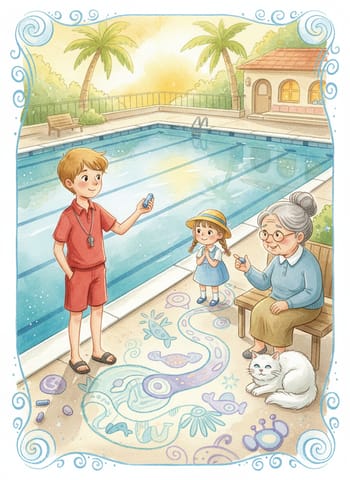
On the grey stone beside the door, someone has drawn a large blue whale in chalk. It is a careful drawing. The whale has a white belly, a tiny eye, and a curved line of water rising from its back. Next to the whale lies a short stub of blue chalk, worn down almost to nothing.
Di atas batu abu-abu di samping pintu, seseorang telah menggambar seekor paus biru besar dengan kapur. Gambarnya dibuat dengan teliti. Paus itu punya perut putih, mata yang sangat kecil, dan garis air melengkung yang menyembur dari punggungnya. Di sebelah paus itu tergeletak sepotong kecil kapur biru, aus hingga hampir habis.
Ozan crouches and picks it up. The chalk is warm from the lamp and leaves a blue powder on his fingers. He looks at the whale for a long moment. Then he checks his watch, because the cleaner will hose down the pavement at nine, and the whole drawing will be gone in ten minutes.
Ozan berjongkok dan memungutnya. Kapur itu hangat oleh sinar lampu dan meninggalkan serbuk biru di jarinya. Ia memandangi paus itu cukup lama. Lalu ia melihat jam tangannya, karena petugas kebersihan akan menyemprot trotoar pukul sembilan, dan seluruh gambar itu akan hilang dalam sepuluh menit.
Edin, the cleaner, is already unrolling the hose when Ozan reaches the corner. He is a quiet man with a moustache and a bad knee, and he has worked at the pool longer than anyone can remember.
Edin, petugas kebersihan itu, sudah mulai menggulung keluar selang ketika Ozan sampai di sudut bangunan. Ia pria pendiam berkumis dengan lutut yang bermasalah, dan ia sudah bekerja di kolam renang itu lebih lama daripada yang bisa diingat siapa pun.
"Wait," Ozan says. "Please don't wash the pavement yet."
"Tunggu," kata Ozan. "Tolong jangan semprot trotoarnya dulu."
Edin looks at him over his glasses. "It is the same every night, my friend. I wash it at nine. Nothing important is ever on this pavement."
Edin menatapnya dari atas kacamatanya. "Tiap malam sama saja, Nak. Aku menyemprotnya pukul sembilan. Tidak pernah ada yang penting di trotoar ini."
"There is a whale," says Ozan.
"Ada seekor paus," kata Ozan.
Edin sighs, walks to the door, and studies the drawing in silence. Then he turns off the water with a small, practical twist of his wrist. "Five minutes," he says. "After that, the whale goes to the sea."
Edin menghela napas, berjalan ke pintu, dan mengamati gambar itu dalam diam. Lalu ia mematikan air dengan putaran pergelangan tangan yang kecil dan praktis. "Lima menit," katanya. "Setelah itu, pausnya pulang ke laut."
Ozan understands that five minutes is a gift, and that he should use it well. He holds up the stub of chalk. "Somebody left this. I should return it to whoever owns it."
Ozan mengerti bahwa lima menit adalah hadiah, dan ia harus memanfaatkannya dengan baik. Ia mengangkat potongan kapur itu. "Seseorang meninggalkan ini. Aku harus mengembalikannya kepada pemiliknya."
He takes it first to the front desk, where the receptionist is counting coins into a plastic tray. She is a cheerful woman who knows the name of every regular, and she glances at the chalk without much interest.
Pertama-tama ia membawanya ke meja resepsionis, tempat sang resepsionis sedang menghitung koin ke dalam nampan plastik. Ia seorang perempuan ceria yang tahu nama setiap pengunjung tetap, dan ia melirik kapur itu tanpa banyak minat.
"That belongs to the swimming instructor," she says. "She teaches the beginners on Tuesdays, and she draws on the pavement to explain strokes."
"Itu milik instruktur renang," katanya. "Dia mengajar kelas pemula hari Selasa, dan dia menggambar di trotoar untuk menjelaskan gaya renang."
"It's a whale," Ozan says.
"Ini seekor paus," kata Ozan.
"She draws all kinds of animals. Take it to her, she's in the staff room."
"Dia menggambar segala macam binatang. Bawa saja ke dia, dia ada di ruang staf."
The instructor is sitting with her shoes off, eating an orange. She turns the chalk over in her fingers and shakes her head.
Sang instruktur duduk dengan sepatu terlepas, sedang makan jeruk. Ia membolak-balik kapur itu di jarinya lalu menggeleng.
"I use white chalk, and I draw on a board, not on the ground. Besides, I am the worst drawer in the whole city." She laughs. "Whoever made your whale is much better than I am. Ask Edin. He knows who comes and goes around here."
"Saya pakai kapur putih, dan saya menggambar di papan tulis, bukan di tanah. Lagi pula, saya ini orang yang paling buruk menggambar di seluruh kota." Ia tertawa. "Siapa pun yang membuat pausmu itu jauh lebih pandai daripada saya. Tanya Edin. Dia tahu siapa saja yang keluar masuk di sini."
Ozan returns to the side door with the chalk still in his hand. Edin has moved a bench to the wall and sits down with a groan, his knee stretched out in front of him. He looks at the stub of chalk, then at the whale, then at Ozan.
Ozan kembali ke pintu samping dengan kapur masih di tangannya. Edin telah memindahkan sebuah bangku ke dinding dan duduk sambil mengerang, lututnya terjulur ke depan. Ia memandang potongan kapur itu, lalu paus itu, lalu Ozan.
"You went to the front desk and the staff room," Edin says. "Of course. People always look for an owner in the offices. The owner is usually outside, waiting for his mother."
"Kamu pergi ke meja resepsionis dan ruang staf," kata Edin. "Tentu saja. Orang selalu mencari pemilik di kantor-kantor. Pemiliknya biasanya ada di luar, menunggu ibunya."
"I don't understand."
"Aku tidak mengerti."
"Neither did I, at first." Edin rubs the knee, and a slow smile appears under his moustache. "A boy comes here every evening with his mother. She works late in the café on the next street, and the boy waits outside the pool until she finishes. Last week I found a chalk heart on this pavement. The week before it was a bicycle. Each night I hose it away, and each night something new appears."
"Aku juga tidak, awalnya." Edin mengusap lututnya, dan senyum perlahan muncul di bawah kumisnya. "Ada seorang anak laki-laki yang datang ke sini setiap sore bersama ibunya. Ibunya bekerja sampai malam di kafe di jalan sebelah, dan si anak menunggu di luar kolam sampai ibunya selesai. Minggu lalu aku menemukan gambar hati dari kapur di trotoar ini. Minggu sebelumnya sebuah sepeda. Setiap malam kusemprot sampai bersih, dan setiap malam muncul gambar baru."
"So he draws them knowing you will wash them off?"
"Jadi dia menggambarnya padahal tahu Bapak akan menyemprotnya sampai hilang?"
"I think that is the point," says Edin. "A drawing that lasts is a thing to look at. A drawing that disappears is a thing you have to make again."
"Kurasa justru itu intinya," kata Edin. "Gambar yang awet adalah sesuatu untuk dipandang. Gambar yang hilang adalah sesuatu yang harus kamu buat lagi."
Ozan looks down at the stub of chalk in his palm. It is so short that it has almost no shape left. Whoever owns it has drawn a lot of whales and bicycles, and has probably never received a new piece.
Ozan menunduk menatap potongan kapur di telapak tangannya. Kapur itu begitu pendek sampai nyaris tak berbentuk lagi. Siapa pun pemiliknya, ia sudah menggambar banyak paus dan sepeda, dan mungkin tidak pernah mendapat kapur baru.
At that moment, a small figure appears at the corner of the building. It is a boy of about nine, in a coat too large for him, with a school bag hanging off one shoulder. He stops dead when he sees two men standing over his whale.
Saat itu, sesosok kecil muncul di sudut bangunan. Seorang anak laki-laki berusia sekitar sembilan tahun, memakai mantel yang kebesaran, dengan tas sekolah tersampir di satu bahunya. Ia berhenti mendadak ketika melihat dua pria berdiri di atas pausnya.
"I'm sorry," the boy says quickly. "I know that I'm not allowed to draw here. I'll go."
"Maaf," kata anak itu cepat-cepat. "Aku tahu aku tidak boleh menggambar di sini. Aku pergi."
"You are not in trouble," Ozan says. He kneels down so that his face is level with the boy's. "I found something of yours."
"Kamu tidak dalam masalah," kata Ozan. Ia berlutut agar wajahnya sejajar dengan wajah si anak. "Aku menemukan sesuatu milikmu."
He opens his hand. The boy stares at the chalk for a second, and then at Ozan, and then at the chalk again. He takes it carefully, with the tips of two fingers, as if it might still belong to someone else.
Ia membuka tangannya. Anak itu menatap kapur itu sejenak, lalu menatap Ozan, lalu menatap kapur itu lagi. Ia mengambilnya dengan hati-hati, dengan ujung dua jari, seolah-olah benda itu mungkin masih milik orang lain.
"It was getting too small," the boy whispers. "I could not hold it properly any more. I thought I had lost it."
"Kapurnya sudah terlalu kecil," bisik anak itu. "Aku tidak bisa memegangnya dengan benar lagi. Kukira aku sudah kehilangannya."
"It was waiting for you," Edin says solemnly. "In my experience, good chalk always does."
"Kapur itu menunggumu," kata Edin dengan khidmat. "Menurut pengalamanku, kapur yang bagus memang selalu begitu."
Ozan feels in his pocket. At the bottom, beside a folded bus ticket, he finds a second piece of chalk. He took it from the instructor's board without thinking. It is white and almost new. He puts it in the boy's hand next to the blue stub.
Ozan merogoh sakunya. Di dasar saku, di samping selembar tiket bus yang terlipat, ia menemukan sepotong kapur kedua. Ia mengambilnya dari papan tulis sang instruktur tanpa sadar. Kapur itu putih dan hampir baru. Ia meletakkannya di tangan si anak, di samping potongan kapur biru itu.
"It's for the clouds," he says. "Whales need something to look at."
"Ini untuk awan," katanya. "Paus butuh sesuatu untuk dilihat."
The boy nods very seriously. Then he walks to the edge of the drawing and kneels. With the white chalk he draws a small cloud above the whale, and then another. His tongue pokes out between his teeth as he works.
Anak itu mengangguk dengan sangat serius. Lalu ia berjalan ke tepi gambar dan berlutut. Dengan kapur putih, ia menggambar sebuah awan kecil di atas paus, lalu satu lagi. Lidahnya menjulur di sela giginya selagi ia bekerja.
Edin switches on his torch and holds it over the pavement so that the boy can see. He does not say anything about the hose. It stands coiled against the wall, its end dripping a little onto the stone.
Edin menyalakan senternya dan mengarahkannya ke trotoar agar si anak bisa melihat. Ia tidak berkata apa-apa soal selang. Selang itu tergulung bersandar di dinding, ujungnya meneteskan sedikit air ke atas batu.
When the cloud is finished, the boy stands and looks at his work. Then he moves a few steps to the left, to the blank space beside the whale. There he draws a long straight line that rises from the ground toward the wall. At the top he draws a small square with a dark circle inside it.
Ketika awannya selesai, anak itu berdiri dan memandangi hasil karyanya. Lalu ia bergeser beberapa langkah ke kiri, ke ruang kosong di samping paus. Di sana ia menggambar garis lurus panjang yang naik dari tanah menuju dinding. Di puncaknya ia menggambar sebuah kotak kecil dengan lingkaran gelap di dalamnya.
"What is that?" Ozan asks.
"Itu apa?" tanya Ozan.
The boy only shrugs and keeps drawing. It looks like a window, high on a wall, with a light behind it.
Anak itu hanya mengangkat bahu dan terus menggambar. Gambar itu tampak seperti jendela, tinggi di sebuah dinding, dengan cahaya di baliknya.
Ozan glances at Edin. Edin shakes his head very slightly, and the hose stays where it is.
Ozan melirik Edin. Edin menggeleng sangat pelan, dan selang itu tetap di tempatnya.