Anthony's Nose
一个面向英语学习者的免费 C1 级英语故事,可用 7 种语言在线阅读,也可以在免费的 Storyteller 应用中收听。
A tall tale explains how a Hudson River peak got its odd name — from a trumpeter's enormous, sun-catching nose and the sturgeon it accidentally cooked.
试听结束!在免费的 Storyteller 应用中收听完整故事。 下载应用
音频暂时无法播放。
The Hudson Highlands are suggestively named Bear Mountain, Sugar Loaf, Cro' Nest, Storm King, called by the Dutch Boterberg, or Butter Hill, from its likeness to a pat of butter; Beacon Hill, where the fires blazed to tell the country that the Revolutionary war was over; Dunderberg, Mount Taurus, so called because a wild bull that had terrorized the Highlands was chased out of his haunts on this height, and was killed by falling from a cliff on an eminence to the northward, known, in consequence, as Breakneck Hill. These, with Anthony's Nose, are the principal points of interest in the lovely and impressive panorama that unfolds before the view as the boats fly onward.
哈德逊高地一带的许多山峰都起了颇有意味的名字,比如熊山、糖锥山、克罗巢山、风暴王山——荷兰人管它叫波特堡格,即“黄油山”,因为它的形状很像一块黄油;还有灯塔山,当年正是在那里燃起烽火,告诉全国革命战争已经结束;邓德堡格山;还有陶鲁斯山,得名是因为一头曾在高地一带横行肆虐的野牛,被人从这座山头的老巢里赶了出来,最终从北面一处高地摔下悬崖而死,那处高地因此得名“断颈山”。这些山峰,加上安东尼鼻山,构成了这片美丽而壮观的全景中最引人注目的几处景致,随着船只不断向前航行,一一展现在人们眼前。
Concerning the last-named elevation, the aquiline promontory that abuts on the Hudson opposite Dunderberg, it takes title from no resemblance to the human feature, but is so named because Anthony Van Corlaer, the trumpeter, who afterwards left a reason for calling the upper boundary of Manhattan Island Spuyten Duyvil Creek, killed the first sturgeon ever eaten at the foot of this mountain.
说到这最后提到的这座高地——那座隔着哈德逊河与邓德堡格山相对、形似鹰钩的岬角——它得名的缘由,并非因为它的形状像人的鼻子,而是因为号手安东尼·范·科尔拉尔——此人后来还留下了一段典故,让曼哈顿岛北端的那条小溪得名“斯普伊滕·杜维尔溪”——曾在这座山脚下,吃掉了有史以来第一条被人食用的鲟鱼。
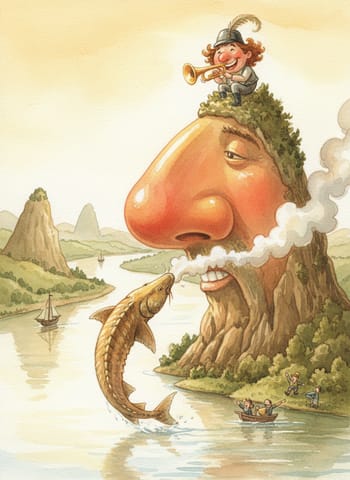
It happened in this wise: By assiduous devotion to keg and flagon Anthony had begotten a nose that was the wonder and admiration of all who knew it, for its size was prodigious; in color it rivalled the carbuncle, and it shone like polished copper. As Anthony was lounging over the quarter of Peter Stuyvesant's galley one summer morning this nose caught a ray from the sun and reflected it hissing into the water, where it killed a sturgeon that was rising beside the vessel.
事情是这样的:安东尼常年热衷于酒桶和酒瓶,因此练就了一个令所有认识他的人都惊叹不已的鼻子,那鼻子大得出奇;颜色鲜艳得可与红宝石媲美,亮得像擦亮的铜器一样闪闪发光。一个夏日的清晨,安东尼正倚在彼得·斯托伊弗桑特的大帆船船舷上闲逛,这个鼻子恰好接住了一缕阳光,把它带着嘶嘶声反射进了水里,当场击毙了一条正浮出水面、贴着船身游动的鲟鱼。
The fish was pulled aboard, eaten, and declared good, though the singed place savored of brimstone, and in commemoration of the event Stuyvesant dubbed the mountain that rose above his vessel Anthony's Nose.
这条鱼被打捞上船,吃掉了,大家都说味道不错,虽然那被灼烧过的地方带着点硫磺的气味;为了纪念这件事,斯托伊弗桑特便给船只上方耸立的这座山峰,起名叫“安东尼鼻山”。