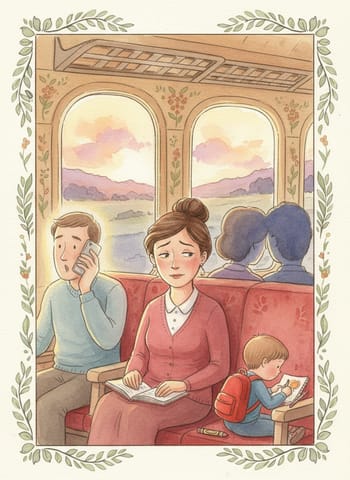
Liv has chosen the quiet carriage for the same reason she chooses most things: it promises that other people will behave. The sign above the door shows a face with a finger across its lips, and she settles beneath it with the satisfaction of someone who has, for once, read the instructions. Before the train has cleared the platform she has opened a mental file on the man opposite, who is eating crisps with the slow, wet commitment of a person alone in his kitchen.
莉芙选了安静车厢,理由和她选择大多数事物时一样:它保证别人会守规矩。门上方的标志画着一张脸,一根手指竖在唇前,她在标志底下坐定,带着一个人难得一次认真读了说明书的满足感。列车还没驶出站台,她心里就已经给对面那个男人开了一个档案,他吃薯片的样子,是一个人独自待在自家厨房里那种缓慢、黏湿、全神贯注的架势。
The file grows. A woman across the aisle types as though she were arguing with her keyboard; a student's headphones leak a thin, insect hiss; somebody's bag occupies a seat as if it had paid for the ticket. Liv says nothing, naturally. Saying something would make her one of the people who cause scenes, and what she prefers, always, is the superior silence of the person keeping score.
档案越来越厚。过道对面的女人敲键盘,像是在跟键盘吵架;一个学生的耳机漏出细细的、昆虫般的嘶嘶声;有人的包占了一个座位,仿佛它也付过车票钱。莉芙当然什么也没说。开口说话,就会让她变成那些制造事端的人之一,而她永远更喜欢的,是那种记着账的人所拥有的高人一等的沉默。
Forty minutes in, a man two rows ahead lifts a phone to his ear. Her stomach tightens in advance, and she is already composing the look she will give him when he speaks. But he cups his hand around the mouthpiece and, in a voice so low that she has to lean in against her own principles, he says, "Hello, bear. Is it story time already?"
过了四十分钟,前面隔了两排的一个男人把手机举到了耳边。她的胃提前绷紧了,已经在酝酿等他开口时要给他的那个眼神。可是他用手拢住了话筒,用一个低得让她不得不违背自己的原则探身去听的声音说:“你好呀,小熊。已经到讲故事的时间了吗?”
There is a pause while he listens, nodding at the seat in front of him. He explains, in a murmur that barely reaches her, that he is on the train and that the carriage has a rule about voices. Tonight, therefore, the story will be told in the small voice, the one bears use in winter. It would seem that somebody at the other end has agreed to these terms.
他听着对面说话,朝前座的靠背点了点头,停了一会儿。他用几乎传不到她耳朵里的喃喃低语解释说,他在火车上,这节车厢有个关于说话声音的规矩。所以今晚,故事要用小小的声音来讲,就是熊在冬天用的那种声音。看来,电话另一头的那位同意了这些条件。
What strikes Liv is not the tenderness, which she would have expected to find irritating, but the care with which he is obeying the rule. He could have walked to the end of the carriage, where nothing forbids a phone call. Instead he has stayed in his seat, bent towards the window, spending an entire evening's voice through the narrowest possible channel. If she had been asked an hour earlier who in this carriage was breaking the rules, she would have named him first.
让莉芙意外的,不是那份温柔,她本来预料自己会觉得那很讨厌,而是他遵守规矩时的那份用心。他完全可以走到车厢尽头,那里没有任何规定禁止打电话。可他却留在座位上,朝着车窗弯下身子,把一整个晚上的嗓音,通过最狭窄的渠道一点一点地花掉。如果一个小时前有人问她,这节车厢里谁在违反规矩,她第一个会点他的名。
The bear in the story, it turns out, is lost in a snowstorm and keeps arriving at the same fallen tree. Listening in against her will, Liv catches this in fragments, a word here, a rustle there. Only when the bear reaches home does she realise that she has stopped composing anything at all. The man opposite has folded his empty packet into a neat square. Even the woman with the keyboard has paused, hands hovering over the keys, in what might well be the first silence she has kept all journey.
故事里的那头熊,原来在暴风雪里迷了路,一次又一次回到同一棵倒下的树前。莉芙违背自己的意愿偷听着,只听到一些零碎的片段,这里一个词,那里一阵窸窣。直到熊终于到了家,她才意识到,自己早已不再酝酿任何东西。对面的男人把空薯片袋叠成了一个整整齐齐的小方块。就连那个敲键盘的女人也停了下来,双手悬在键盘上方,这很可能是她一路上保持的第一阵沉默。
Then the man ahead says goodnight three times, each one smaller than the last, and lowers the phone. Liv looks at her own phone, face down on the table, and at the note on it titled "Carriage offences", which runs to nine entries. At the next station he stands, collects his coat without a sound, and is gone.
然后前面那个男人说了三遍晚安,一遍比一遍轻,放下了手机。莉芙看看自己的手机,它屏幕朝下放在桌上,上面有一条备忘,标题是“车厢违规行为”,已经写了九条。到了下一站,他站起身,一声不响地拿起外套,就这样走了。
Liv watches the door close behind him. Then she turns to the man opposite and, in the smallest voice she owns, asks whether she might have one of his crisps.
莉芙看着车门在他身后合上。然后她转向对面的男人,用她所拥有的最小的声音,问他能不能给她一片他的薯片。