The Quiet Carriage
Cerita bahasa Inggris gratis level C1 untuk pelajar, bisa dibaca online dalam 5 bahasa, dengan pilihan untuk mendengarkannya di aplikasi Storyteller gratis.
A commuter who silently judges every rule-breaker in the quiet carriage overhears a whispered phone call that undermines her certainty.
Itu cuplikannya! Dengarkan cerita lengkapnya di aplikasi Storyteller gratis. Unduh aplikasi
Audio belum tersedia saat ini.
Liv has chosen the quiet carriage for the same reason she chooses most things: it promises that other people will behave. The sign above the door shows a face with a finger across its lips, and she settles beneath it with the satisfaction of someone who has, for once, read the instructions. Before the train has cleared the platform she has opened a mental file on the man opposite, who is eating crisps with the slow, wet commitment of a person alone in his kitchen.
Liv memilih gerbong tenang karena alasan yang sama dengan kebanyakan pilihannya: gerbong itu menjanjikan bahwa orang lain akan berperilaku baik. Papan di atas pintu menampilkan wajah dengan jari di bibir, dan ia duduk di bawahnya dengan kepuasan seseorang yang, untuk sekali ini, membaca petunjuk. Sebelum kereta meninggalkan peron, ia sudah membuka berkas mental tentang pria di seberangnya, yang makan keripik dengan kesungguhan pelan dan basah seperti orang yang sendirian di dapurnya.
The file grows. A woman across the aisle types as though she were arguing with her keyboard; a student's headphones leak a thin, insect hiss; somebody's bag occupies a seat as if it had paid for the ticket. Liv says nothing, naturally. Saying something would make her one of the people who cause scenes, and what she prefers, always, is the superior silence of the person keeping score.
Berkas itu bertambah. Seorang perempuan di seberang lorong mengetik seakan sedang bertengkar dengan papan tuts; headphone seorang mahasiswa bocor desis tipis seperti serangga; tas seseorang menempati kursi seakan telah membayar tiketnya. Liv tentu saja tak berkata apa-apa. Berkata sesuatu akan menjadikannya salah satu orang yang membuat keributan, dan yang selalu ia pilih adalah keheningan superior orang yang diam-diam menghitung skor.
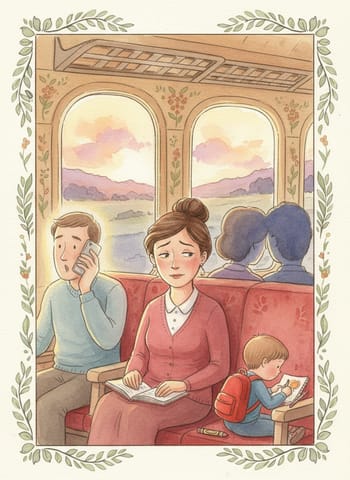
Forty minutes in, a man two rows ahead lifts a phone to his ear. Her stomach tightens in advance, and she is already composing the look she will give him when he speaks. But he cups his hand around the mouthpiece and, in a voice so low that she has to lean in against her own principles, he says, "Hello, bear. Is it story time already?"
Empat puluh menit kemudian, seorang pria dua baris di depan mengangkat ponsel ke telinganya. Perutnya mengencang lebih dulu, dan ia sudah menyusun tatapan yang akan ia berikan ketika pria itu bicara. Tetapi pria itu menangkupkan tangan di sekitar corong ponsel dan, dengan suara begitu rendah sampai ia harus mencondongkan tubuh melawan prinsipnya sendiri, berkata, "Halo, Beruang. Sudah waktunya dongeng, ya?"
There is a pause while he listens, nodding at the seat in front of him. He explains, in a murmur that barely reaches her, that he is on the train and that the carriage has a rule about voices. Tonight, therefore, the story will be told in the small voice, the one bears use in winter. It would seem that somebody at the other end has agreed to these terms.
Ada jeda saat ia mendengarkan, mengangguk ke arah kursi di depannya. Ia menjelaskan, dengan gumaman yang nyaris tak sampai kepadanya, bahwa ia sedang di kereta dan bahwa gerbong ini punya aturan soal suara. Maka malam ini dongengnya akan dibacakan dengan suara kecil, suara yang dipakai beruang di musim dingin. Tampaknya seseorang di ujung sana telah menyetujui syarat-syarat itu.
What strikes Liv is not the tenderness, which she would have expected to find irritating, but the care with which he is obeying the rule. He could have walked to the end of the carriage, where nothing forbids a phone call. Instead he has stayed in his seat, bent towards the window, spending an entire evening's voice through the narrowest possible channel. If she had been asked an hour earlier who in this carriage was breaking the rules, she would have named him first.
Yang menyentuh Liv bukan kelembutannya, yang seharusnya ia temukan menjengkelkan, melainkan kehati-hatian pria itu dalam menaati aturan. Ia bisa saja berjalan ke ujung gerbong, tempat tak ada larangan menelepon. Sebaliknya ia tetap di kursinya, membungkuk ke arah jendela, menghabiskan suara seluruh malam lewat saluran yang paling sempit. Seandainya sejam sebelumnya ia ditanya siapa di gerbong ini yang melanggar aturan, ia akan menyebut pria itu lebih dulu.
The bear in the story, it turns out, is lost in a snowstorm and keeps arriving at the same fallen tree. Listening in against her will, Liv catches this in fragments, a word here, a rustle there. Only when the bear reaches home does she realise that she has stopped composing anything at all. The man opposite has folded his empty packet into a neat square. Even the woman with the keyboard has paused, hands hovering over the keys, in what might well be the first silence she has kept all journey.
Beruang dalam dongeng itu, rupanya, tersesat dalam badai salju dan terus tiba di batang pohon tumbang yang sama. Mendengarkan di luar kemauannya, Liv menangkapnya dalam potongan-potongan, sepatah kata di sini, desir di sana. Baru ketika beruang itu sampai di rumah ia sadar bahwa ia sudah berhenti menyusun apa pun. Pria di seberangnya telah melipat bungkus kosongnya menjadi persegi rapi. Bahkan perempuan dengan papan tuts itu berhenti, tangannya melayang di atas tuts, dalam apa yang mungkin kesunyian pertama yang ia jaga sepanjang perjalanan.
Then the man ahead says goodnight three times, each one smaller than the last, and lowers the phone. Liv looks at her own phone, face down on the table, and at the note on it titled "Carriage offences", which runs to nine entries. At the next station he stands, collects his coat without a sound, and is gone.
Lalu pria di depan mengucapkan selamat malam tiga kali, masing-masing lebih kecil daripada sebelumnya, dan menurunkan ponselnya. Liv menatap ponselnya sendiri, telungkup di meja, dan catatan di dalamnya berjudul "Pelanggaran gerbong", yang berisi sembilan butir. Di stasiun berikutnya pria itu berdiri, mengambil mantelnya tanpa suara, dan menghilang.
Liv watches the door close behind him. Then she turns to the man opposite and, in the smallest voice she owns, asks whether she might have one of his crisps.
Liv memandangi pintu menutup di belakangnya. Lalu ia menoleh kepada pria di seberangnya dan, dengan suara terkecil yang ia punya, bertanya apakah ia boleh minta satu keripiknya.