Anthony's Nose
Una historia gratuita en inglés de nivel C1 para estudiantes, para leer en línea en 7 idiomas, con opción de escucharla en la app gratuita Storyteller.
A tall tale explains how a Hudson River peak got its odd name — from a trumpeter's enormous, sun-catching nose and the sturgeon it accidentally cooked.
¡Ese fue el avance! Escucha la historia completa en la app gratuita Storyteller. Descargar la app
El audio no está disponible en este momento.
The Hudson Highlands are suggestively named Bear Mountain, Sugar Loaf, Cro' Nest, Storm King, called by the Dutch Boterberg, or Butter Hill, from its likeness to a pat of butter; Beacon Hill, where the fires blazed to tell the country that the Revolutionary war was over; Dunderberg, Mount Taurus, so called because a wild bull that had terrorized the Highlands was chased out of his haunts on this height, and was killed by falling from a cliff on an eminence to the northward, known, in consequence, as Breakneck Hill. These, with Anthony's Nose, are the principal points of interest in the lovely and impressive panorama that unfolds before the view as the boats fly onward.
Las Tierras Altas del Hudson llevan nombres sugestivos: Bear Mountain, Sugar Loaf, Cro' Nest, Storm King, llamado por los holandeses Boterberg, o Colina de la Mantequilla, por su parecido con una porción de mantequilla; Beacon Hill, donde ardían las hogueras para anunciar al país que la guerra de la Revolución había terminado; Dunderberg, Mount Taurus, así llamado porque un toro salvaje que había aterrorizado las Tierras Altas fue ahuyentado de sus dominios en esta altura, y murió al caer de un acantilado en una eminencia hacia el norte, conocida, en consecuencia, como Breakneck Hill. Estos, junto con Anthony's Nose, son los principales puntos de interés en el hermoso e impresionante panorama que se despliega ante la vista mientras los barcos avanzan.
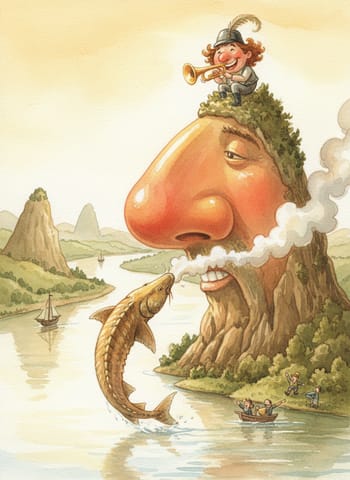
Concerning the last-named elevation, the aquiline promontory that abuts on the Hudson opposite Dunderberg, it takes title from no resemblance to the human feature, but is so named because Anthony Van Corlaer, the trumpeter, who afterwards left a reason for calling the upper boundary of Manhattan Island Spuyten Duyvil Creek, killed the first sturgeon ever eaten at the foot of this mountain.
En cuanto a la última elevación mencionada, el promontorio aguileño que se asoma al Hudson frente a Dunderberg, no toma su nombre de ningún parecido con el rasgo humano, sino que se llama así porque Anthony Van Corlaer, el trompetista, quien más tarde dejó una razón para llamar al límite superior de la Isla de Manhattan Spuyten Duyvil Creek, mató al primer esturión que se comió al pie de esta montaña.
It happened in this wise: By assiduous devotion to keg and flagon Anthony had begotten a nose that was the wonder and admiration of all who knew it, for its size was prodigious; in color it rivalled the carbuncle, and it shone like polished copper. As Anthony was lounging over the quarter of Peter Stuyvesant's galley one summer morning this nose caught a ray from the sun and reflected it hissing into the water, where it killed a sturgeon that was rising beside the vessel.
Sucedió de esta manera: por su asidua devoción al barril y a la jarra, Anthony había cultivado una nariz que era el asombro y la admiración de todos los que la conocían, pues su tamaño era prodigioso; en color rivalizaba con el carbunclo, y brillaba como cobre pulido. Mientras Anthony holgazaneaba en la popa de la galera de Peter Stuyvesant una mañana de verano, esta nariz capturó un rayo de sol y lo reflejó silbando hacia el agua, donde mató a un esturión que emergía junto al barco.
The fish was pulled aboard, eaten, and declared good, though the singed place savored of brimstone, and in commemoration of the event Stuyvesant dubbed the mountain that rose above his vessel Anthony's Nose.
El pez fue subido a bordo, comido, y declarado bueno, aunque la parte chamuscada sabía a azufre, y en conmemoración del suceso Stuyvesant bautizó a la montaña que se alzaba sobre su barco como Anthony's Nose.