The Buyout Clause
Una historia gratuita en inglés de nivel C1 para estudiantes, para leer en línea en 3 idiomas, con opción de escucharla en la app gratuita Storyteller.
When a corporate buyer offers to purchase their eight-year-old letterpress studio, two business partners discover they disagree completely about what the shop was ever actually for.
¡Ese fue el avance! Escucha la historia completa en la app gratuita Storyteller. Descargar la app
El audio no está disponible en este momento.
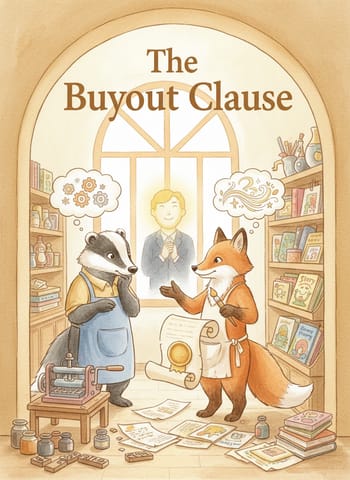
Halina and Gideon had run the letterpress studio together for eight years without a single written agreement about what would happen if one of them wanted out. It had never seemed necessary, the way a smoke detector never seems necessary until the toast catches fire. Then a company calling itself Bright Column Holdings offered to buy them out, and Gideon, to Halina's genuine astonishment, wanted to say yes.
Halina y Gideon habían dirigido el taller de imprenta tipográfica juntos durante ocho años sin un solo acuerdo escrito sobre qué pasaría si uno de los dos quisiera irse. Nunca había parecido necesario, de la misma manera que un detector de humo nunca parece necesario hasta que el pan tostado se quema. Entonces una empresa que se llamaba a sí misma Bright Column Holdings les ofreció comprarles el negocio, y Gideon, para el genuino asombro de Halina, quería decir que sí.
"It's not even a real name," she said, reading the offer letter a third time at the shop's one working table. "Bright Column. It sounds like a vitamin."
«Ni siquiera es un nombre real», dijo ella, leyendo la carta de oferta por tercera vez en la única mesa útil del taller. «Bright Column. Suena a una vitamina».
"It's four hundred thousand dollars, Halina. That's not a vitamin, whatever it sounds like." Gideon rubbed his eyes, the way he did when he'd already had this argument in his head several times before saying any of it out loud. "I'm forty-four. I have a kid starting college in three years. I can't keep printing wedding invitations on faith."
«Son cuatrocientos mil dólares, Halina. Eso no es una vitamina, suene como suene». Gideon se frotó los ojos, como hacía cuando ya había tenido esa discusión en su cabeza varias veces antes de decir algo en voz alta. «Tengo cuarenta y cuatro años. Tengo un hijo que empieza la universidad en tres años. No puedo seguir imprimiendo invitaciones de boda a puro acto de fe».
She understood the arithmetic; she simply didn't believe the arithmetic was the whole question. Had money been the only thing either of them cared about, they would have sold the presses years ago and taken ordinary jobs with ordinary hours. Something else had kept them both here through two recessions and one flood, and she wasn't ready to pretend that thing had stopped mattering just because a number had finally gotten large enough to notice.
Ella entendía la aritmética; simplemente no creía que la aritmética fuera toda la cuestión. Si el dinero hubiera sido lo único que le importaba a cualquiera de los dos, habrían vendido las prensas hacía años y habrían tomado empleos comunes con horarios comunes. Algo más los había mantenido ahí a los dos durante dos recesiones y una inundación, y ella no estaba lista para fingir que esa cosa había dejado de importar solo porque por fin había aparecido un número lo bastante grande como para notarlo.
"What happens to the shop name?" she asked. "The equipment? Do we even get a say in what they do with it, once it's theirs?"
«¿Qué pasa con el nombre del taller?», preguntó ella. «¿Y el equipo? ¿Siquiera tenemos voz en lo que hagan con él, una vez que sea suyo?».
"They keep the name for branding. The presses go into storage, probably. Realistically, in a year, it's a logo on a website that used to be a place." Gideon said this flatly, not because he didn't feel it but because, she suspected, feeling it too much would have made the offer impossible to accept.
«Se quedan con el nombre para su imagen de marca. Las prensas probablemente vayan a un depósito. Siendo realistas, en un año, esto es un logo en un sitio web que antes era un lugar de verdad». Gideon lo dijo sin ninguna emoción, no porque no lo sintiera, sino porque, sospechaba ella, sentirlo demasiado habría hecho imposible aceptar la oferta.
"So we'd be selling the thing that makes it worth anything, and keeping the parts that don't matter."
«Entonces estaríamos vendiendo lo que le da valor a esto, y quedándonos con las partes que no importan».
"Or," he said, "we'd be finally getting paid for eight years of not sleeping, and letting someone else worry about the roof."
«O», dijo él, «por fin nos estarían pagando por ocho años de no dormir, y dejaríamos que otra persona se preocupara por el techo».
Neither of them was wrong, which was somehow worse than either of them being wrong. Rarely had Halina felt so unable to argue with a position she still, completely, disagreed with. She looked around the shop: the cat asleep in a bin of scrap paper, the proof of a wedding invitation drying on the rack, ink she'd still be scrubbing off her hands at midnight. Then she tried to weigh it honestly against a number she couldn't actually picture spending.
Ninguno de los dos estaba equivocado, lo cual, de alguna manera, era peor que si alguno lo estuviera. Pocas veces se había sentido Halina tan incapaz de discutir contra una postura con la que, de todos modos, seguía estando completamente en desacuerdo. Miró alrededor del taller: el gato dormido en un cajón de papel de descarte, la prueba de una invitación de boda secándose en el estante, tinta que todavía estaría restregándose de las manos a medianoche. Luego intentó sopesarlo con honestidad frente a un número que en realidad no podía imaginarse gastando.
"Give me a week," she said finally. "Not to talk you out of it. To figure out if there's a version of yes I can actually live with."
«Dame una semana», dijo ella por fin. «No para convencerte de que no lo hagas. Para averiguar si existe una versión del sí con la que en verdad pueda vivir».
"And if there isn't one?"
«¿Y si no existe ninguna?».
"Then you buy me out instead, and I find out the hard way whether I love this place enough to run it alone." She almost laughed, hearing herself say it. "Which, frankly, terrifies me more than Bright Column Holdings does."
«Entonces tú me compras a mí, y yo descubro por las malas si quiero este lugar lo suficiente como para dirigirlo sola». Casi se rio al oírse decir eso. «Lo cual, francamente, me aterra más que Bright Column Holdings».
Gideon managed something close to a smile for the first time since the offer had arrived. "That," he said, "is the most honest either of us has been all week."
Gideon logró algo parecido a una sonrisa por primera vez desde que había llegado la oferta. «Eso», dijo, «es lo más honesto que hemos sido cualquiera de los dos en toda la semana».