Anthony's Nose
Uma história gratuita em inglês de nível C1 para estudantes, para ler online em 7 idiomas, com opção de ouvir no app gratuito Storyteller.
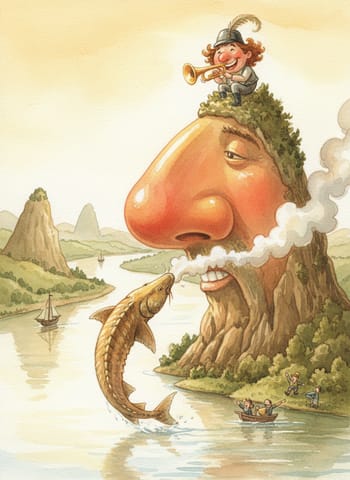
A tall tale explains how a Hudson River peak got its odd name — from a trumpeter's enormous, sun-catching nose and the sturgeon it accidentally cooked.
Essa foi a prévia! Ouça a história completa no app gratuito Storyteller. Baixar o app
O áudio não está disponível no momento.
The Hudson Highlands are suggestively named Bear Mountain, Sugar Loaf, Cro' Nest, Storm King, called by the Dutch Boterberg, or Butter Hill, from its likeness to a pat of butter; Beacon Hill, where the fires blazed to tell the country that the Revolutionary war was over; Dunderberg, Mount Taurus, so called because a wild bull that had terrorized the Highlands was chased out of his haunts on this height, and was killed by falling from a cliff on an eminence to the northward, known, in consequence, as Breakneck Hill. These, with Anthony's Nose, are the principal points of interest in the lovely and impressive panorama that unfolds before the view as the boats fly onward.
As Terras Altas do Hudson têm nomes bem sugestivos: Monte do Urso, Pão de Açúcar, Ninho do Corvo, Rei da Tempestade, chamado pelos holandeses de Boterberg, ou Colina da Manteiga, por sua semelhança com um bloco de manteiga; Colina do Farol, onde as fogueiras ardiam para anunciar ao país que a Guerra da Revolução havia terminado; Dunderberg, Monte Touro, assim chamado porque um touro selvagem que aterrorizava as Terras Altas foi expulso de seus domínios naquela altura, e morreu ao cair de um penhasco numa elevação mais ao norte, conhecida, por consequência, como Colina Quebra-Pescoço. Estas, junto com o Nariz de Anthony, são os principais pontos de interesse no belo e impressionante panorama que se descortina diante da vista à medida que os barcos avançam velozes.
Concerning the last-named elevation, the aquiline promontory that abuts on the Hudson opposite Dunderberg, it takes title from no resemblance to the human feature, but is so named because Anthony Van Corlaer, the trumpeter, who afterwards left a reason for calling the upper boundary of Manhattan Island Spuyten Duyvil Creek, killed the first sturgeon ever eaten at the foot of this mountain.
Quanto à última elevação mencionada, o promontório adunco que se projeta sobre o Hudson em frente a Dunderberg, ela tira o nome não de alguma semelhança com o rosto humano, mas porque Anthony Van Corlaer, o trompetista, que mais tarde deixou um motivo para se chamar o limite norte da Ilha de Manhattan de Riacho Spuyten Duyvil, matou o primeiro esturjão já comido ao pé desta montanha.
It happened in this wise: By assiduous devotion to keg and flagon Anthony had begotten a nose that was the wonder and admiration of all who knew it, for its size was prodigious; in color it rivalled the carbuncle, and it shone like polished copper. As Anthony was lounging over the quarter of Peter Stuyvesant's galley one summer morning this nose caught a ray from the sun and reflected it hissing into the water, where it killed a sturgeon that was rising beside the vessel.
Aconteceu do seguinte modo: por causa de sua assídua devoção ao barril e ao frasco, Anthony havia adquirido um nariz que era motivo de espanto e admiração para todos que o conheciam, pois seu tamanho era prodigioso; em cor rivalizava com o carbúnculo, e brilhava como cobre polido. Enquanto Anthony estava recostado na popa da galera de Peter Stuyvesant numa manhã de verão, esse nariz captou um raio de sol e o refletiu, sibilante, na água, onde matou um esturjão que subia à tona ao lado do navio.
The fish was pulled aboard, eaten, and declared good, though the singed place savored of brimstone, and in commemoration of the event Stuyvesant dubbed the mountain that rose above his vessel Anthony's Nose.
O peixe foi puxado a bordo, comido e declarado saboroso, embora o lugar chamuscado tivesse um leve gosto de enxofre, e, em comemoração ao evento, Stuyvesant batizou a montanha que se erguia acima de seu navio de Nariz de Anthony.