The Paper Boat Race
Cerita bahasa Inggris gratis level A1 untuk pelajar, bisa dibaca online dalam 7 bahasa, dengan pilihan untuk mendengarkannya di aplikasi Storyteller gratis.
After a night of rain, two cousins race paper boats down a fast stream and follow them all the way to an old stone bridge.
Itu cuplikannya! Dengarkan cerita lengkapnya di aplikasi Storyteller gratis. Unduh aplikasi
Audio belum tersedia saat ini.
It rained all night. In the morning, the sun came out. The world smelled fresh. Arlo ran to the kitchen window. The little stream behind Grandma's house was full and fast.
Hujan turun sepanjang malam. Pagi harinya, matahari muncul. Dunia berbau segar. Arlo berlari ke jendela dapur. Sungai kecil di belakang rumah Nenek penuh dan deras.
"Bao!" he shouted. "Wake up! The stream is big!"
"Bao!" teriaknya. "Bangun! Sungainya besar!"
Bao was his cousin. He came to the kitchen with his hair standing up. He looked out and smiled. "A paper boat day," he said.
Bao sepupunya. Ia datang ke dapur dengan rambut mencuat. Ia melihat keluar dan tersenyum. "Hari yang pas untuk perahu kertas," katanya.
They sat at the table. They made boats from old newspaper. Arlo made a tall boat. It had a red mark on the side. Bao made a long, flat boat with a blue mark. Grandma gave them a candle to rub on the paper.
Mereka duduk di meja dan membuat perahu dari koran bekas. Arlo membuat perahu yang tinggi dengan tanda merah di sisinya. Bao membuat perahu panjang dan pipih dengan tanda biru. Nenek memberi mereka sebatang lilin untuk digosokkan pada kertas.
"Wax keeps the water out," she said. "Now go. And stay on the grass."
"Lilin menahan air agar tidak masuk," kata Nenek. "Sekarang pergilah. Dan tetaplah di atas rumput."
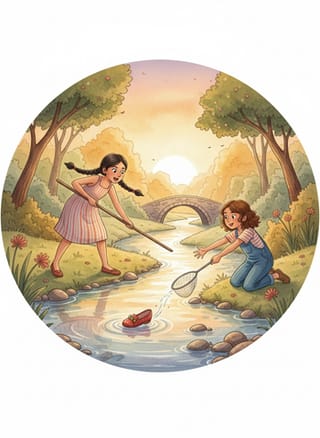
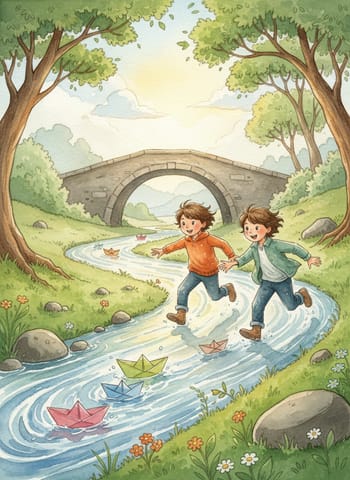
The boys ran to the stream. It was loud and brown. Leaves and small sticks floated on it.
Kedua anak itu berlari ke sungai. Airnya riuh dan cokelat. Daun dan ranting kecil hanyut di atasnya.
"We race to the old stone bridge," said Arlo. "The first boat there wins."
"Kita balapan sampai jembatan batu tua," kata Arlo. "Perahu yang tiba lebih dulu menang."
"That is very far," said Bao.
"Itu jauh sekali," kata Bao.
"Then it is a long race," said Arlo.
"Berarti balapannya panjang," kata Arlo.
They counted to three. Then they put the boats in the water together.
Mereka menghitung sampai tiga. Lalu mereka meletakkan perahu ke air bersamaan.
The boats shot away. The red boat went left. The blue boat went right. Arlo and Bao ran along the bank, shouting and laughing.
Perahu-perahu itu meluncur. Perahu merah ke kiri. Perahu biru ke kanan. Arlo dan Bao berlari di sepanjang tepian sambil berteriak dan tertawa.
"Go, red!" shouted Arlo.
"Ayo, merah!" teriak Arlo.
"Go, blue!" shouted Bao.
"Ayo, biru!" teriak Bao.
At the first turn, the blue boat hit a branch. It turned round and round. Bao jumped over a rock. He pushed it free with a stick. The boat moved again.
Di tikungan pertama, perahu biru menabrak sebuah dahan. Perahu itu berputar-putar. Bao melompati sebuah batu. Ia mendorong perahunya hingga lepas dengan sebatang tongkat. Perahu itu bergerak lagi.
The red boat dropped down a small waterfall. Arlo held his breath. The boat went under the water. Then it came up again, wet but still open.
Perahu merah terjun dari air terjun kecil. Arlo menahan napas. Perahunya masuk ke bawah air. Lalu muncul lagi, basah tetapi masih terbuka.
"It lives!" he shouted.
"Dia masih hidup!" teriaknya.
Now the boats moved side by side. A green frog watched them from a stone. A duck swam away. It made an angry sound.
Sekarang perahu-perahu itu bergerak berdampingan. Seekor katak hijau memperhatikan mereka dari atas batu. Seekor bebek berenang menjauh sambil bersuara marah.
Around the big field, the stream became wide and slow. The boats floated in the middle, close to each other. The boys ran as fast as they could. Their shoes were full of mud.
Di sekitar ladang yang luas, sungai menjadi lebar dan tenang. Perahu-perahu itu mengapung di tengah, berdekatan. Kedua anak itu berlari secepat mungkin. Sepatu mereka penuh lumpur.
Then Arlo saw the stone bridge ahead. It was very close. The water ran in a dark tunnel under it.
Lalu Arlo melihat jembatan batu di depan. Sudah sangat dekat. Air mengalir ke dalam terowongan gelap di bawahnya.
The two boats went into the tunnel together. The boys stood at the end of the bridge. They waited. A minute passed. Then another.
Kedua perahu masuk ke terowongan bersama-sama. Kedua anak itu berdiri di ujung jembatan. Mereka menunggu. Semenit berlalu. Lalu semenit lagi.
"Where are they?" asked Bao.
"Di mana mereka?" tanya Bao.
Arlo looked into the dark. He saw a small white shape. "There!" he said.
Arlo memandang ke dalam gelap. Ia melihat bentuk putih kecil. "Itu!" katanya.
But only one boat came out. It was the red one. The blue boat did not appear.
Tetapi hanya satu perahu yang keluar. Perahu merah. Perahu biru tidak muncul.
"I win," said Arlo, but he did not feel happy. He walked into the cold water. He looked under the bridge.
"Aku menang," kata Arlo, tetapi ia tidak merasa senang. Ia melangkah ke air yang dingin. Ia memeriksa di bawah jembatan.
The blue boat was stuck between two stones. It was wet, and the blue mark was nearly gone. Arlo took it out. He put it in Bao's hands.
Perahu biru tersangkut di antara dua batu. Perahu itu basah, dan tanda birunya hampir hilang. Arlo mengambilnya. Ia meletakkannya di tangan Bao.
"It was a tie," he said. "Both boats got to the bridge."
"Kita seri," katanya. "Kedua perahu sampai di jembatan."
Bao looked at the boat and then at Arlo. "No," he said. "Red won. But my boat was brave."
Bao memandang perahunya, lalu memandang Arlo. "Bukan," katanya. "Merah yang menang. Tapi perahuku berani."
They walked home slowly with their wet shoes. In the kitchen, Grandma gave them hot milk. She gave them more newspaper too.
Mereka berjalan pulang pelan-pelan dengan sepatu basah. Di dapur, Nenek memberi mereka susu hangat. Nenek juga memberi mereka koran lagi.
"Again?" she asked.
"Mau lagi?" tanyanya.
"Again," said Arlo. "But this time, a longer stream."
"Mau," kata Arlo. "Tapi kali ini, sungai yang lebih panjang."