The Two Summers
Una historia gratuita en inglés de nivel C1 para estudiantes, para leer en línea en 3 idiomas, con opción de escucharla en la app gratuita Storyteller.
Five years after an unspoken near-miss at a lake house, June and Milo meet again for one last August together, three weeks before she moves across the country for good.
¡Ese fue el avance! Escucha la historia completa en la app gratuita Storyteller. Descargar la app
El audio no está disponible en este momento.
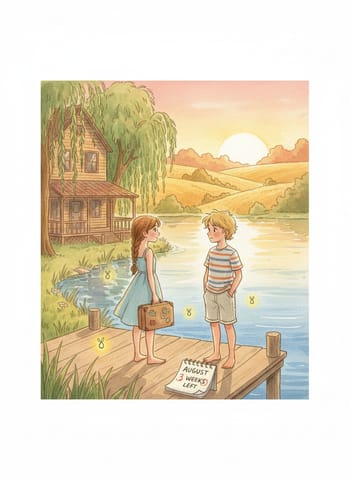
The lake house had belonged to June's grandparents for as long as she could remember. So had the summer she spent there at thirteen. That was the one where she and Milo had built an entire private language out of inside jokes and a shared inability to admit either of them liked the other. Nothing had happened that summer, not really — a near-miss at the end of a dock, a held glance that neither of them acted on. Then her family had stopped renting the place, and five years had passed without a single message between them. Had they kept renting it even one more year, she sometimes thought, that near-miss on the dock might have become something neither of them would have waited half a decade to say.
La casa del lago había pertenecido a los abuelos de June desde que ella podía recordar. Igual que el verano que pasó ahí a los trece años. Ese fue el verano en que ella y Milo construyeron todo un lenguaje privado hecho de bromas internas y una incapacidad compartida para admitir que cada uno le gustaba al otro. No había pasado nada realmente ese verano —un casi-momento al final de un muelle, una mirada sostenida que ninguno de los dos siguió—. Después su familia dejó de alquilar el lugar, y pasaron cinco años sin un solo mensaje entre ellos. Si hubieran seguido alquilando el lugar aunque fuera un año más, pensaba ella a veces, ese casi-momento en el muelle podría haberse convertido en algo que ninguno de los dos habría esperado media década para decir.
Rarely had a summer returned to her so completely uninvited. She hadn't expected to see him again, let alone here, let alone three weeks before she moved across the country for good. But the lake house was back in the family's rotation for one final August. There he was on the same dock, taller and quieter than the boy she remembered, holding two coffees as though he'd somehow known she'd arrive at exactly that hour.
Pocas veces un verano había regresado a ella tan por completo sin ser invitado. No esperaba volver a verlo, y menos aquí, y menos tres semanas antes de mudarse al otro lado del país para siempre. Pero la casa del lago volvía a estar en la rotación de la familia por un último agosto. Ahí estaba él, en el mismo muelle, más alto y más callado que el chico que ella recordaba, con dos cafés en las manos como si de alguna manera hubiera sabido que ella llegaría exactamente a esa hora.
"I got you one on the chance you still take it black," he said. "I wasn't sure. It's been a while."
«Te traje uno por si todavía lo tomas negro», dijo él. «No estaba seguro. Ha pasado un tiempo».
"Five years," June said. "You remembered how I take my coffee from five years ago?"
«Cinco años», dijo June. «¿Te acordaste de cómo tomo mi café después de cinco años?».
"I remember a lot from five years ago," he said, and didn't elaborate, which struck her as exactly the kind of thing thirteen-year-old Milo would have said and then panicked about immediately afterward.
«Me acuerdo de muchas cosas de hace cinco años», dijo él, y no dio más detalles, lo cual a ella le pareció exactamente el tipo de cosa que el Milo de trece años habría dicho para luego entrar en pánico de inmediato.
What followed was not, either of them silently agreed without ever discussing it, a summer meant to repeat the first one. It couldn't be. She was leaving in three weeks, a fact that sat under every conversation they had like a stone under still water — visible if you looked but easy enough to ignore if you didn't. They spent most evenings on that same dock anyway, talking about nothing that mattered and everything that did, both of them aware that whatever this was had an ending built into it from the start.
Lo que siguió no fue, según ambos acordaron en silencio sin nunca hablarlo, un verano hecho para repetir el primero. No podía serlo. Ella se iba en tres semanas, un hecho que se sentaba bajo cada conversación que tenían como una piedra bajo agua quieta —visible si la buscabas, pero fácil de ignorar si no lo hacías—. De todas formas pasaban casi todas las tardes en ese mismo muelle, hablando de nada que importara y de todo lo que sí, ambos conscientes de que lo que fuera esto tenía un final incorporado desde el principio.
On her last night, he finally said the thing neither of them had managed at thirteen. "I liked you," he said, plainly, the way he seemed to say everything now. "Then, and apparently now too, which is inconvenient, given the whole other-side-of-the-country situation."
En su última noche, él finalmente dijo lo que ninguno de los dos había logrado decir a los trece. «Me gustabas», dijo, con sencillez, como parecía decirlo todo ahora. «Entonces, y al parecer ahora también, lo cual es inconveniente, dada toda la situación del otro lado del país».
"You waited five years and three weeks to tell me that."
«Esperaste cinco años y tres semanas para decirme eso».
"Would it have helped, five years ago?"
«¿Habría ayudado, hace cinco años?».
She thought about it honestly, which he seemed to want more than a quick answer. "Probably not. We were thirteen."
Ella lo pensó con honestidad, que era lo que él parecía querer más que una respuesta rápida. «Probablemente no. Teníamos trece años».
"Right. So this is actually good timing, comparatively."
«Cierto. Así que en realidad este es un buen momento, comparativamente».
She laughed, and didn't say it back exactly, though she didn't need to. She reached over and took his hand instead, and they sat there until the dock lights came on automatically, neither of them making any promises about what a coast and a calendar couldn't keep.
Ella se rio, y no lo dijo de vuelta exactamente, aunque no le hacía falta. En su lugar, extendió la mano y tomó la de él, y se quedaron ahí sentados hasta que las luces del muelle se encendieron automáticamente, sin que ninguno de los dos hiciera promesas sobre lo que una costa y un calendario no podían mantener.