The Winter Shelter
Una historia gratuita en inglés de nivel C1 para estudiantes, para leer en línea en 4 idiomas, con opción de escucharla en la app gratuita Storyteller.
A teenage volunteer serving soup at a night shelter recognises a guest as his old primary-school teacher and has to choose how to greet him.
¡Ese fue el avance! Escucha la historia completa en la app gratuita Storyteller. Descargar la app
El audio no está disponible en este momento.
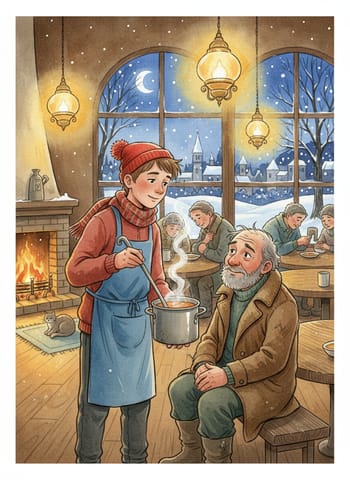
On his second Thursday at the winter shelter, Nathaniel is on soup duty. That means standing behind a steel counter in the community hall with a ladle and a single rule: look at people, not at their bags. He is seventeen and has signed up for forty volunteer hours for a school award. So far the hardest part has been staying out of the way of the coordinator, a retired nurse who calls everyone "my friend" and means it.
En su segundo jueves en el refugio de invierno, Nathaniel está de turno de sopa. Eso significa estar detrás de un mostrador de acero en el salón comunitario con un cucharón y una sola regla: mirar a las personas, no sus bolsas. Tiene diecisiete años y se ha apuntado a cuarenta horas de voluntariado para un premio escolar. Hasta ahora lo más difícil ha sido no estorbar a la coordinadora, una enfermera jubilada que llama a todos «mi amigo» y lo dice en serio.
At half past seven a man in a grey wool coat reaches the counter and says, "Just the soup, thanks." Nathaniel knows the voice before he knows why. The man's face is thinner than it should be, his beard has not been trimmed for some time, and his glasses are mended at one hinge with a strip of tape. Then he pushes them up the bridge of his nose with one knuckle, exactly as he used to in front of a classroom. Nathaniel is nine years old again, reading aloud badly at the back of Room 4.
A las siete y media un hombre con un abrigo de lana gris llega al mostrador y dice: «Solo la sopa, gracias». Nathaniel conoce la voz antes de saber por qué. El rostro del hombre está más delgado de lo que debería, la barba lleva tiempo sin recortarse y sus lentes están remendados en una bisagra con una tira de cinta. Entonces se los sube por el puente de la nariz con un nudillo, exactamente como solía hacerlo frente a una clase. Nathaniel tiene nueve años otra vez, leyendo en voz alta, mal, al fondo del aula 4.
It is Mr. Anselm. Mr. Anselm, who pinned one new word to the board every Monday. Who let Nathaniel stay in at lunch to finish a book rather than go out and be bad at football. Who once taught thirty children to fold a paper boat that would float for a full minute, and who said, when Nathaniel's sank at once, that a sunk boat was only data.
Es el señor Anselm. El señor Anselm, que clavaba una palabra nueva en la pizarra cada lunes. Que dejaba a Nathaniel quedarse en el recreo para terminar un libro en vez de salir a ser malo en el fútbol. Que una vez enseñó a treinta niños a doblar un barco de papel que flotaría un minuto entero, y que dijo, cuando el de Nathaniel se hundió de inmediato, que un barco hundido era solo un dato.
The ladle stops halfway to the bowl. Two options arrive with the speed of a reflex. He can act as though he has never seen this man before, which is plainly what the man hopes, since his eyes are fixed on the counter. Or he can say the name aloud, and a hall full of strangers will turn to look. Had the coordinator put him on the door tonight instead of the kitchen, he would have been spared the choice altogether.
El cucharón se detiene a medio camino del plato. Dos opciones llegan con la rapidez de un reflejo. Puede actuar como si nunca hubiera visto a ese hombre, que es claramente lo que este espera, pues tiene los ojos fijos en el mostrador. O puede decir el nombre en voz alta, y un salón lleno de desconocidos se volverá a mirar. Si la coordinadora lo hubiera puesto en la puerta esta noche en vez de en la cocina, se habría ahorrado la elección por completo.
What decides it is not exactly kindness. It is the memory of those lunch hours, and the way nobody had ever made a fuss.
Lo que lo decide no es exactamente bondad. Es el recuerdo de aquellas horas de recreo, y de cómo nadie había hecho nunca un alboroto.
He fills the bowl to the line, adds two rolls without asking, and sets them on the counter at the height he would offer them to anyone. "Good evening, Mr. Anselm," he says, in his ordinary voice. "It's lentil tonight. It's better than it sounds."
Llena el plato hasta la línea, añade dos panes sin que se los pidan y los deja en el mostrador a la altura en que se los ofrecería a cualquiera. «Buenas noches, señor Anselm», dice, con su voz de siempre. «Esta noche hay lentejas. Son mejores de lo que suena».
For a moment nothing moves in the man's face. Then his shoulders come down by about an inch. "Nathaniel," he says, quietly. It is not a question. "Room 4. You made the boat that sank."
Por un momento nada se mueve en el rostro del hombre. Luego sus hombros bajan unos dos centímetros. «Nathaniel», dice en voz baja. No es una pregunta. «Aula 4. Tú hiciste el barco que se hundió».
"Every time," Nathaniel says. "You said it was data."
«Todas las veces», dice Nathaniel. «Usted decía que era un dato».
"I did say that." Something almost like a smile appears and is put away again. "I'd rather it stayed between us, if it's all the same to you."
«Eso dije». Algo casi parecido a una sonrisa aparece y se guarda de nuevo. «Preferiría que quedara entre nosotros, si a ti te da lo mismo».
"There's nothing to stay. You're a guest, and I'm on soup."
«No hay nada que quede. Usted es un huésped, y yo estoy en la sopa».
Mr. Anselm nods once, takes the bowl in both hands, and carries it to a table in the corner by the radiator. Nathaniel serves the next forty people without really seeing them. Twice the coordinator glances at him, but she says nothing, and he is grateful for that too.
El señor Anselm asiente una vez, toma el plato con ambas manos y lo lleva a una mesa en la esquina junto al radiador. Nathaniel sirve a las cuarenta personas siguientes sin verlas realmente. Dos veces la coordinadora lo mira, pero no dice nada, y también se lo agradece.
Later, wiping down the counter, he looks across the hall. The man has finished the soup and eaten both rolls. He has taken a paper napkin from the dispenser and is folding it, slowly, with a precision Nathaniel recognises from across eight years. It takes nine moves. When it is done, Mr. Anselm sets the little boat on the water in his glass and watches it, his chin on his hand, with the grave attention of someone marking work. Nathaniel stops wiping and starts to count.
Más tarde, mientras limpia el mostrador, mira a través del salón. El hombre ha terminado la sopa y se ha comido los dos panes. Ha tomado una servilleta de papel del dispensador y la está doblando, despacio, con una precisión que Nathaniel reconoce a través de ocho años. Son nueve movimientos. Cuando termina, el señor Anselm posa el barquito sobre el agua de su vaso y lo observa, con la barbilla en la mano, con la grave atención de quien corrige un trabajo. Nathaniel deja de limpiar y empieza a contar.