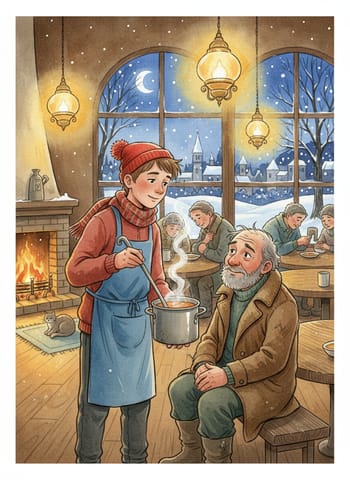
The Winter Shelter
A free C1-level English story for language learners, readable online in 4 languages, with an option to listen via the free Storyteller app.
A teenage volunteer serving soup at a night shelter recognises a guest as his old primary-school teacher and has to choose how to greet him.
That was the preview! Hear the full story in the free Storyteller app. Get the app
Audio isn't available right now.
On his second Thursday at the winter shelter, Nathaniel is on soup duty. That means standing behind a steel counter in the community hall with a ladle and a single rule: look at people, not at their bags. He is seventeen and has signed up for forty volunteer hours for a school award. So far the hardest part has been staying out of the way of the coordinator, a retired nurse who calls everyone "my friend" and means it.
At half past seven a man in a grey wool coat reaches the counter and says, "Just the soup, thanks." Nathaniel knows the voice before he knows why. The man's face is thinner than it should be, his beard has not been trimmed for some time, and his glasses are mended at one hinge with a strip of tape. Then he pushes them up the bridge of his nose with one knuckle, exactly as he used to in front of a classroom. Nathaniel is nine years old again, reading aloud badly at the back of Room 4.
It is Mr. Anselm. Mr. Anselm, who pinned one new word to the board every Monday. Who let Nathaniel stay in at lunch to finish a book rather than go out and be bad at football. Who once taught thirty children to fold a paper boat that would float for a full minute, and who said, when Nathaniel's sank at once, that a sunk boat was only data.
The ladle stops halfway to the bowl. Two options arrive with the speed of a reflex. He can act as though he has never seen this man before, which is plainly what the man hopes, since his eyes are fixed on the counter. Or he can say the name aloud, and a hall full of strangers will turn to look. Had the coordinator put him on the door tonight instead of the kitchen, he would have been spared the choice altogether.
What decides it is not exactly kindness. It is the memory of those lunch hours, and the way nobody had ever made a fuss.
He fills the bowl to the line, adds two rolls without asking, and sets them on the counter at the height he would offer them to anyone. "Good evening, Mr. Anselm," he says, in his ordinary voice. "It's lentil tonight. It's better than it sounds."
For a moment nothing moves in the man's face. Then his shoulders come down by about an inch. "Nathaniel," he says, quietly. It is not a question. "Room 4. You made the boat that sank."
"Every time," Nathaniel says. "You said it was data."
"I did say that." Something almost like a smile appears and is put away again. "I'd rather it stayed between us, if it's all the same to you."
"There's nothing to stay. You're a guest, and I'm on soup."
Mr. Anselm nods once, takes the bowl in both hands, and carries it to a table in the corner by the radiator. Nathaniel serves the next forty people without really seeing them. Twice the coordinator glances at him, but she says nothing, and he is grateful for that too.
Later, wiping down the counter, he looks across the hall. The man has finished the soup and eaten both rolls. He has taken a paper napkin from the dispenser and is folding it, slowly, with a precision Nathaniel recognises from across eight years. It takes nine moves. When it is done, Mr. Anselm sets the little boat on the water in his glass and watches it, his chin on his hand, with the grave attention of someone marking work. Nathaniel stops wiping and starts to count.