The Exam Proctor
A free C1-level English story for language learners, readable online in 4 languages, with an option to listen via the free Storyteller app.
During a university exam, a proctor sees a hard-working student glance at a hidden note and must decide what the rules, and fairness, ask of her.
That was the preview! Hear the full story in the free Storyteller app. Get the app
Audio isn't available right now.
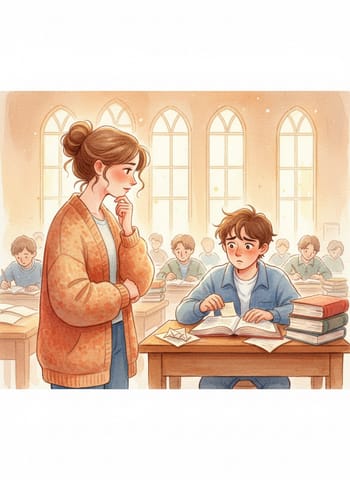
At twenty to eleven, with ninety minutes of the exam gone and thirty to go, Sibylle sees Miriam's eyes drop to her left knee and come back up. It takes no more than a second. A folded square of paper held in the palm below the edge of the desk; a glance; then the pen moving again, a little faster than before.
Sibylle goes on walking up the aisle at the same pace, because the first rule of proctoring is never to let a student see that you have seen. Among two hundred bent heads in the grey light of the hall, she keeps her face as blank as her clipboard, while her mind goes everywhere at once. She knows Miriam. Everyone in the department who has bothered to ask knows her. She is the quiet student in the third row who works nights at a bakery on the ring road. She arrives at morning lectures with flour still in the creases of her knuckles, and she has never once asked for an extension.
The rule is unambiguous. Unauthorised material means the paper is taken and a report is filed, and the report goes to a committee, which, for a first offence in a core course, may fail the year. Sibylle has read the regulations and does not doubt their purpose, which is to protect the students who did not cheat, and there are a hundred and ninety-nine of them in the room.
What stops her is not sympathy but the arithmetic of the alternatives. If she looked away, she would be deciding, silently and for good, that rules bend for people who seem deserving, and the next proctor would bend them for someone with a weaker case. If she made a scene, Miriam would lose her last half hour, and very possibly the whole exam, to humiliation. Neither feels like the thing she is here to do.
So she chooses a third way. Stopping at Miriam's desk as though to check the clock on the far wall, she lays one hand flat beside the paper and says, in a voice meant for nobody else, "I'll take that, please." Miriam does not look up. Slowly, like someone surrendering an object that has grown hot, she opens her left hand, and Sibylle slides the note into her folder and walks on. Miriam keeps writing. Her pen, Sibylle notices, does not slow down.
Only when the last scripts are stacked does she unfold it. It is not a formula or a date. It is a list in a tired hand: the times of three night buses, a phone number with no name beside it, and one definition from the syllabus. The definition has been copied out twice, as if to be sure of it. Flour dusts the creases. Had she been a different proctor, she thinks, she would have seen the definition and nothing else.
She catches Miriam in the corridor and tells her the truth. The report has to be filed. She will write down exactly what she saw, one glance and nothing used, and she will add what she knows of Miriam's work over the term. Miriam nods twice. "Thank you for telling me," she says, which is worse than anger, and then goes to catch her bus.
In the office, Sibylle fills in the form. Under Action Taken she writes the time, the room and the facts. Under Recommendation, where the form invites an opinion, she leaves the line empty and looks at it until the corridor lights switch themselves off. Then she slides the folded note into the folder beside the report, bus times and all, and does not know which of the two the committee will read first.