The Lemon Tree Stays
Una historia gratuita en inglés de nivel A2 para estudiantes, para leer en línea en 7 idiomas, con opción de escucharla en la app gratuita Storyteller.
During a power cut, Elsbeth finally asks Sandor the question everyone in the building avoids.
¡Ese fue el avance! Escucha la historia completa en la app gratuita Storyteller. Descargar la app
El audio no está disponible en este momento.
At nine o'clock, every light in the building goes out. The fridge stops. The fan stops. Elsbeth's phone has two percent left. She stands in the dark kitchen and hears the whole building groan.
A las nueve en punto, todas las luces del edificio se apagan. El refrigerador se detiene. El ventilador se detiene. Al teléfono de Elsbeth le queda un dos por ciento. Ella está de pie en la cocina a oscuras y oye cómo todo el edificio cruje.
"Roof!" shouts her brother from the hall. "Everyone is going to the roof!"
«¡Azotea!», grita su hermano desde el pasillo. «¡Todos van a la azotea!»
It is true. Doors open on every floor. People climb the stairs with candles and cold drinks. They talk in loud, happy voices. A power cut is a party when it happens to everyone.
Es cierto. Se abren puertas en todos los pisos. La gente sube las escaleras con velas y bebidas frías. Hablan con voces fuertes y alegres. Un apagón es una fiesta cuando les pasa a todos.
Elsbeth takes her jacket and follows them. Her family moved here two years ago. She knows the stairs and the smell of every kitchen. She knows the broken light on the fourth floor. She does not really know the people.
Elsbeth toma su chaqueta y los sigue. Su familia se mudó aquí hace dos años. Conoce las escaleras y el olor de cada cocina. Conoce la luz rota del cuarto piso. Pero no conoce de verdad a la gente.
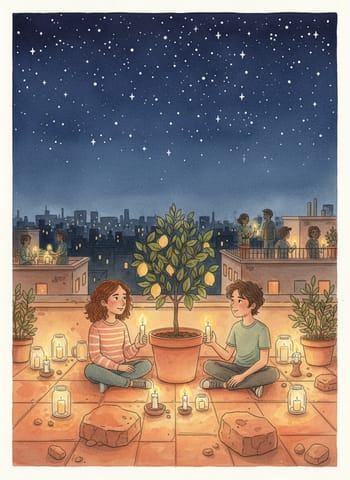
The roof is wide and flat. It has a low wall and a water tank. A few plastic chairs stand around. Beyond the wall, the whole city is dark. Only a few cars move on the far road. Above them, there are more stars than Elsbeth ever sees.
La azotea es amplia y plana. Tiene un muro bajo y un tanque de agua. Hay unas cuantas sillas de plástico alrededor. Más allá del muro, toda la ciudad está a oscuras. Solo unos pocos autos se mueven por el camino lejano. Arriba hay más estrellas de las que Elsbeth suele ver.
"Wow," says her brother. For once, he has nothing else to say.
«Guau», dice su hermano. Por una vez, no tiene nada más que decir.
In the corner of the roof stands a lemon tree. It is not tall. It grows in a big clay pot, as wide as a bucket. A piece of white tape is on its side. On the tape, in black letters, are three words: DO NOT MOVE.
En un rincón de la azotea hay un limonero. No es alto. Crece en una gran maceta de barro, tan ancha como un balde. En un costado tiene un trozo de cinta blanca. En la cinta, con letras negras, hay tres palabras: NO MOVER.
Elsbeth sees it every day. She never asks about it. Nobody does.
Elsbeth la ve todos los días. Nunca pregunta por ella. Nadie lo hace.
A boy sits next to the pot with his knees up. He is Sandor, from the sixth floor. He is her age, maybe a year older. They go to different schools. They say "hi" on the stairs, and that is all.
Un chico está sentado junto a la maceta con las rodillas levantadas. Es Sandor, del sexto piso. Tiene su edad, quizá un año más. Van a escuelas distintas. Se dicen «hola» en las escaleras, y nada más.
Tonight, Sandor does not say hi. He just looks at the tree.
Esta noche, Sandor no dice hola. Solo mira el árbol.
A man in a loud shirt shouts across the roof. "We need space for the chairs!" He points at the corner. "Who wants to move that thing?"
Un hombre de camisa llamativa grita al otro lado de la azotea. «¡Necesitamos espacio para las sillas!». Señala el rincón. «¿Quién quiere mover esa cosa?»
"I will do it," says another man. He walks over and puts both hands on the pot.
«Yo lo hago», dice otro hombre. Se acerca y pone las dos manos sobre la maceta.
"Please don't," says Sandor.
«Por favor, no», dice Sandor.
The man laughs. "It is only a plant, my friend."
El hombre se ríe. «Es solo una planta, amigo».
"Please don't touch it." Sandor is on his feet now. His voice is not loud, but it is hard. "Not even a little."
«Por favor, no la toque». Sandor ya está de pie. Su voz no es fuerte, pero es dura. «Ni un poquito».
The man looks at him. Then he shrugs and walks away. "Okay, okay. Keep your lemons," he says. Some people laugh. Then they talk about something else. The roof goes back to being a party.
El hombre lo mira. Luego se encoge de hombros y se aleja. «Bueno, bueno. Quédate con tus limones», dice. Algunos se ríen. Después hablan de otra cosa. La azotea vuelve a ser una fiesta.
Nobody asks Sandor why. The grown-ups go back to their chairs. Elsbeth thinks about it for a minute. Then she walks over to the corner.
Nadie le pregunta a Sandor por qué. Los adultos vuelven a sus sillas. Elsbeth lo piensa un minuto. Luego camina hacia el rincón.
"Is it okay if I sit here?" she asks.
«¿Te molesta si me siento aquí?», pregunta.
"Yes, you can sit here," says Sandor.
«No, puedes sentarte aquí», dice Sandor.
She sits down on the warm stone. For a while, they say nothing. Below them, someone plays a guitar badly. A baby cries and then stops. The lemon tree smells strong and green, like soap.
Se sienta sobre la piedra tibia. Durante un rato no dicen nada. Abajo, alguien toca mal la guitarra. Un bebé llora y luego se calla. El limonero huele fuerte y verde, como a jabón.
"It never gives lemons," says Sandor at last. "Not many, anyway. Two last year. Both small."
«Nunca da limones», dice Sandor al fin. «Bueno, no muchos. Dos el año pasado. Los dos pequeños».
"Then why can't anyone move it?"
«Entonces, ¿por qué nadie puede moverlo?»
"It is a rule from my mother." He almost smiles. "When you move a lemon tree, it gets angry. It drops its flowers. My mother says it can take a year to forgive you."
«Es una regla de mi mamá». Casi sonríe. «Cuando mueves un limonero, se enoja. Suelta sus flores. Mi mamá dice que puede tardar un año en perdonarte».
"That is a lot of feelings for a plant."
«Son muchos sentimientos para una planta».
"Yes." He touches a leaf with one finger. "She brought it in a taxi when we came here. She held it on her knees the whole way. She chose this corner because the sun reaches it first."
«Sí». Toca una hoja con un dedo. «Lo trajo en un taxi cuando llegamos aquí. Lo llevó sobre las rodillas todo el camino. Eligió este rincón porque el sol llega primero».
Elsbeth watches his hand. She sees how carefully he touches the leaf. She remembers something else. Last Sunday, she saw three boxes on the stairs outside his door. They were big boxes for moving house. She did not think about them then.
Elsbeth mira su mano. Ve con cuánto cuidado toca la hoja. Recuerda algo más. El domingo pasado vio tres cajas en la escalera, afuera de su puerta. Eran cajas grandes, de mudanza. Entonces no pensó en ellas.
She thinks about them now.
Ahora sí piensa en ellas.
Everyone in the building sees the boxes. Nobody asks about them.
Todos en el edificio ven las cajas. Nadie pregunta por ellas.
Her heart beats faster. It is a small question, but it feels big in her mouth.
El corazón le late más rápido. Es una pregunta pequeña, pero se siente enorme en su boca.
"Sandor," she says. "Are you moving away?"
«Sandor», dice. «¿Se van a mudar?»
He does not answer right away. The night air moves across the roof. The leaves shake. He stares at the pot.
Él no responde enseguida. El aire de la noche recorre la azotea. Las hojas tiemblan. Él mira fijamente la maceta.
"I do not know," he says. His voice is small and honest. "My father says maybe. My mother says maybe, too. They talk in the kitchen at night with the door closed. I stand behind it and listen. Nobody tells me."
«No lo sé», dice. Su voz es pequeña y sincera. «Mi papá dice que tal vez. Mi mamá también dice que tal vez. Hablan en la cocina por la noche con la puerta cerrada. Yo me quedo detrás y escucho. Nadie me dice nada».
"And the tree?"
«¿Y el árbol?»
"That is the problem." He laughs, but it is not a happy laugh. "If we go, we cannot take it. It will hate that. So I water it every night. I check the leaves. It is stupid, I know."
«Ese es el problema». Se ríe, pero no es una risa feliz. «Si nos vamos, no podemos llevarlo. Lo odiaría. Así que lo riego todas las noches. Reviso las hojas. Es una tontería, lo sé».
"It is not stupid," says Elsbeth.
«No es una tontería», dice Elsbeth.
They are quiet again. Nearby, her brother tells a long story to a stranger. A candle burns low. The stars look very close.
Vuelven a quedarse callados. Cerca, su hermano le cuenta una historia larga a un desconocido. Una vela se consume. Las estrellas parecen muy cercanas.
"Thank you," says Sandor. "For asking. Nobody did."
«Gracias», dice Sandor. «Por preguntar. Nadie lo hizo».
Elsbeth does not know what to say. She picks a dry leaf from the ground. She turns it in her fingers. "Can I water it tomorrow?" she asks. "If you are busy."
Elsbeth no sabe qué decir. Recoge una hoja seca del suelo. La gira entre los dedos. «¿Puedo regarlo mañana?», pregunta. «Si estás ocupado».
"Maybe," says Sandor. But he does not say no.
«Tal vez», dice Sandor. Pero no dice que no.
Then, without any warning, the lights come back. The lamps in the streets blink and shine. The city below them wakes up all at once, street by street. On the roof, people clap and cheer.
Entonces, sin ningún aviso, vuelve la luz. Las lámparas de las calles parpadean y brillan. La ciudad de abajo despierta de golpe, calle por calle. En la azotea, la gente aplaude y vitorea.
In the sudden light, Elsbeth looks at the tape on the pot. The corner lifts a little. Under it, in a different pen, are two words. She reads them before Sandor puts his hand over them. STAYS HERE.
En la luz repentina, Elsbeth mira la cinta de la maceta. La esquina se levanta un poco. Debajo, con otra pluma, hay dos palabras. Las lee antes de que Sandor ponga la mano encima. SE QUEDA AQUÍ.