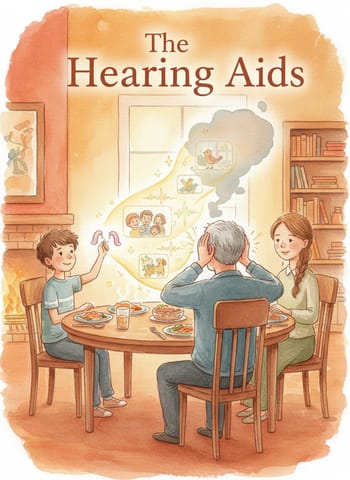
The Hearing Aids
Una historia gratuita en inglés de nivel B2 para estudiantes, para leer en línea en 4 idiomas, con opción de escucharla en la app gratuita Storyteller.
Enrique finds a way to show his stubborn father what he has been missing at the dinner table.
¡Ese fue el avance! Escucha la historia completa en la app gratuita Storyteller. Descargar la app
El audio no está disponible en este momento.
For about two years, Enrique's father had been nodding at the right moments. Enrique noticed it first at family dinners. There was the small, confident "Yes, yes" in reply to questions that had not quite been asked. There was the pause before he laughed, as if he were waiting to see whether everyone else was laughing too.
Desde hacía unos dos años, el padre de Enrique asentía en los momentos adecuados. Enrique lo notó primero en las cenas familiares. Estaba ese pequeño y seguro «Sí, sí» como respuesta a preguntas que no habían llegado a formularse del todo. Estaba la pausa antes de reírse, como si esperara a ver si los demás también se reían.
Whenever anyone mentioned hearing aids, the old man shook his head. His ears were fine, he said. The rest of the world had simply started mumbling.
Cada vez que alguien mencionaba los audífonos, el viejo negaba con la cabeza. Sus oídos estaban bien, decía. Era el resto del mundo el que había empezado a murmurar.
Enrique had tried reasoning with him, and he had tried joking. Neither worked. What finally changed his mind was something much smaller. On a Sunday in March, he asked his father whether he wanted more soup, and his father answered, "Thursday is best for me."
Enrique había intentado razonar con él, y había intentado bromear. Nada funcionó. Lo que por fin lo hizo cambiar de opinión fue algo mucho más pequeño. Un domingo de marzo le preguntó a su padre si quería más sopa, y su padre contestó: «El jueves me viene mejor».
Enrique said nothing at the time. But that evening, he sat in his car outside the house and wondered how many conversations had been going on without his father. They must have sounded like a radio playing in another room.
Enrique no dijo nada en ese momento. Pero esa tarde se sentó en su coche frente a la casa y se preguntó cuántas conversaciones habían transcurrido sin su padre. Debían de sonarle como una radio encendida en otra habitación.
The next Sunday, he propped his phone against the salt shaker, with the recorder switched on. Nobody noticed. The table was crowded, as usual, with cousins, a neighbor, and a niece who talked quickly with her mouth full. The recording picked up everything: the clatter of plates, the overlapping voices, and, in the middle of it all, his father's deep, cheerful "Yes, yes."
El domingo siguiente apoyó su teléfono contra el salero, con la grabadora activada. Nadie lo notó. La mesa estaba repleta, como de costumbre, de primos, un vecino y una sobrina que hablaba deprisa con la boca llena. La grabación captó todo: el estrépito de los platos, las voces superpuestas y, en medio de todo ello, el «Sí, sí» profundo y alegre de su padre.
On Monday, Enrique drove over with the phone in his pocket. He made tea, sat across the kitchen table, and said he wanted to play something. His father put on his reading glasses, as though that would help him listen.
El lunes, Enrique fue en coche con el teléfono en el bolsillo. Preparó té, se sentó frente a él a la mesa de la cocina y dijo que quería que escuchara algo. Su padre se puso las gafas de leer, como si eso fuera a ayudarlo a oír.
At first, the old man just frowned. He could not make out the voices. Enrique turned up the volume and then played it again, slowly, with the speaker next to his father's good ear.
Al principio, el viejo solo frunció el ceño. No lograba distinguir las voces. Enrique subió el volumen y la reprodujo de nuevo, despacio, con el altavoz junto al oído bueno de su padre.
"Is that Sunday?" his father asked.
«¿Es el domingo?», preguntó su padre.
"Yes. Listen to the part about the lost suitcase."
«Sí. Escucha la parte de la maleta perdida».
On the recording, someone told a long, funny story about a lost suitcase, and the whole table burst into laughter. Then his father's voice said, solemnly, "That's terrible." There was a short silence. Then someone, quite kindly, giggled.
En la grabación, alguien contaba una larga y graciosa historia sobre una maleta perdida, y toda la mesa estallaba en risas. Entonces la voz de su padre decía, solemne: «Qué terrible». Hubo un breve silencio. Luego alguien, con mucha bondad, soltó una risita.
His father listened to it twice. His face did not change, but his hand, which had been resting on the table, slowly closed.
Su padre la escuchó dos veces. Su rostro no cambió, pero su mano, que descansaba sobre la mesa, se fue cerrando lentamente.
"I thought it was a sad story," he said at last.
«Pensé que era una historia triste», dijo al fin.
"It wasn't."
«No lo era».
"What else did I miss?" His voice was smaller than Enrique had ever heard it. "If I'd heard everything, I would have asked to go home earlier. Or I would have stayed later."
«¿Qué más me perdí?». Su voz era más pequeña de lo que Enrique la había oído jamás. «Si hubiera oído todo, habría pedido irme antes a casa. O me habría quedado más tiempo».
Enrique didn't answer right away. He had not expected to win the argument this way, and he found that he didn't want to.
Enrique no respondió de inmediato. No había esperado ganar la discusión de esta manera, y descubrió que no quería.
After a long moment, his father took off his glasses and rubbed his eyes. "Make the appointment," he said. "Thursday morning. And write down the time. I'm told I miss things."
Tras un largo momento, su padre se quitó las gafas y se frotó los ojos. «Pide la cita», dijo. «El jueves por la mañana. Y anota la hora. Me dicen que se me olvidan cosas».