The Shared Battery
Una historia gratuita en inglés de nivel B2 para estudiantes, para leer en línea en 4 idiomas, con opción de escucharla en la app gratuita Storyteller.
During a three-day blackout, a neighborhood argues over a single solar battery until one neighbor writes a fair priority list in chalk.
¡Ese fue el avance! Escucha la historia completa en la app gratuita Storyteller. Descargar la app
El audio no está disponible en este momento.
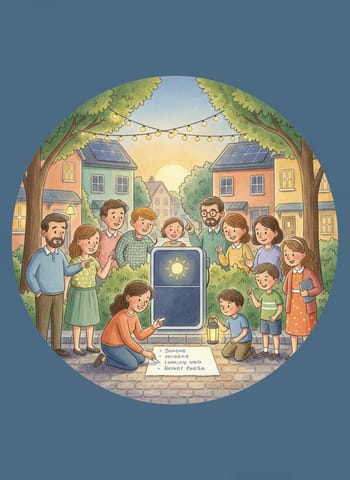
The community battery on Orchard Row was the size of a garden shed. For six years it had been charged by the solar panels on the old bike shop's roof. On ordinary days nobody thought about it. A screen above its door showed a percentage, and the street saved a little money every winter.
La batería comunitaria de Orchard Row tenía el tamaño de una caseta de jardín. Durante seis años la habían cargado los paneles solares del techo de la vieja tienda de bicicletas. En los días normales nadie pensaba en ella. Una pantalla sobre su puerta mostraba un porcentaje, y la calle ahorraba un poco de dinero cada invierno.
On the first night of the storm, that changed. A fallen tree took down the main line, and the streetlights died. The battery, which had been designed for sharing, became the only electricity for forty households.
La primera noche de la tormenta, eso cambió. Un árbol caído derribó la línea principal, y las farolas se apagaron. La batería, que había sido diseñada para compartir, se convirtió en la única electricidad de cuarenta hogares.
By the second morning, thirty-odd people were standing outside the shed, each holding something to plug in. A man carried a cooler full of fish. A teenager held a phone with two percent left. Someone had even brought a drill, although there was no job to use it on.
Para la segunda mañana, unas treinta personas se encontraban frente a la caseta, cada una con algo que conectar. Un hombre llevaba una nevera portátil llena de pescado. Un adolescente sostenía un teléfono con el dos por ciento de carga. Alguien había traído incluso un taladro, aunque no había ningún trabajo para usarlo.
"I was here first," a woman said. "This is exactly how it will end," said another. "Whoever shouts loudest gets the power." Jovana, whose mother needed a small breathing machine at night, stood very still at the back. She had not raised her voice once, and Cornelia noticed that.
«Yo llegué primero», dijo una mujer. «Así es exactamente como va a acabar esto», dijo otro. «El que grite más fuerte se queda con la energía.» Jovana, cuya madre necesitaba un pequeño equipo de respiración por las noches, estaba muy quieta al fondo. No había levantado la voz ni una vez, y Cornelia lo notó.
Cornelia, who chaired the street's volunteer committee, had been up since five, checking the screen. What she had seen was alarming: sixty-one percent, falling much faster than the clouds would let the sun refill it.
Cornelia, que presidía el comité de voluntarios de la calle, llevaba levantada desde las cinco, vigilando la pantalla. Lo que había visto era alarmante: sesenta y uno por ciento, bajando mucho más rápido de lo que las nubes dejarían que el sol la recargara.
"If we carry on like this, it will be empty by tonight," she said, loudly enough for the front row. "If we were sensible, we would decide in advance who needs it most."
«Si seguimos así, estará vacía esta noche», dijo, lo bastante fuerte para la primera fila. «Si fuéramos sensatos, decidiríamos de antemano quién la necesita más.»
An argument followed. The man with the fish said that his freezer was a week of food. The teenager said that phones were how help was called. Somebody muttered that it was typical of the committee to want to be in charge.
Siguió una discusión. El hombre del pescado dijo que su congelador era una semana de comida. El adolescente dijo que los teléfonos eran la forma de pedir ayuda. Alguien murmuró que era típico del comité querer mandar.
Cornelia took a piece of chalk from her pocket and wrote on the door of the shed, where everyone could read it. First: medical devices, day and night. Second: fridges that hold medicine. Third: phones, ten minutes each, in the order people had arrived. The freezers, she added, would have to wait for the sun, and she was sorry about that.
Cornelia sacó una tiza del bolsillo y escribió en la puerta de la caseta, donde todos pudieran leerlo. Primero: equipos médicos, de día y de noche. Segundo: refrigeradores que guardan medicinas. Tercero: teléfonos, diez minutos cada uno, en el orden en que habían llegado. Los congeladores, añadió, tendrían que esperar al sol, y lo lamentaba.
"Who decided this?" someone asked.
«¿Quién decidió esto?», preguntó alguien.
"Nobody decided it," Cornelia said. "I'm proposing it. If you can think of a fairer list, I will rub mine out right now."
«Nadie lo decidió», dijo Cornelia. «Lo estoy proponiendo. Si se les ocurre una lista más justa, borro la mía ahora mismo.»
Nobody could. There was a silence, and then the man with the fish laughed, tiredly, and carried his cooler to the back of the line.
Nadie pudo. Hubo un silencio, y luego el hombre del pescado se rio, cansado, y llevó su nevera al final de la fila.
For three days the list stayed on the door. Jovana's mother's machine ran every night. The medicine fridges were topped up at noon. Phones were charged in ten-minute shifts, and the man with the fish, to everyone's surprise, volunteered to keep time with his watch.
Durante tres días la lista se quedó en la puerta. El equipo de la madre de Jovana funcionó todas las noches. Los refrigeradores de medicinas se recargaban al mediodía. Los teléfonos se cargaban en turnos de diez minutos, y el hombre del pescado, para sorpresa de todos, se ofreció a medir el tiempo con su reloj.
On the fourth morning, the main line hummed back to life, and the streetlights blinked on one by one, as if embarrassed. People stood around the shed for a while anyway, unsure what to do with their hands.
La cuarta mañana, la línea principal volvió a zumbar, y las farolas se encendieron una por una, como avergonzadas. La gente se quedó un rato alrededor de la caseta de todos modos, sin saber qué hacer con las manos.
Cornelia reached for the chalk to wipe the door, then stopped. Instead, she copied the list onto paper and taped it up between the maintenance notice and a faded flyer for the street party.
Cornelia alcanzó la tiza para borrar la puerta, y se detuvo. En cambio, copió la lista en papel y la pegó con cinta entre el aviso de mantenimiento y un volante desteñido de la fiesta de la calle.
When she came back in the afternoon, someone had added a line in pencil at the bottom: Phones, but ask the person behind you first.
Cuando volvió por la tarde, alguien había añadido una línea a lápiz al final: Teléfonos, pero pregúntale primero a la persona que está detrás de ti.