The Shared Battery
A free B2-level English story for language learners, readable online in 4 languages, with an option to listen via the free Storyteller app.
During a three-day blackout, a neighborhood argues over a single solar battery until one neighbor writes a fair priority list in chalk.
That was the preview! Hear the full story in the free Storyteller app. Get the app
Audio isn't available right now.
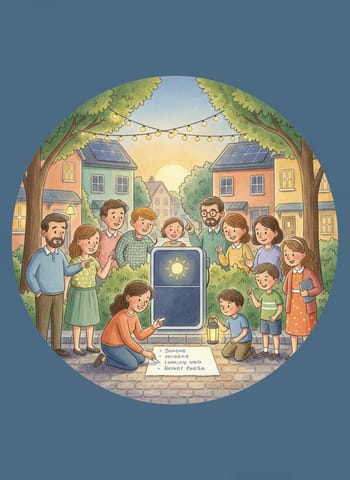
The community battery on Orchard Row was the size of a garden shed. For six years it had been charged by the solar panels on the old bike shop's roof. On ordinary days nobody thought about it. A screen above its door showed a percentage, and the street saved a little money every winter.
On the first night of the storm, that changed. A fallen tree took down the main line, and the streetlights died. The battery, which had been designed for sharing, became the only electricity for forty households.
By the second morning, thirty-odd people were standing outside the shed, each holding something to plug in. A man carried a cooler full of fish. A teenager held a phone with two percent left. Someone had even brought a drill, although there was no job to use it on.
"I was here first," a woman said. "This is exactly how it will end," said another. "Whoever shouts loudest gets the power." Jovana, whose mother needed a small breathing machine at night, stood very still at the back. She had not raised her voice once, and Cornelia noticed that.
Cornelia, who chaired the street's volunteer committee, had been up since five, checking the screen. What she had seen was alarming: sixty-one percent, falling much faster than the clouds would let the sun refill it.
"If we carry on like this, it will be empty by tonight," she said, loudly enough for the front row. "If we were sensible, we would decide in advance who needs it most."
An argument followed. The man with the fish said that his freezer was a week of food. The teenager said that phones were how help was called. Somebody muttered that it was typical of the committee to want to be in charge.
Cornelia took a piece of chalk from her pocket and wrote on the door of the shed, where everyone could read it. First: medical devices, day and night. Second: fridges that hold medicine. Third: phones, ten minutes each, in the order people had arrived. The freezers, she added, would have to wait for the sun, and she was sorry about that.
"Who decided this?" someone asked.
"Nobody decided it," Cornelia said. "I'm proposing it. If you can think of a fairer list, I will rub mine out right now."
Nobody could. There was a silence, and then the man with the fish laughed, tiredly, and carried his cooler to the back of the line.
For three days the list stayed on the door. Jovana's mother's machine ran every night. The medicine fridges were topped up at noon. Phones were charged in ten-minute shifts, and the man with the fish, to everyone's surprise, volunteered to keep time with his watch.
On the fourth morning, the main line hummed back to life, and the streetlights blinked on one by one, as if embarrassed. People stood around the shed for a while anyway, unsure what to do with their hands.
Cornelia reached for the chalk to wipe the door, then stopped. Instead, she copied the list onto paper and taped it up between the maintenance notice and a faded flyer for the street party.
When she came back in the afternoon, someone had added a line in pencil at the bottom: Phones, but ask the person behind you first.