The Shift Nobody Wanted
A free B2-level English story for language learners, readable online in English, with an option to listen via the free Storyteller app.
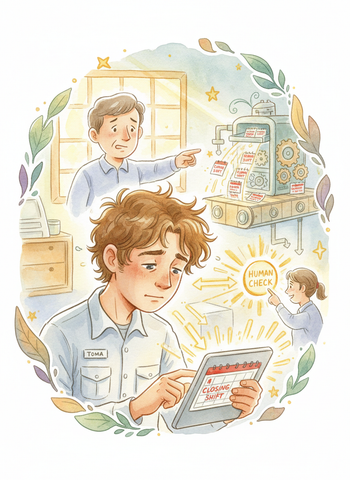
When an automated scheduling system assigns him four closing shifts in a row, Toma documents the pattern until his manager forces a human check back into the process.
Toma had worked the same closing shift at the store for three years, trading it occasionally with coworkers whenever life required it. The new scheduling system had been installed to make that kind of trading easier, not harder.
Instead, it had started assigning shifts by an algorithm nobody fully understood, optimizing for something the company called "coverage efficiency."
"It gave me four closes in a row this week," Toma told his manager, staring at the app's neat, color-coded calendar. "I haven't had that happen since I started here."
"The system says it's balancing everyone's availability," his manager said, sounding almost as confused as Toma felt. "I don't actually control the assignments anymore."
If a human had built this schedule, Toma thought, someone would have noticed a person working four closing shifts straight. The algorithm had simply optimized around the constraints it was given, and fairness hadn't been one of them.
He tried requesting a swap through the app, but the system rejected it automatically, citing "insufficient coverage" for the shift he wanted to give away. A coworker had reportedly been told the same thing the previous month.
"Has anyone actually complained to the company directly?" Toma asked during break, looking around at the tired faces of his coworkers.
"I did, once," said a woman from the bakery counter. "Got a message back saying the system 'learns from patterns over time.' Didn't say what that meant."
Toma decided to keep a written log instead, documenting exactly which shifts he'd been assigned and when he'd requested swaps that got rejected. If the algorithm wouldn't listen, maybe a manager reading actual evidence would.
Three weeks and one detailed log later, his manager brought the printed pages into a meeting with regional management.
"This isn't sustainable," she said, pointing to the pattern. "Someone should have caught this months ago. We need a human to review the schedule before it's finalized, every week."
The change wasn't instant, but within a month, a manager's approval step had been added before any schedule went live.
"Still not perfect," Toma said. "But at least a person looks at it now, not just a number."
